Explore product-specific spaces to ask questions, share insights, and learn best practices.
Recently active
If I create a segment using a prop as the dimension and set the container to 'Visit,' does that basically make the prop act like an eVar?
Note: This question concerns Adobe Commerce (Magento). Commerce does not appear in the category list.Hello,Could someone please ask the developers of Adobe Commerce/Magento to make the Scope dropdown op the product page in the Catalog larger? I have 60 stores to scroll through daily, and just a stamp size dropdown menu. There's a lot of room for a larger one.If .store-switcher could get a min-width of 300px and a max-height of at least 1000px I would be very very grateful.Thank you so much!LianScreenshot of everything that is currently visibile in my dropdown:
I think the new “Assets” Tab now looks much nicer than the classic view.Having said that, I do miss the old icons that showed whether the trigger campaigns were activated versus not. It was also helpful for the batch ones to see which ones are actively scheduled, previously ran, never ran, etc. Food for thought!
OverviewData Distiller Accelerators help users move faster from raw data to repeatable analysis by providing Adobe-authored SQL templates for common business, industry, and technical use cases. Accelerators are available in the Queries workspace and can be used to analyze areas such as customer segmentation, campaign performance, commerce behavior, audience overlap, fraud detection, retention, product reviews, attribution, and more. Access and PermissionsAccelerators are available to organizations with Data Distiller entitlements. Users can access them from the Accelerators tab in the Queries workspace. Viewing Available AcceleratorsGo to Queries in the left navigation, then open the Accelerators tab.The accelerator catalog displays available templates with a name and description, making it easy to identify the right starting point for your use case. Using an AcceleratorSelect an accelerator to open it in Query Editor.The SQL is preloaded and read-only by default. Users can provide the
Workfront Fusion Custom UI extensions OverviewFusion can display your own web UI inside its interface. Build a small web app (a guest extension), publish it via Adobe App Builder, and Fusion will show a new menu item in its navigation that opens your UI in the main canvas. The guest automatically receives context such as the signed‑in user, organization, team, and other metadata so your extension can adapt to the current environment.The technology underneathYour guest is built with two Adobe technologies:Adobe App Builder — Free hosting and tooling for small web apps and serverless actions. App Builder hosts your static UI on Adobe’s CDN and provides the aio CLI to create, build, and publish the app. Adobe UI Extensibility SDK (UIX) — The libraries that let host and guest talk. Use @adobe/uix-guest in your guest; Fusion uses @adobe/uix-host on its side.Extension pointsAn extension point is a named slot in Fusion where a guest may appear. Extension point names use the format: service/n
While it is currently possible to select multiple assets within the UI, the available filters do not provide an option to view assets located exclusively in archived folders. At present, users can only choose to include archived folders in their search results, which means archived and active assets are returned together.It would be valuable to have the ability to filter for archived folders only.Use CaseDuring instance clean-up and governance activities, teams often need to review assets that have already been archived. Being able to isolate assets within archived folders would make it easier to distinguish them from live, in-use assets, reducing the risk of accidentally unapproving, modifying, or deleting active assets. This functionality would improve efficiency, support better instance management, and help ensure that clean-up efforts are focused only on retired content.
Question: Adobe Target A/B Testing with AEM as a Cloud Service Adaptive FormsHi ,I’m currently using AEM as a Cloud Service with Adaptive Forms based on Core Components.I would like to understand whether Adobe Target is supported with this setup, specifically for running A/B tests on Adaptive Forms.If it is supported, could someone please share the recommended implementation approach and steps for: Integrating Adobe Target with AEM as a Cloud Service. Setting up A/B testing for an Adaptive Form using Core Components. Creating two different form experiences/variations in Adobe Target. Configuring the audience and traffic split (for example, 50/50). Tracking form submissions/conversions as the success metric. Using A4T/Analytics for reporting, if applicable. Any required Web SDK, Tags/Data Collection, Target client-side libraries, or Cloud Service configurations. Any limitations or prerequisites specific to Adaptive Forms Core Components. If someone has implemented this suc
DescriptionImprove Timesheet Behavior for Manually Pinned TasksWhy is this feature important to youCurrently, manually pinned tasks remain on a user's timesheet even after being marked as Completed or Cancelled. This can lead to confusion, as users may continue logging hours on tasks that are no longer active. It also affects data accuracy and time tracking consistency.How would you like the feature to workWe suggest enhancing the timesheet functionality to better handle manually pinned tasks by:Automatically removing pinned tasks from the timesheet once they are marked as Completed or CancelledPreventing time entry on tasks that are no longer active, regardless of manual pinningIntroducing configuration options to restrict manual pinning based on task statusAllowing system administrators to disable the manual pinning feature (Alt+P) for specific user profiles or globallyCurrent BehaviourUsers can manually pin tasks to their timesheet using Alt+P or the pin iconPinned tasks remain visi
Join us on Tuesday, September 1st at 4:00 pm CDT to hear the latest installment of WebSDK Journey as we near the end. Don’t forget to check out our previous sessions in our series, Diary of a WebSDK Implementation, on our YouTube Channel. We're almost at the WebSDK finish line! 🏁 Our production cut over is right around the corner. Join our next session to help us prep for the big launch: 🗓️ The Journey: See everything we've built over the last six months. 📋 The Blueprint: Walk through our production cut over checklist. 🔄 The Data: Learn how we're handling historical data and active integrations. 📣 The Roll out: Sync on updates for our end users and technology partners. 🆔 The Switch: Prep to turn on Identity Map. Link to Sign Up: https://usergroups.adobe.com/events/details/adobe-user-groups-analytics-usa-central-chapter-presents-diary-of-a-websdk-implementation-the-final-countdown/
Does anyone have any experience creating a MMS message using Code Based Experience? The configuration setup looks like it’s strictly for In-App use, and not code that I can push to the service carrier as a JSON. The issue is there are some campaigns where we would like the image to appear before the text. The current MMS template places the image below the text. Please advise.
Can someone explain me the difference between the two setups: Detail:2.Detail:
In Assets Essentials view, when I open an asset in a collection, it opens in the file's location, so if I try to page through the assets using the arrows at the bottom, it goes to other assets in the asset's folder instead of the assets in the collection. Ideally, when in a collection, we could page through assets within the collection. Users are confused when viewing assets in collections. This behavior is different in the admin/touch UI.Users should be able to page through assets in a collection. Ideally, this would be the default behavior, but it should at least be an option.
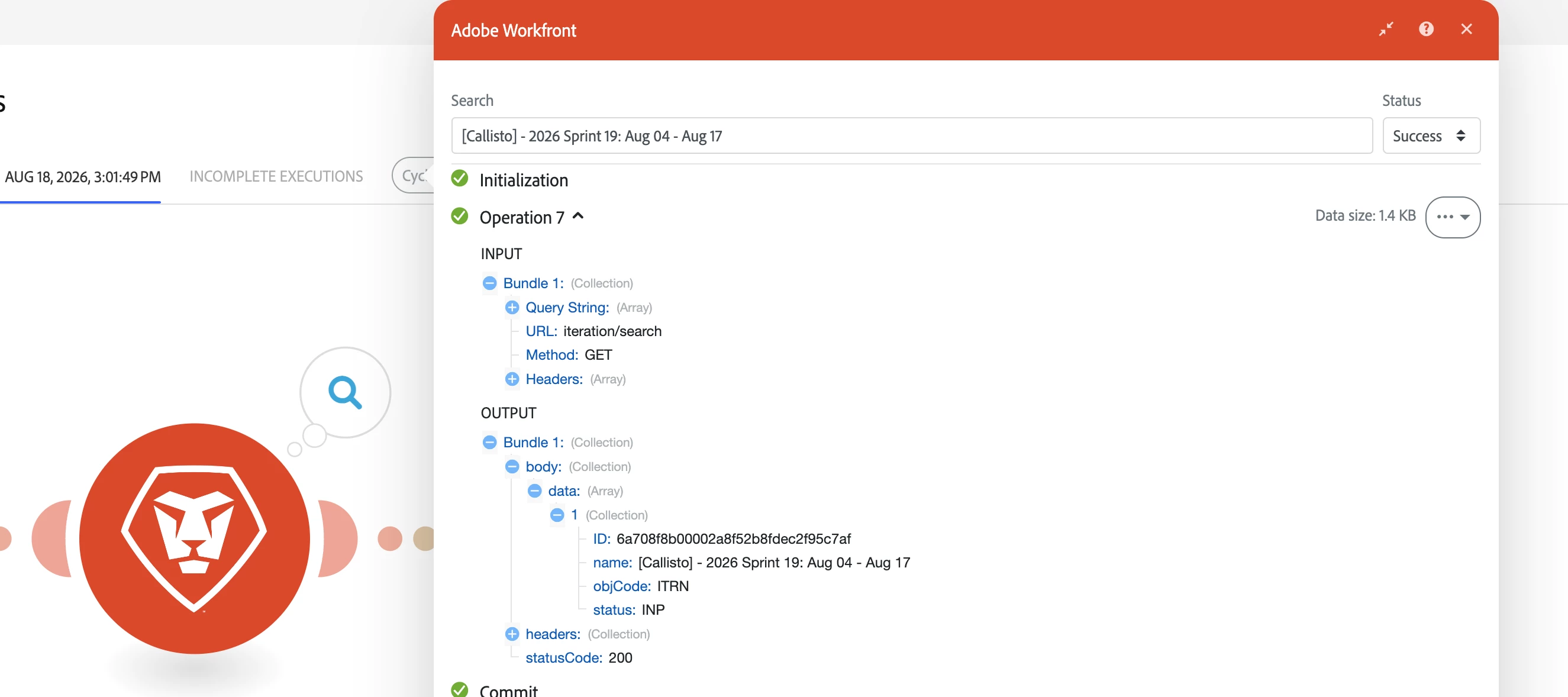
Search input and output bundles in scenario executionsPreviously you could not search the actual input and output bundles shown in an execution. Now you can search both input and output bundles directly from the execution UI — use the module/filter output search bars or the execution search to find specific bundle content, IDs, or events.OverviewWe’ve added the ability to search the text and metadata inside bundle payloads for both inputs and outputs in an execution. This makes it much faster to locate a particular bundle, debug processing logic, or verify that expected data passed through a specific step. You can search at the module/filter level or across the entire execution timeline.What’s newSearch the contents of input bundles shown for a module or filter. Search the contents of output bundles shown for a module or filter. Combine content searches with status filtering to surface only Success, Warning, Failed, Passed, or Failed bundles as applicable.How to search bundle contentO
Dear Adobe Campaign Community,Your time is precious, and we understand the importance of efficiency when it comes to troubleshooting issues with Adobe Campaign.That's why we're excited to again bring you our carefully curated collection of Top KCS (Knowledge-Base) Articles for June 2026, designed to help you resolve common challenges swiftly and effectively.Our Top KCS Articles are your shortcut to:Quickly identifying and resolving recurring issues. Accessing expert insights and best practices for Adobe Campaign. Streamlining your troubleshooting process for maximum productivity. Empowering yourself with the knowledge to tackle any campaign-related problem head-on.Why spend hours searching for solutions, when our Top KCS Articles have already done the heavy lifting for you?Let us help you save time so you can focus on what truly matters – creating exceptional campaigns with Adobe Campaign.Start supercharging your problem-solving skills today by exploring our Top KCS Articles! Take a lo
I have a proof of concept to work on where we need to migrate around 2000 xdp forms to adaptive forms .I have tried with the AFCS service for the automated conversion but it's only converting the fields and some field validation like for email validation, but it's not converting all the rules present in the xdp form also the relatable sections , the add and remove buttons all these are not getting converted. My question is how to approach for this bulk migration where our conversion will be faster and kind of automated ? We have also tried AI for this but can't also Fully convert as it can't access the aem instance .Thank you
Hi everyone,I have a question regarding **Adobe Experience Platform Data Streams and Adobe Analytics**.Suppose I have configured a Data Stream and under **Services** I have enabled **only Adobe Analytics** (with the required Report Suite).If I send an event using **Adobe Experience Platform Web SDK (`alloy.sendEvent()`)**, will that event/data also be ingested into **Adobe Experience Platform (AEP)** automatically, or will it only be sent to Adobe Analytics?In other words:**Scenario 1:*** Data Stream → Adobe Analytics = Enabled* Data Stream → Adobe Experience Platform = Not enabledWill the Web SDK event be available in an AEP Event Dataset?**Scenario 2:*** Data Stream → Adobe Analytics = Enabled* Data Stream → Adobe Experience Platform = Enabled + Event Dataset configuredI understand that in Scenario 2 the data can be ingested into the AEP dataset.What I'm specifically trying to clarify is **whether AEP ingestion happens automatically when only Adobe Analytics is enabled in the Data St
Hi everyone,I'm trying to build an Event-Based Journey in Adobe Journey Optimizer where the journey should start immediately after a customer submits an AJO Landing Page Form.My setupCreated an XDM ExperienceEvent schema. Created an Experience Event Dataset based on this schema. Created a Streaming Connection. Created a Form Preset and selected the Experience Event Dataset. Created an AJO Landing Page using this Form Preset. Form submission reaches the generated HTTP API Source/Dataflow successfully.ProblemThe Dataflow runs successfully, but every submission fails during dataset ingestion.Error: DCVS-1106-400The message cannot be validated because a required property is missing:required key [_id] not foundObservationsForm submission reaches the HTTP API Source. Source Flow is created automatically. Records are received but none are ingested. Experience Event schema contains the standard required fields including: _id timestamp The generated schema sample JSON includes _id. Mapping al
If we have enterprise license for Adobe Target under a single IMS Org, how do I use distinct audiences in Target for multiple sites, where one site will be using Audiences from AEP while another needs to be use Audiences based out of Marketo.E.g. If I have two websitesSite A with AEP and RTCDP (Websdk)Site B with Marketo and not AEP or RTCDP (At.js)How can I use Adobe Target Enterprise under the single IMS org for AB testing on both Site A and Site B using distinct audiences from AEP for site A, and Marketo Audiences from site B?
Hi, I'm facing an issue in AEM as a Cloud Service where asset references are not being displayed in the DAM UI under References → Local References, even though the assets are actively used on pages.I have authored images on pages and verified that they are being referenced correctly by components.However, when I open the asset in DAM and navigate to:Asset Details → References → Local Referencesthe referencing pages are not displayed.The issue occurs for almost all assets in our DAM.Interestingly, there is one specific folder where assets are showing references correctly in the UI.I compared the assets but nothing is different. Also when i call /bin/wcm/references.json?path=/content/dam/path/to/image.jpg it returns the pages where the asset is referenced. But UI is not showing
Sometimes we need to create report on something - some area of interest - that is just too ungainly in a single report.The report freezes and crashes. It is hard to read and navigate, and it very slow to load and update.So in general on the platform, I would like a way to do have multiple reports grouped together.I have thought maybe a widget, that acts as a navigation point to link multiple reports grouped together might be something like the TABS you have in an excel spreadsheet. Applicable to Adobe Analytics and Customer Journey Analytcis.
Hello,We have recently upgraded .glb files (3D assets) to AEM 6.5 LTS with Dynamic Media integration enabled. The file type is supported, as confirmed by the teams.public.onecdn.static.microsoft/evergreen-assets/safelinks/2/atp-safelinks.html.Current Status:The 3D viewer is working correctly However, thumbnails are not being generated for these assets in AEM Thumbnails are visible when viewing the same assets in a YouTube video Question: How can we ensure that thumbnails are also generated for .glb files in AEM 6.5 LTS?
Description - It would be helpful to have an On Hold (ONH) status for Tasks like there are for Projects and Requests. Why is this feature important to you - Sometimes tasks need to be put on hold as priorities change, etc. We'd like to indicate the true status because it's not New, In Progress, or Complete.How would you like the feature to work - Choose On Hold from the Status dropdown menu and remove it from being factored into the Project Condition. Current Behaviour - Tasks have three options New, In Progress, or Complete. We created a custom On Hold status, but it affects the Project Condition, so we adjust the dates repeatedly until the task is re-engaged and changed to In Progress or Cancelled (another custom status created.) For Cancelled Tasks, we can delete the task but it's useful to show the task was considered for the project. We remove dates and planned duration/hours for it so it will not impact the Project Condition. We don't want to remove them from On Ho
Please provide a report type for Field Tracking so users can access and do their own research when needed. Currently only reporting is available through setup with system admin access on our enterprise.
Hi Team,I have login into Marketo 3 year back. And then I got into Adobe campaign project. But now again I am going to get deployed into Marketo project from next month. But when I try to login into the instance I am getting teh below error. Coud you please anyone help me on this. Error screenshot:
Attached/below. Keen to hear counterpoints and other considerations for use.
Already have an account? Login
Enter your E-mail address. We'll send you an e-mail with instructions to reset your password.