Level 2
August 31, 2026
Solved

How to Identify Visitors Who Later Completed an Order

  • August 31, 2026
  • 5 replies
  • 301 views

Hello,

I am wondering how to build a segment to identify visitors who added a product to their cart but did not place an order within a specific period, and subsequently placed an order after a certain date.

For example, I would like to identify visitors who added a product to their cart but did not place an order between 2025/1/1 and 2026/7/30, but subsequently placed an order from 2026/7/31 onward.

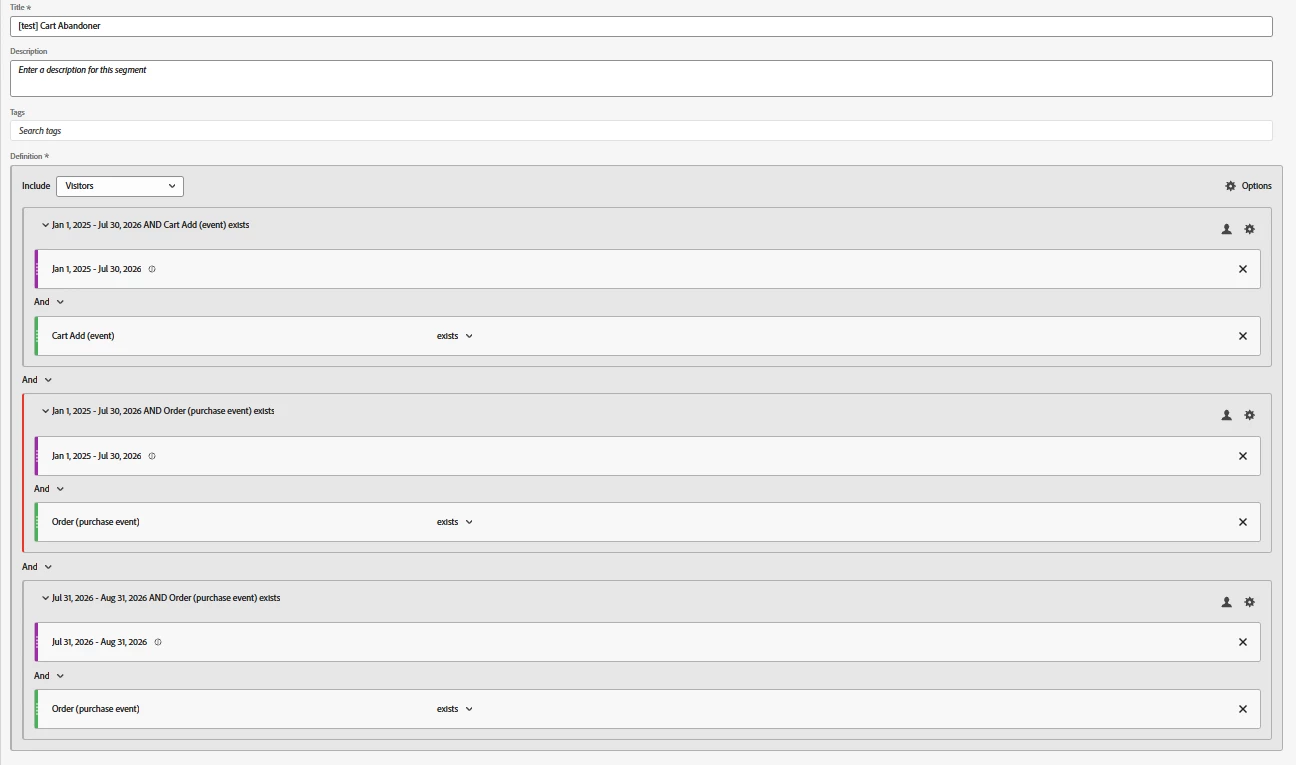
The following is what I built so far:

I’d be grateful if any can enlighten me! 

Best answer by BraxtonBu1

Hi! The general thought process is correct in my understanding, but I think the containers may be introducing some issues. For example, since the top container (Jan 1, 2025 - Jul 30, 2026 AND Cart Add Exists) is at the person level, it will include all people who both have any hits in the time period and have any orders, but these orders may be placed outside of the date range in the segment. The other containers will have similar issues as well. 

To alleviate this issue, I would recommend making the overall segment at the Visitor level, but making the other containers within the segment at the hit level. This will lead to a visitor who

  • Has at least one hit between Jan 1, 2025 - Jul 30, 2026 with a Cart Add
  • Excludes those with a hit between Jan 1, 2025 - Jul 30, 2026 which is an Order
  • Has at least one hit between Jul 31, 2026 - Aug 31, 2026 which is an Order

To double check this logic, if you were to build a table with Orders as the metric using a data range of hit between Jan 1, 2025 - Jul 30, 2026 there should be no Orders in that table since all orders should be excluded.

Let me know if anything is unclear or if this segment does not satisfy the desired results!
5 replies

BraxtonBu1Accepted solution
Level 2
August 31, 2026

Hi! The general thought process is correct in my understanding, but I think the containers may be introducing some issues. For example, since the top container (Jan 1, 2025 - Jul 30, 2026 AND Cart Add Exists) is at the person level, it will include all people who both have any hits in the time period and have any orders, but these orders may be placed outside of the date range in the segment. The other containers will have similar issues as well. 

To alleviate this issue, I would recommend making the overall segment at the Visitor level, but making the other containers within the segment at the hit level. This will lead to a visitor who

  • Has at least one hit between Jan 1, 2025 - Jul 30, 2026 with a Cart Add
  • Excludes those with a hit between Jan 1, 2025 - Jul 30, 2026 which is an Order
  • Has at least one hit between Jul 31, 2026 - Aug 31, 2026 which is an Order

To double check this logic, if you were to build a table with Orders as the metric using a data range of hit between Jan 1, 2025 - Jul 30, 2026 there should be no Orders in that table since all orders should be excluded.

Let me know if anything is unclear or if this segment does not satisfy the desired results!

Jennifer_Dungan
Adobe Champion and Community Advisor
September 1, 2026

Yeah, I wanted to review some logic before responding myself… dates in segments work differently than they used to… I am not sure what will happen in this scenario… it’s not something I’ve attempted myself.

manpreetkaur27
Adobe Support
Adobe Support
September 7, 2026

Hey ​@HM1022 Are there any further questions, or do you have everything you need to move forward? If so, please consider marking a best answer.