Explore product-specific spaces to ask questions, share insights, and learn best practices.
Recently active
I have to pull tags from page properties and add into dialog tagfield while dialog is loading using js.i wrote below script for the same but its adding single field (last index) not all which are in loop.if i directly set array without loop, it will show in single field in dialog while loading.Can someone help me here? $(document).on("dialog-loaded", function (e) { let currentPagePath = window.location.pathname.replace("editor.html/","").replace(".html",""); $dialog = e.dialog; var $dialogContent = $dialog.find(dialogContentSelector); var dialogContent = $dialogContent.length > 0 ? $dialogContent[0] : undefined; if (dialogContent) {retrieveLocationData(currentPagePath); for (let i = 0; i < locationTags.length; i++) { $dialog.find(locationsTagsDialog).adaptTo("foundation-field")
Hi, I have a page view with two eVars set. When I use one eVar it shows an Average Time Spent as X minsWhen I use eVar1 and eVar2 then Average Time Spent is 50% of what I see when evar1 is taken How is that possible? Is there something wrong being done from my end?
Hi all, I tried searching for an answer and have done extensive testing, but have not yet arrived at a solution. Is there a way in the Microsoft 365 calendar module to set the parameter so when an event is created, it creates an all day event in your home calendar? I have been exploring the configuration/parameters in the module but have not seen a way to do this. Thank you for your help, Nick
I have created the following schemas for a B2B RT-CDP usecase:(1) individual profile schema for person level demographics(2)Business account schema(3)XDM Business Account Person Relation schema which links 1 and 2(4)One event dataset at person level(5)Another event dataset at account level. This has multiple event records aggregated at account level, with timestamp field. There is no person level field. For dataset (5), should we use account id as the primary identity? Will it create issues with identity graph because other datasets are at person level? If not, how to still use this dataset for RT-CDP segments? Since primary identity is mandatory to enable profile.
This is going to be a doozy, so I apologize in advance to anyone that actually takes the time to read this. You are appreciated!! ProjectInternal campaign notifying 'site owners' of an upcoming transition from one platform to another (couple thousand people?)Many are owners of multiple sitesFour emails (Four levels of priority)Two forms with different sets of questions (Only for Emails 1 and 2. The other two are just notifications.)Depending on how they respond, they will get an email with a link to book a meeting with ITIt would go something like this: Priority 1 Email > Fill out Survey > If answers one way, send Priority 1 Meeting > If answers another way, send Priority 2 MeetingPriority 2 Email > Fill out Survey > If answers one way, send Priority 2 Meet
Hi,I’m struggling to get an accurate count of customers who actually received a specific journey message. I tried creating an audience using the journey version ID or journey action ID, but the numbers are always wrong. I was told this happens because if the journey has multiple comms (e.g., 2 emails + 3 SMS), customers who receive more than one get counted multiple times.I’m working with both one-off campaigns and journeys that trigger regularly (e.g., every 15 days), and I just need a clean list of customer IDs who received the communication.Is running a Query Service query against the tracking datasets (email/SMS) really the only reliable way to do this? And is there any way to turn this into a reusable audience in AEP?I have access to SFTP and using that to get csv file..Any advice or examples would be appreciated.
Hi ,I am trying to create an schema through Schema registry API in Postman.But i got an error , is attached below,please give some insights .
Hi folks, While updating them mechanics of our Executive Status Report solution, I hit the age-old question of whether the computer (i.e. Workfront) or the human (i.e. the PM) should decide what to report as the official project condition, with -- for context -- condition in this case referring generically to "How is it going?" (e.g. Green / Yellow / Red). Thinking that the situation could vary across organizations (or even between departments, or even among department projects, or even over time), I decided to allow for both, but am also interested to hear whether there's a clear majority these days. In your organization, who sets the official project condition: Workfront (automatically), or the PM (manually)? Regards, Doug cc: note to self @doug_den_hoed__atappstore [edited to simplify]
I am working on configuring an Arabic subject line for an email in Adobe Journey Optimizer (AJO). When I copy and paste the subject line into the AJO subject field, it does not render correctly and the text order appears altered. The subject line includes a combination of Arabic and English text, numbers, and an emoji/icon. I have attempted to resolve the issue by using HTML and JSON code to enforce right-to-left (RTL) formatting, but these methods have not been effective.Has anyone experienced a similar issue or found a solution for ensuring proper RTL rendering in AJO subject lines that contain mixed languages and symbols? Any guidance would be appreciated.
Wondering if anyone else has seen this and has a workaround. I have a fusion scenario set to run whenever a new row is added to a Microsoft Excel spreadsheet. The scenario runs fine, however I noticed that it wasn't seeing new rows (form submissions) in a timely manner. I realized that the fusion scenario is working as expected, but unless I have the spreadsheet open and active (attached to a MS form) it isn't populating (or doesn't seem to). Does anyone else know of a trick to keep the spreadsheet 'active' without having it open? Between trying to keep it open and our company security policies forcing me to log in after a certain amount of time this isn't an ideal way to keep my scenario running.
What is the main difference between Optimize (New Update) and Condition activity in the orchestration in AJO ?We see experimentation in optimize which could have been achieved by percentage split earlier. And Similarly the Targeting Rule path could be created using data source condition.What is the significant difference between these options ?
I have ingested few records to AEP, and with all the required attributes satisfying the required segment qualification . Segment Condition -Include (edwGlobal Ultimate Parent number exists or edwGlobal Ultimate Parent number does not equal "" nor 0)and ((Last name exists and Last name does not equal " nor ' nor 0)or (First name exists and First name does not equal " nor ' nor 0))and (Last Updated Date occurs in last 10 day(s) or AeplastUpdatedDate occurs in last 10 day(s))and email_conditions includes the audienceProfile Attributes - first name - test | Last name - User | address - eady@gmail.com | AEPLastUpdatedDate - 16-11-2025 |edwGlobal Ultimate Parent - exists |"BUT THE PROFILE IS NOT GETTING QUALIFIED"
Hi all,Some component folders under /apps/myproject/components aren’t getting deployed even though they exist in ui.apps/src/main/content/jcr_root/apps/myproject/components.Here’s my filter.xml:<workspaceFilter version="1.0"> <filter root="/apps/myproject"/> <filter root="/content/myproject"/> </workspaceFilter>I rebuilt (mvn clean install) and redeployed to local + Cloud, but still missing those folders.Could this be due to how filter.xml handles subpaths or exclusions?Do I need to explicitly include those component paths or adjust filters to fix it?
Hello, We need to update the source dataflow schedule time. I’m attempting this using AEP Flows API calls. For the request body, I’m using: [{"op": "replace","path": "/scheduleParams/startTime","value": "1762482630000"}] However, this approach isn’t working—I’m receiving a 412 Precondition Failed error. I am passing the flow ID and the If-Match (etag) header as required. Could you please assist me in resolving this issue?
Is it possible to hide Workfront Project/Task Updates Tab for certain set of Users
Are there any other ways except for Monitoring ?
Hi All,Was there a change to how to pull in Workload Balancer views into dashboards or am I just doing something wrong? Previously, I would go to the WLB, set up any filters I wanted (and share them), and then hit the "shareable link" icon to get a link that I could paste into a dashboard. The dashboard displayed a pared down version of the WLB, without an icon for filters, no nav links across the top, etc. (see Fig 1 "normal") but now when I do the same thing I get a lot of clutter (see Fig 2 "current"). Am I doing something wrong or was there a process change? Thank you in advance.
lets say i have primaryemailid as an attribute in the profile. i want to make an upsert or overwrite on that dataset. but before i do that, i want to trace which dataset contributed to that attribute in profile store. how do i find that dataset ?
Is there anyway to include a 'documents' section to a task custom form? ie so the person completing the form can upload a document in the form rather than using the task's document section.
AJO guardrails of engaging customers upto 90days once they enter in the journey. Is there any hack or work around if customer needs to be engaged for longer period of time ?I m trying to think of converting read audience based journey into trigger based journey so event attributes can be accessed for personalization. However the some of the conditions in audience goes beyond 90 days of their initial event trigger.
Hi all, We have a live journey which is triggered by a unitary event, and inmeditaley after is followed by a condition activity that checks a couple of profile attributes (to serve as a filter) to only allow Friends&Family profiles to continue the journey. The issue here is that we're getting HTTP 429 error in the condition, resulting in a big number of profiles being discarded. Do you have any suggestion/explanation on how to resolve this? Here's the condition used (fictional): (#{ExperiencePlatform.ProfileFieldGroup.profile.customerId} == 'Test-xxx') or(#{ExperiencePlatform.ProfileFieldGroup.profile.customerId} == 'Test-yyy')
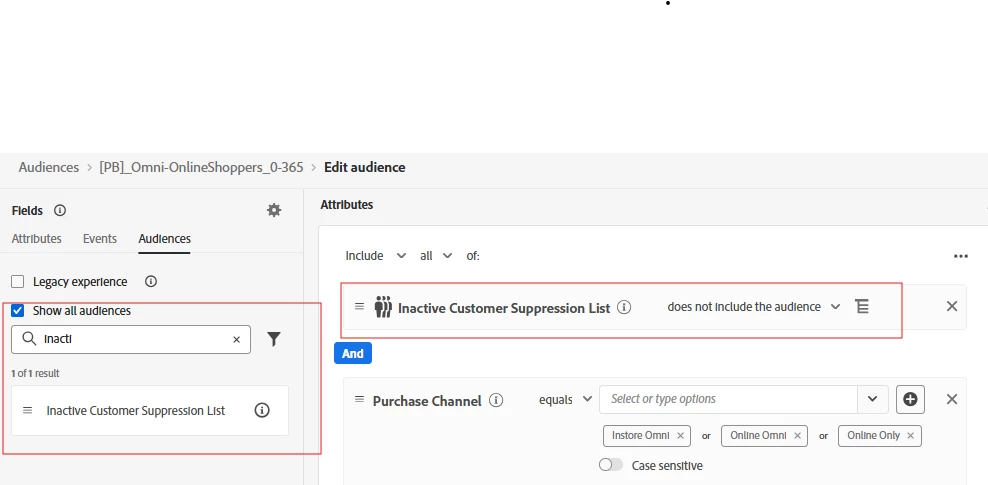
Hi Adobe Community, I have 2 audience - audience A and audience B. Audience A is just a normal campaign audience. However, in audience B, we don't want to send any messages to people that were a part of audience A in the last 30 days. We can't just put "exclude audience A" in our criteria for audience B because it will just exclude people that weren't a part of audience A today but we want anyone that was a part of audience A at all in the last 30 days so even if they were in the audience 25 days ago and dropped out of the audience 10 days ago, we still want to exclude them. Anyone have any ideas on how to do this in AEP. Thanks, Nick
When we profile enable a Schema and Dataset from Marketo, all the data ingested into it is included in profile. But we have data quality issues in Marketo due to which do not want to include all the data into Profile, only certain data matching few qualified campaigns should be included into profile. Marketo doesn't support row level filtering for Individual Records data. Is there any easier way to achieve this?
lets say there is a requirement that any data that is exported out from AEP to any destination, that data should also be exported into inhouse datawarehouse for audit purpose. Now instead of marking every audience activation at two destination manually, is there a way better way to do it sandbox level so that every export automatically gets exported into inhouse datawarehouse as well ?
Bumping a previous question I posted--if anyone has knowledge on this? When I apply a non-default attribution model to a metric counting specific events, and I apply it to a Web Page dimension (or any dimension), and select last touch, I notice that the grand total count is different than the row amounts combined. How do I make sense or interpret these numbers, relative to the attribution? With my understanding, in Last Touch attribution, a success metric-- e.g. an application submit event-- should not be attributed to more than one dimension item--therefore the sum of all rows should be equivalent to the grand total... but doesn't seem to be the case. If anyone has insight please let me know!
Already have an account? Login
Enter your E-mail address. We'll send you an e-mail with instructions to reset your password.