Cette conversation a été verrouillée en raison de son inactivité. Veuillez créer une nouvelle publication.
Niveau 1
Niveau 2
Se connecter à la communauté
Connectez-vous pour voir tous les badges
Cette conversation a été verrouillée en raison de son inactivité. Veuillez créer une nouvelle publication.
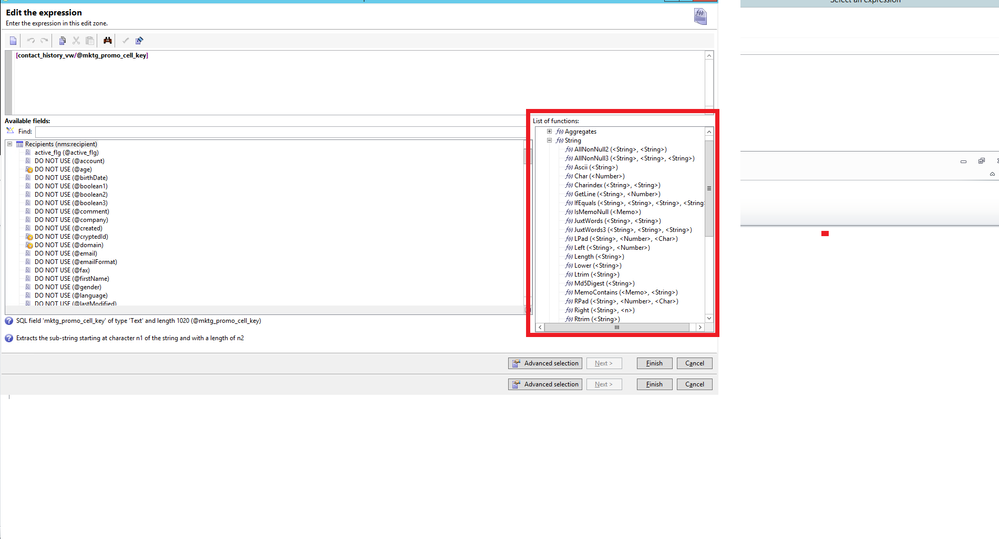
Can anyone point me in the right direction to create from the advanced SQL list of functions:
...a substring of Substr(MKTG_PROMO_CELL_KEY) from character 13 to 6 as "source_id" (field)?
So the function formula is "Substring (<String>, <Offset>, <Length>)", how can I select from the above field ("MKTG_PROMO_CELL_KEY") the characters 13 to 6 within that field (to create a new field ,"source_id")?
Thanks.
Finally, can anyone point me to a good online resource that teaches or lists all of these SQL functions. They're are a lot of SQL sites that lists SQL functions, but anyone know a good site that lists all of them found in Adobe Campaign?
Thanks.
Résolu ! Accéder à la solution.
Vues
Réponses
Nombre de J’aime
Hi Jael,
The only documentation is:
https://docs.campaign.adobe.com/doc/AC/en/PTF_Creating_queries_Methodology.html
These SQL functions are written in the database underlying language code, and you can find them all in the Adobe Campaign folder node:
Administration>Settings>SQL Script.
Select your own Database system (mySql, Postgres, SQL Server, Oracle, etc) to see how the functions listed are written in the underlying DB engine language (T-SQL for SQL Server, PL/SQL for Oracle, etc).
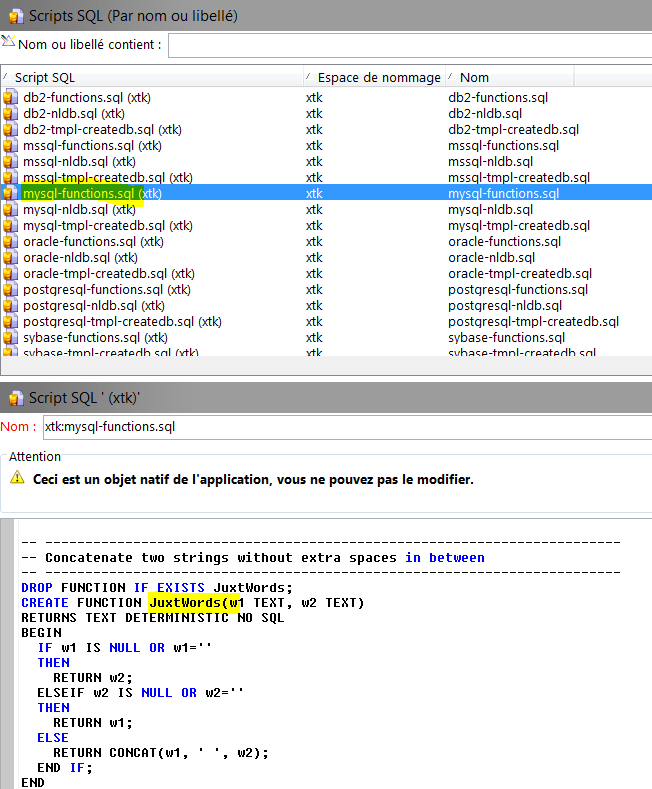
And one very efficient way to learn quickly is to display the generated SQL query (SQL query link, at the bottom of the form) when you define the Query through the UI, especially for date manipulation, it is easier.
Regards.
Jean-Serge
Vues
Réponses
Nombre de J’aime
Hi Jael,
The only documentation is:
https://docs.campaign.adobe.com/doc/AC/en/PTF_Creating_queries_Methodology.html
These SQL functions are written in the database underlying language code, and you can find them all in the Adobe Campaign folder node:
Administration>Settings>SQL Script.
Select your own Database system (mySql, Postgres, SQL Server, Oracle, etc) to see how the functions listed are written in the underlying DB engine language (T-SQL for SQL Server, PL/SQL for Oracle, etc).
And one very efficient way to learn quickly is to display the generated SQL query (SQL query link, at the bottom of the form) when you define the Query through the UI, especially for date manipulation, it is easier.
Regards.
Jean-Serge
Vues
Réponses
Nombre de J’aime
Hi, Jael,
Please don't ask the same question in multiple threads, use one thread and If you need something urgent tag one of us(florentlb, Jean-Serge Biron Adhiyan Vipul Raghav david_garcia ) but please don't create duplicate threads.
florentlb, Can you close/merge the duplicate threads in one, similar to this question?
You can follow the instructions given above and extend xtk:funcList schema, Use this custom schema to enable your namespace in the default function list. The default supported names space are 'xtk','nl','nms','ncm', 'crm' and you can extend this list for your use case.
regards,
Amit
Vues
Réponses
Nombre de J’aime
Hi Amit,
Sorry for the duplicate post, I believe it was in error as I must of clicked on post it twice.
Sorry and thank you and the forum moderators for your continual help!
Sincerely,
Jae
Vues
Réponses
Nombre de J’aime
Hi Jae
Could you get through your issue following Jean-Serge's suggestions?
(I've locked the duplicate thread)
Thanks,
Florent
Vues
Réponses
Nombre de J’aime
Yes, thank you so much and sorry for the dup.
Jae
Vues
Réponses
Nombre de J’aime
Hi Jean-Serge,
Is there a new url?
https://docs.campaign.adobe.com/doc/AC/en/PTF_Creating_queries_Methodology.html
404 not found error message:
The requested URL /doc/AC/en/PTF_Creating_queries_Methodology.html was not found on this server.
Thanks.
Vues
Réponses
Nombre de J’aime
Hi,
Looks like the link changed. It's probably that URL now: Steps to create a query
You can also use the search here: Browse Collection
Florent
Vues
Réponses
Nombre de J’aime
Vues
Likes
Réponses