Date range creation: Year to date, Year to date (last year), | Community
Skip to main content
Level 3
January 12, 2023
Solved

Date range creation: Year to date, Year to date (last year),

  • January 12, 2023
  • 2 replies
  • 2507 views

Hi all,

For some report I have to create my own date range, mainly year to date.

For this one I think I'm good (I created this on the 12JAN2023): 
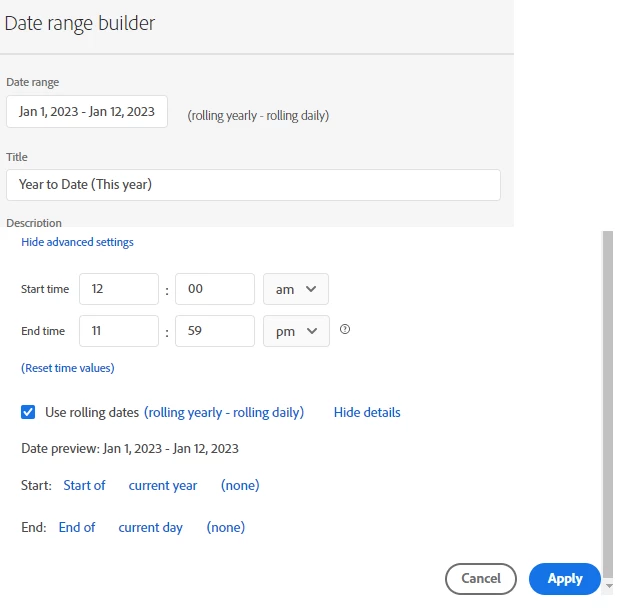
But I want to compare this period with previous year YearToDate.

So I dit this: same definition for the second one by adding minus 1 year but result is not ok in the preview
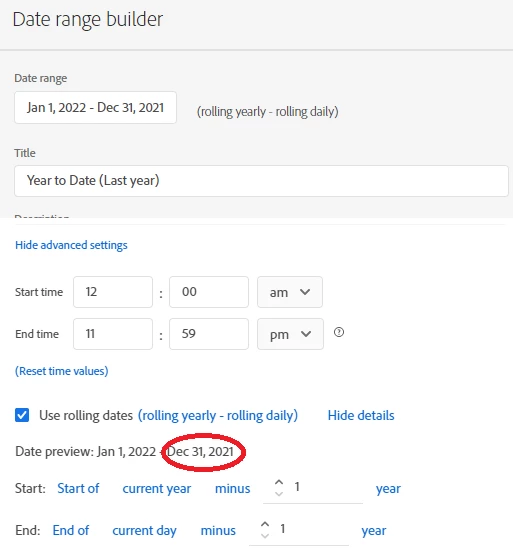
As you see in red, the end date is not the expected one.....

So I change with 11 months:
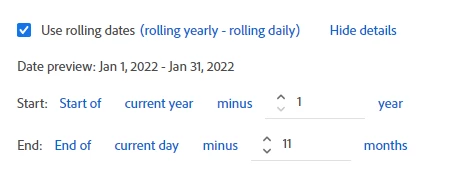
Month is ok but I lost the current day...


Does anyone of you have any suggestion?


Thanks


Robin
This post is no longer active and is closed to new replies. Need help? Start a new post to ask your question.
Best answer by robinl39529461

Thanks Jennifer,

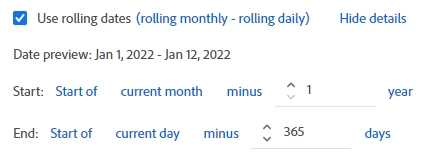
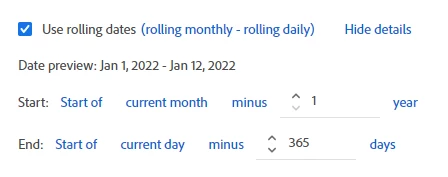
By changing with minus 365 days, result looks ok:

I found that depending if you choose minus x year, month, days, ... the granularity is different.

By selecting month, it won't take care of the day. So I have to select days to force the tool to stay on day granularity.

Hope it will others persons.


So I have a bonus question: I have to do it also with month.

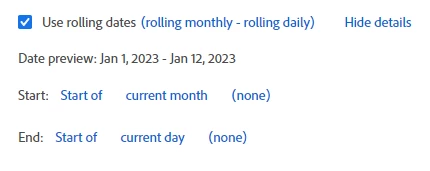
No problem for Month to date this month:

Same for Month to Date (Last Year):


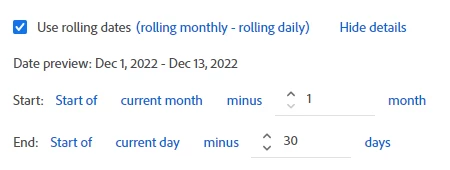
But I also have to create a Month to Date (Last month):

and for this one, as month can have a different number of days, not sure it will always be correct.


Any suggestion? Excel is not an option: all have to be in Analytics.


Thanks again


Robin


2 replies

Jennifer_Dungan
Community Advisor and Adobe Champion
January 12, 2023

Well, that is interesting.... That sure doesn't look right to me either... but I am getting the same result.....


Right now, I can't see any way to get the expected results... 


While you could use "current day minus 365 days"... leap years are going to have issues....


If you can live with weekly granularity... you could do "current week minus 52 weeks" (which would include some extra days) or "current week minus 53 weeks" (which should take you to the equivalent start of this week)


One possible suggestion would be to pull this report using Report Builder in Excel... you can then have better control over the date ranges, using Excel's date formulas. Then make your two comparative pulls use "Dates from Cells" rather than Adobe Defined Dates.... 

robinl39529461AuthorAccepted solution
Level 3
January 13, 2023

Thanks Jennifer,

By changing with minus 365 days, result looks ok:

I found that depending if you choose minus x year, month, days, ... the granularity is different.

By selecting month, it won't take care of the day. So I have to select days to force the tool to stay on day granularity.

Hope it will others persons.


So I have a bonus question: I have to do it also with month.

No problem for Month to date this month:

Same for Month to Date (Last Year):


But I also have to create a Month to Date (Last month):

and for this one, as month can have a different number of days, not sure it will always be correct.


Any suggestion? Excel is not an option: all have to be in Analytics.


Thanks again


Robin


Jennifer_Dungan
Community Advisor and Adobe Champion
January 13, 2023

I am sure you used to be able to mix granularity.... maybe something changed (or maybe I am just crazy 😛 )


As for "Month to Date (Last month)"... not sure if this would work, but if your data range is set to "This Month (excluding today)" you can just use "Last Month" as a column and it will be filtered to match up to yesterday.... this works for Year too....


You don't even need super customized date ranges when done like this......