Convert MS Word document to HTML in Fusion? | Community
Skip to main content
_Manish_Singh
Level 9
January 13, 2025
Solved

Convert MS Word document to HTML in Fusion?

  • January 13, 2025
  • 1 reply
  • 1194 views

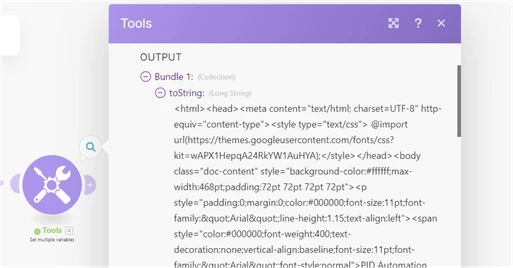
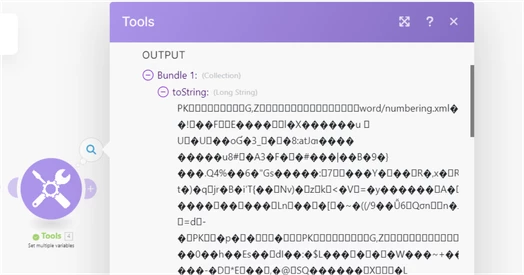
I am trying to download an MS Word document from Workfront, but I need to convert it to an HTML file first because the output from the MS Word document is not readable. Is it possible to convert it in Fusion without doing it manually? I'm sharing examples below. FYI, have used toString() function in Tools app.

MS Word output (unreadable):


MS Word converted to HTML (manually):

This post is no longer active and is closed to new replies. Need help? Start a new post to ask your question.
Best answer by monicacardoso

Hi @_manish_singh


Thank you for your question! Can I ask: is there a reason that you are using a word document to store HTML code? 


I ask because the Download Document module for Workfront only outputs the raw data available; this is the strange string with lots of unreadable characters. The module is meant to retrieve the document and serve as an aid to move it from Workfront into another application (for example, move a document from Workfront into Google Drive). The module is not meant to be retrieved from Workfront and then read in Fusion. 


https://experienceleague.adobe.com/en/docs/workfront-fusion/using/references/apps-and-their-modules/adobe-connectors/workfront-modules#:~:text=The%20module%20returns%20the%20document%E2%80%99s%20content%2C%20filename%2C%20file%20extension%2C%20and%20file%20size.%20You%20can%20map%20this%20information%20in%20subsequent%20modules%20in%20the%20scenario.


If what you're trying to achieve is simply to get HTML code into Fusion, there are other options available: 


1) Hard code the HTML into Fusion through the use of a Create Variable module. 


or 


2) If the HTML code is coming from users who submit this word document, you could setup a request queue with a field for the HTML code. Then use Fusion to read the contents of the custom field and do something with it. 


or 


3) Upload that HTML to GitHub and then call GitHub's API to output it.


If you'd like to see this functionality implemented into Fusion in the future, I would recommend submitting a feature idea to our innovation lab. 


https://experienceleague.adobe.com/en/docs/workfront/using/basics/tips-tricks-for-basics/idea-exchange


- Monica 

1 reply

monicacardosoAdobe EmployeeAccepted solution
Adobe Employee
January 22, 2025

Hi @_manish_singh


Thank you for your question! Can I ask: is there a reason that you are using a word document to store HTML code? 


I ask because the Download Document module for Workfront only outputs the raw data available; this is the strange string with lots of unreadable characters. The module is meant to retrieve the document and serve as an aid to move it from Workfront into another application (for example, move a document from Workfront into Google Drive). The module is not meant to be retrieved from Workfront and then read in Fusion. 


https://experienceleague.adobe.com/en/docs/workfront-fusion/using/references/apps-and-their-modules/adobe-connectors/workfront-modules#:~:text=The%20module%20returns%20the%20document%E2%80%99s%20content%2C%20filename%2C%20file%20extension%2C%20and%20file%20size.%20You%20can%20map%20this%20information%20in%20subsequent%20modules%20in%20the%20scenario.


If what you're trying to achieve is simply to get HTML code into Fusion, there are other options available: 


1) Hard code the HTML into Fusion through the use of a Create Variable module. 


or 


2) If the HTML code is coming from users who submit this word document, you could setup a request queue with a field for the HTML code. Then use Fusion to read the contents of the custom field and do something with it. 


or 


3) Upload that HTML to GitHub and then call GitHub's API to output it.


If you'd like to see this functionality implemented into Fusion in the future, I would recommend submitting a feature idea to our innovation lab. 


https://experienceleague.adobe.com/en/docs/workfront/using/basics/tips-tricks-for-basics/idea-exchange


- Monica 
_Manish_Singh
Level 9
January 23, 2025

Basically, my MS Word is set up as a change request template, and most of the content is in tables. Here's an example:

KeyValue
Enter ProjectProject X
OwnerManish
Change ApproverSingh
Decision Date01/01/25
Impact if not ImplementedNA
and so and so......


If I can convert this document to HTML, in the next steps of the scenario, it'll be easier for me to see that 'Project X' is linked to 'Enter Project' and not something else, because HTML tables have structure, and there is no chance of going wrong.

The Download Document module in Workfront isn't just for moving docs between apps, it can also be used for parsing like handling CSV files. From my testing, it handles text documents pretty well, but I'm not sure why it messes up with MS Word.

Adobe Employee
January 23, 2025

Thanks for your response. My experience is that the Download Document module will always output data that is unreadable and is prepared to use in an Upload Document module (either to Workfront or another application). Below are the outputs for a .notepad, .rtf and .txt file. 


The difference with CSV files is that Fusion has native CSV modules that allow the data to be parsed into a readable format. The output from the Download Document is still unreadable data, but then you can use these native CSV modules to transform that data. 


https://experienceleague.adobe.com/en/docs/workfront-fusion/using/references/apps-and-their-modules/tools-and-transformers/csv#parse-csv


Unfortunately, there is nothing similar for text or word documents. 


- Monica