Translating pages : Overwrite Language Master | Community
Skip to main content
June 26, 2023
Solved

Translating pages : Overwrite Language Master

  • June 26, 2023
  • 3 replies
  • 1952 views

I am aware of the option "Create Language Copy" while adding pages to the translation project - https://github.com/AdobeDocs/experience-manager-65.en/blob/main/help/sites-administering/tc-manage.md#performing-initial-translations-and-updating-existing-translations
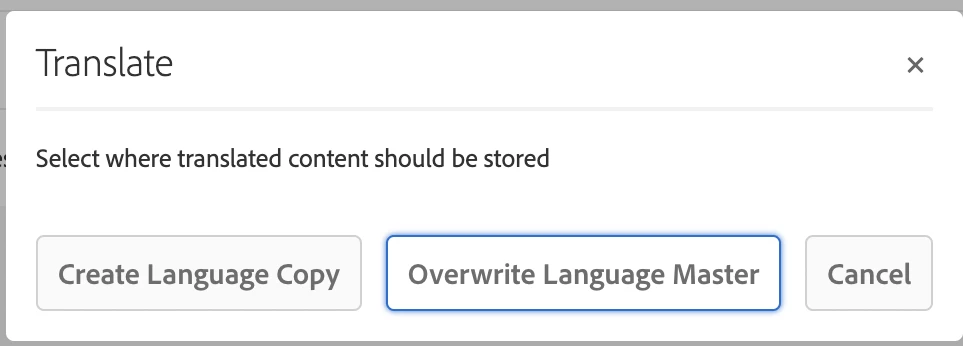


Though I am not very sure of the "Overwrite Language Master" option. Could someone please help me out to understand what is it about? and when can we use it? 
I didn't find any documentation explaining when and how to use this feature.


Thanks in advance!

This post is no longer active and is closed to new replies. Need help? Start a new post to ask your question.
Best answer by aanchal-sikka

Hello @hiralva 


"Overwrite Language Master" would reset the Master along with the Language Copy.


In this case, one would generally Translate from say en -> en_us. Not change the Language altogether. 


It can help in the situation, where translators have been working with multiples language versions. It is causing potential misinterpretations, inconsistencies or ambiguities. Setting-up a common standard master can aid the process.


3 replies

Tanika02
June 26, 2023

Hello @hiralva - 


Overwrite Language Master 


  • By default, when you make changes to the language master, those changes are not automatically propagated to the translated language copies. This behavior is designed to preserve the translated content and prevent unintentional overwriting of translations.
  • However, there are situations where you may want to update the language master and propagate those changes to the translated copies. This is where the "Overwrite Language Master" option comes into play. When this option is enabled, any changes made to the language master will be automatically applied to the translated language copies, overwriting their existing content.


You can use the "Overwrite Language Master" option when you need to update the original content and ensure that the changes are reflected in all translated versions. It can be useful when you want to make global updates, corrections, or improvements to the content and ensure consistency across all languages.

HiralVaAuthor
June 26, 2023

Hi @tanika02 , thanks for the quick reply.

Could you please explain the same with examples.

Like for "create language copy" option, we can translate a new/existing translated language copies pages from source(EN) to target(DE-DE) language.

HiralVaAuthor
June 26, 2023

Also, when I try to update one of the language master EN page and then try to add the same page into the translation project, error is thrown : 
com.adobe.cq.wcm.translation.impl.servlet.TranslationJobServlet Error while taking action
java.lang.NullPointerException: null
at com.adobe.cq.wcm.translation.impl.TranslationPodImpl.createLaunchForSubPagesIfReferencesAreUpdated(TranslationPodImpl.java:302) [com.day.cq.wcm.cq-wcm-translation:1.5.86]

ManviSharma
Adobe Employee
Adobe Employee
June 26, 2023

Hi,


You can use the "Overwrite Language Master" option in scenarios where you have made updates or improvements to the translated content, and you want those changes to be reflected in the language master as well. Enabling this option will replace the content in the language master with the translated content from the language copies.

It's important to note that using the "Overwrite Language Master" option should be done with caution, as it can overwrite the existing content in the language master.

HiralVaAuthor
June 26, 2023

Thanks @manvisharma for the reply.


So, what should be the source and target languages for the translation project?


For example:

EN being the language master and FR-FR being the language copy.

aanchal-sikka
Community Advisor
aanchal-sikkaCommunity AdvisorAccepted solution
Community Advisor
June 28, 2023

Hello @hiralva 


"Overwrite Language Master" would reset the Master along with the Language Copy.


In this case, one would generally Translate from say en -> en_us. Not change the Language altogether. 


It can help in the situation, where translators have been working with multiples language versions. It is causing potential misinterpretations, inconsistencies or ambiguities. Setting-up a common standard master can aid the process.


Aanchal Sikka