Change image resolution on Cloud | Community
Skip to main content
Level 3
September 13, 2021
Solved

Change image resolution on Cloud

  • September 13, 2021
  • 3 replies
  • 1345 views

Hi,

Hope you are doing well!

We are trying to change image resolution on Cloud. But, we are not sure if this is the place where image resolution is changed: /system/console/configMgr/com.day.cq.dam.core.impl.cache.CQBufferedImageCache. Also, on cloud we can not access this url. How can we change it? Thanks!
This post is no longer active and is closed to new replies. Need help? Start a new post to ask your question.
Best answer by Steu86

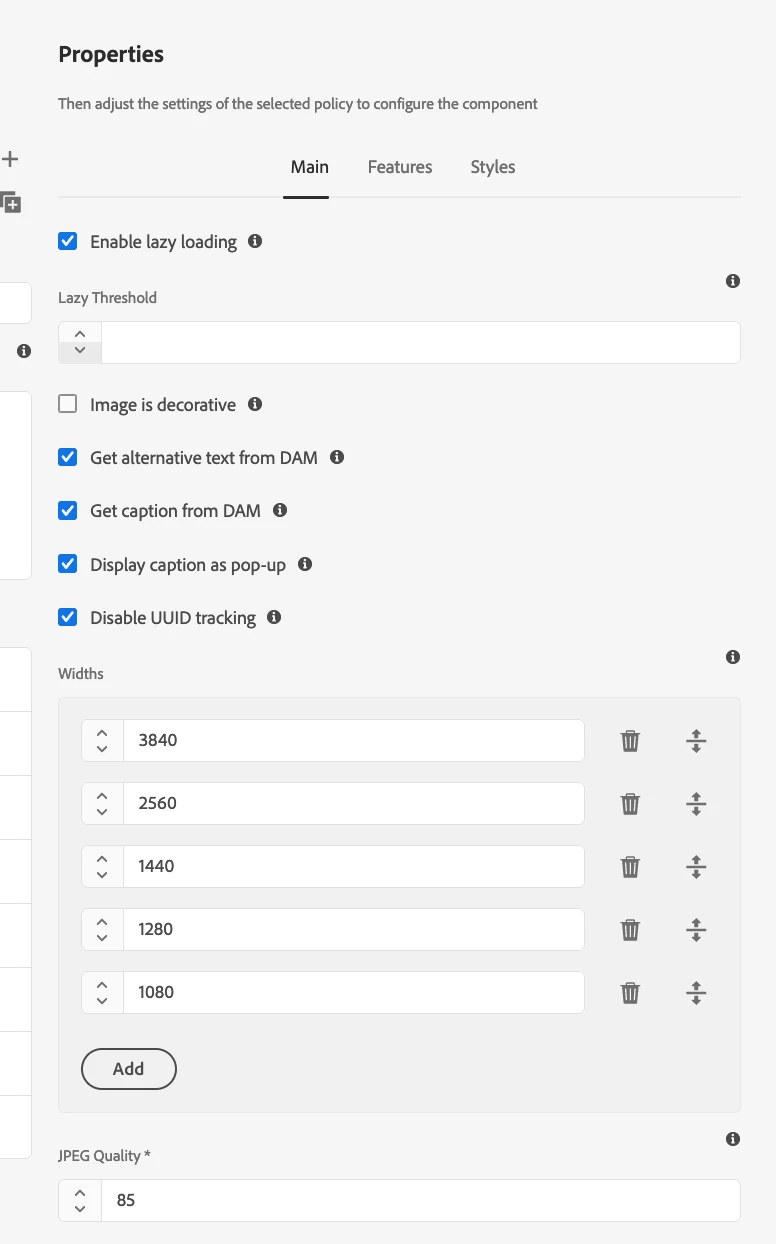
Please check policy of IMAGE core component itself and setup accordingly your required configuration. You also find there the lazy load functionality for your frontend.

3 replies

Asutosh_Jena_
Community Advisor
Community Advisor
September 13, 2021

When you say image resolution, does this mean you want to change the default renditions that are generated while uploading the assets?

If you mean by that it's not the correct place. That needs to be updated as part of the Asset Upload Workflow.


If you want to update this configuration, this needs to be pushed as part of the code and cannot be changed directly on system/console.


Thanks!

Level 3
September 13, 2021

Yes! By default is generated 1280, and big images look bad. Where can i change this?

Asutosh_Jena_
Community Advisor
Community Advisor
September 13, 2021
Kishore_Kumar_
Level 9
September 13, 2021

Hi @ad-engineer 


Please check with Tools -> Assets -> Processing Profiles, and try adding a renditions and check. 


and regarding access to configMgr, We cannot access system console directly in cloud , Instead we need to make use of Developer Console to access it.


and also if you want to change any OSGI Configuration it has to be changed through code and it has to deployed via CI/CD pipeline.

Steu86Accepted solution
Level 2
September 15, 2021

Please check policy of IMAGE core component itself and setup accordingly your required configuration. You also find there the lazy load functionality for your frontend.