Hi @prince_shivhare!
Your post refers to two different topics for AEM as a Cloud Service (AEMaCS):
- Reverse Replication (referenced in your quote)
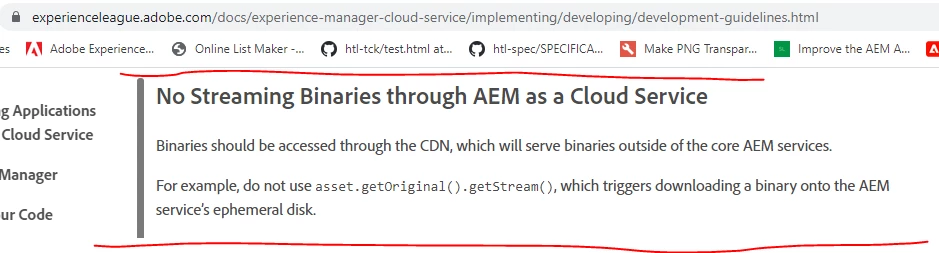
- Processing and streaming of assets (referenced in the screenshot and the article)
IMO, these are not or at least very loosely connected
Reverse Replication
AEMaCS does not provide Reverse Replication of content as it has been known from AEM 6.5 (and earlier). The feature was mainly used for user generated content (UGC), e. g. comments, posts, ratings that your end users could leave at your website. This content would then be replicated from the publish instance where it was initially created back to the authoring instance and re-distributed to all publish instances in place (potentially running through a moderation process on the author side before being distributed).
This practice is no longer supported for AEMaCS. If you need to store user generated content (or have similar use case) the recommendation for AEMaCS is to use a dedicated, shared storage (e. g. external database) or leverage alternative integration patterns (e. g. client-side integration of external services).
Processing and streaming of assets
The process of asset handling has changed quite a bit for AEMaCS compared to non-cloud AEM setups. Asset processing is now being handled by the Asset Compute Microservice and assets are stored in a binary cloud storage that has a dedicated content delivery network (CDN). For non-cloud AEM, assets are processed within the AEM instance and delivered from there (unless you have Dynamic Media in place for asset delivery). For AEMaCS this comes with a changed pattern of how you can (and should) access asset binaries in your code (as mentioned in the development guidelines in your screenshot).
Did this answer your question?
If not, please add some details on what information you are looking for.
Hope that helps!