simple explanation for different values prop and evar? | Community
Skip to main content
Level 4
December 14, 2018
Solved

simple explanation for different values prop and evar?

  • December 14, 2018
  • 13 replies
  • 16374 views

Hello, everyone,

maybe someone can help me?

In order to understand what prop and evar are, I have read some here.

https://webanalyseaufdeutsch.de/2012/01/17/traffic-variables-variablen-in-sitecatalyst-i/

https://webanalyseaufdeutsch.de/2012/01/17/traffic-variables-variablen-in-sitecatalyst-i/

but to better understand and touch this I have a variable which is stored in two different variables.

There is a variable on the page for the status code of the page:

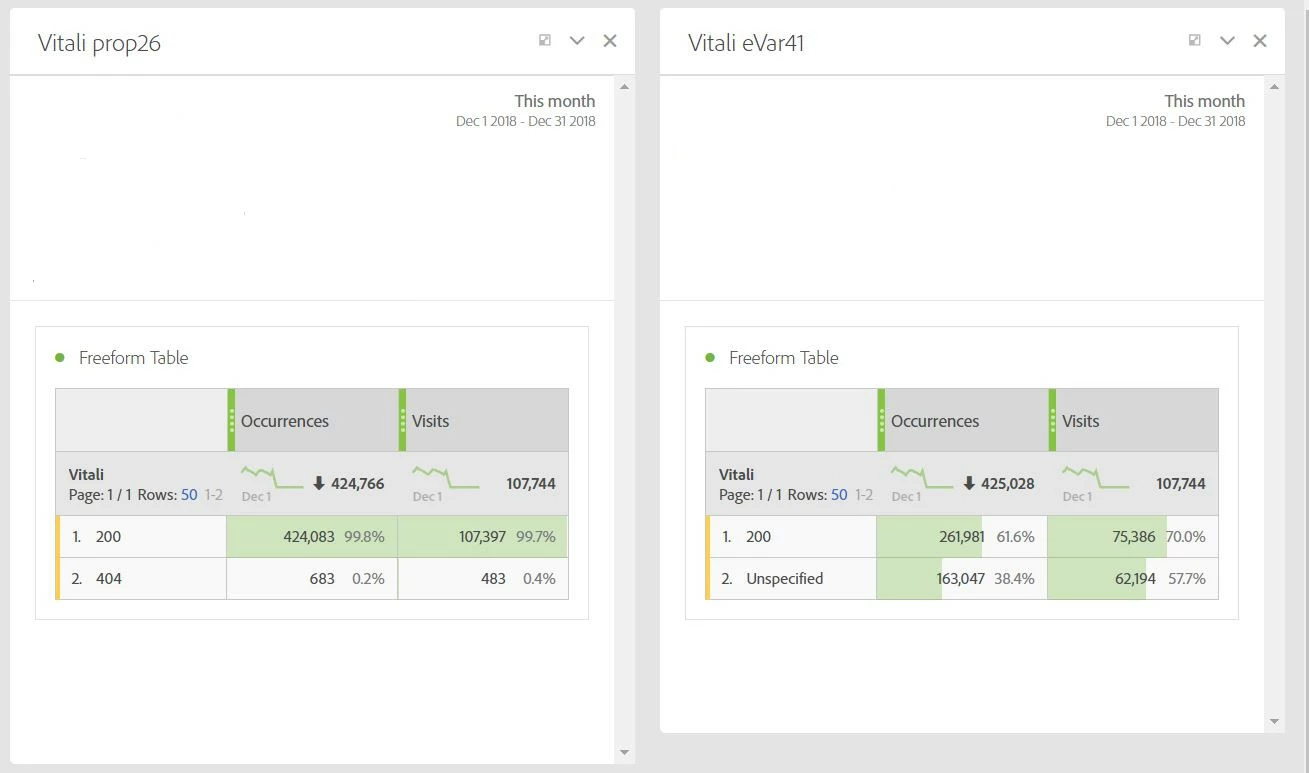
So I have stored the respective status 1x in a prop and 1x in an evar.

And absolutely different values come out.

Can anyone explain this to me?

Hallo alle zusammen,

vielleicht kann mir jemand helfen?

Um zu verstehen was prop und evar sind, habe ich hier einiges gelesen.

https://webanalyseaufdeutsch.de/2012/01/17/traffic-variables-variablen-in-sitecatalyst-i/

https://webanalyseaufdeutsch.de/2012/01/17/traffic-variables-variablen-in-sitecatalyst-i/

Um das jedoch noch besser zu verstehen und das anfassen zu können habe ich eine Variable welche in zwei unterschiedliche Variablen gespeichert.

Es gib auf der Seite eine Variable für den StatusCode der Seite:

Also habe ich den jeweiligen Status 1x in eine prop und 1x in eine evar gespeichert.

Und es kommen absolut unterschiedliche Werte raus.

Kann mir das jemand erklären?

Best answer by Urs_Boller

Hi vitalin58577727

you have several problems in your setup:

1) prop vs. evar:

a prop only saves the value on a single hit when you set the value! that means your occurencies should be the amount of times you send the prop to the database (reportsuite).

an eVar keeps the value as long as you defined. to see an equal metric (counter when eVar is set) take the corresponding "Instance" metric. adding "eVar41 Instances" will show you the amount of times the eVar appears in the server call. But since eVar keep the value (in the database/reporting) you can see the the counter for those hits as well using "occurencies". that means this metric shows you athe amount of times where the eVar is set OR the database still knows the vaule.

I recommend the following article about the difference of "instances vs. occurencies":

- Compare page views, instances, and occurrences

- https://webanalyseaufdeutsch.de/2017/10/03/die-occurences-metrik/

2) eVar settings

Having a closer look at your aVar I saw that you set it as "merchandising eVar". this is kind of a soecial eVar and might not be what you want.

13 replies

Alexis_Cazes_
Level 10
December 14, 2018

If for the same hit(server call) a different value is set then you should look at your implementation to check same value is set at code level and same value is present in server call.

If it is the same and still different value then check there is no VISTA ruless or processing rules that affect either of these variables.

Make sure eVar is not a merchandising eVar and has last toucj allocation

Urs_Boller
Community Advisor
Community Advisor
December 14, 2018

hi @vitalin58777

what metric are you loking at? pageViews, visits? and do you set the value in each hit, page view or just once per visit?

I assume that the difference is based on how the eVars keep their value. eVars can (based on report suite settings) keep the value forever, while props loose the value after the hit. therefore a difference in data is expected based on settings for eVar, how you collect data and how you report (which metric).

maybe you can give more information on collect/eVar settings and a report screenshot and we might give you an explanation.

Level 4
December 17, 2018

Hello, everyone,

Thank you so much for your help.

The setting of eVar can be found in the attachment

Urs_Boller
Community Advisor
Community Advisor
December 17, 2018

hi vitalin58577727

in short: the value of the prop is only stored on the hit where you set the prop. on the other hand the evar keeps the value until the end of the visit (not only on the single hit).

if you send a screenshot of your reporting, we might give you more details about the difference in the numbers

Level 4
December 17, 2018

as said I ask the StatusCoder page and save it in two different variables.

ich versuche die Variable StatusCode in zwei verschiedene Variablen zu speichern.

StatusCode -> prop26

StatusCode -> eVar41

es kommen  unterschiedliche Werte raus. es müssen auch unterschiedliche Werte rauskommen, aber wie erklärt sich das?

Danke im Voraus.

Urs_Boller
Community Advisor
Urs_BollerCommunity AdvisorAccepted solution
Community Advisor
December 17, 2018

Hi vitalin58577727

you have several problems in your setup:

1) prop vs. evar:

a prop only saves the value on a single hit when you set the value! that means your occurencies should be the amount of times you send the prop to the database (reportsuite).

an eVar keeps the value as long as you defined. to see an equal metric (counter when eVar is set) take the corresponding "Instance" metric. adding "eVar41 Instances" will show you the amount of times the eVar appears in the server call. But since eVar keep the value (in the database/reporting) you can see the the counter for those hits as well using "occurencies". that means this metric shows you athe amount of times where the eVar is set OR the database still knows the vaule.

I recommend the following article about the difference of "instances vs. occurencies":

- Compare page views, instances, and occurrences

- https://webanalyseaufdeutsch.de/2017/10/03/die-occurences-metrik/

2) eVar settings

Having a closer look at your aVar I saw that you set it as "merchandising eVar". this is kind of a soecial eVar and might not be what you want.

Level 4
December 18, 2018

Thank you very much for the explanation.

Unfortunately, I do not always fully understand that.

I understand that there are different variables to handle them differently.

Can you give me an example?

Let's take userA to the pageA

UserA -> PageA>PageB>PageC-PageD

Prop26 - ->PageA(200)->PageB(200)->PageC(404)->PageeD(200)

eVar41- ->PageA(200)->PageB()->PageC(404)->PageeD()

occurencies - Prop26(4)

occurencies -eVar41(2)

Is that how it works?

because I don't quite understand that.

German

Vielen Dank für die Erklärung.

Leider verstehe ich das immer nocht nicht ganz.

Ich verstehe das es verschiedene Variablen sind um diese anders zu behandeln sind.

Kannst du mir einen Beispiel geben?

Nehmen wir BenutzerA kommt auf die SeiteA

BenutzerA -> SeiteA>SeiteB>SeiteC-SeiteD

Prop26 -    ->SeiteA(200) ->SeiteB(200) ->SeiteC(404)-> SeiteD(200)

eVar41-     ->SeiteA(200) ->SeiteB()       ->SeiteC(404)-> SeiteD()

occurencies ->Prop26(4)

occurencies ->eVar41(2)

Stimmt das so in etwa?

denn ich verstehe das nicht ganz.

Mir geht um die Unterscheidung wann ich was nutzen soll und kann.

Urs_Boller
Community Advisor
Community Advisor
December 18, 2018

there are a lot of websites describing the difference, eg here: Traffic Props and Conversion eVars

I suggest you have a look at those pages, I think it will solve your questions (and more)

Level 4
January 3, 2019

Die Frage wurde nicht beantwortet aber für den Leser wird das so dargestellt.

Klar habe ich die Links zu dem Unterschied von prop und evar gelesen und noch weitere Seiten gefunden die das erklären.

Das habe ich vorher schon alles gemacht.

Gib es keine einfache Antwort auf meine Frage?

Ist die Frage zu kompliziert oder ist die Antwort nicht möglich?


Urs_Boller
Community Advisor
Community Advisor
January 4, 2019

Hi vitalin58577727

I try to answer your question in short, even if it's not possible to fully answer the question - there are too many special cases.

basically, a prop is a variable set on a single hit and only valid for the single hit. a prop are mainly used for pathing and the "entry"/"exit" values.

(remark: special cases for "list props", "pagename" and some other default variables)

an evar is used for merchandising. that means, a value is set on a single hit and saved for later use. eg. if a user is searching on your page for the word "book" and later buy something, you can break down for the (last) search term.

but: there are a lot of options in the backend which can influence how and how long an evar keeps the values. i skip it here because that would take too much of work (and I'm sure you already read about that)

lets go back to your example and try to figure out how it "might" work:

UserA -> PageA>PageB>PageC-PageD

Prop26 - ->PageA(200)->PageB(200)->PageC(404)->PageeD(200)

eVar41- ->PageA(200)->PageB()->PageC(404)->PageeD()

if you really set the prop26 and eVar26 on each hit, the "occurencies" should be the same.

but as written before, youre settings for the evar indicate that you are using a "merchandising evar" which is a very special case of an evar. just google for this evar type...

the might understand the idea of prop/evar with this example:

page A / prop26: 200 / evar41: 200

page B / prop26: -- / evar41: --

page C / prop26: 404 / evar41: 404

page D / prop26: 200 / evar41: 200

in this case (with an "usual" evar and expiry visit) the result would look like this (occurnecies)

prop26 / 200 -> 2 / 404 -> 1

evar41 / 200 -> 3 / 404 -> 1

the reason for the difference is that the evar "keeps" the value for the hit (occurencies) where no new value is set.

i hope that helps...

Level 2
September 6, 2023

Hi,


Question - so if i define 2 metrics at the visit level - should i not get the same answer whether i use evar or props?  I am counting the existence of an evar or prop in a visit.  The evar is the last in visit.


I am defining the metrics as Visits where var/prop exists. 


Thoughts


Thx

SM_AP1