Sequential Filters with Multiple 'Then' and an 'Only After' or 'Only Before' | Community
Skip to main content
September 27, 2022
Solved

Sequential Filters with Multiple 'Then' and an 'Only After' or 'Only Before'

  • September 27, 2022
  • 2 replies
  • 2411 views

I am building a session based filter where I specify:


Filter = Session {

Event = A

Then

Event = B

Then 

Event = C

}


Then, lets says the only session I have in AA is this: A -> B -> C. 


If I apply this session level segment and look at all events this is what I except:

All: [A = 1, B = 1, C = 1],

Only Before: [A = 1, B = 1],

Only After: [B=1, C=1]


Is this correct?

This post is no longer active and is closed to new replies. Need help? Start a new post to ask your question.
Best answer by Jennifer_Dungan

A segment built like this:
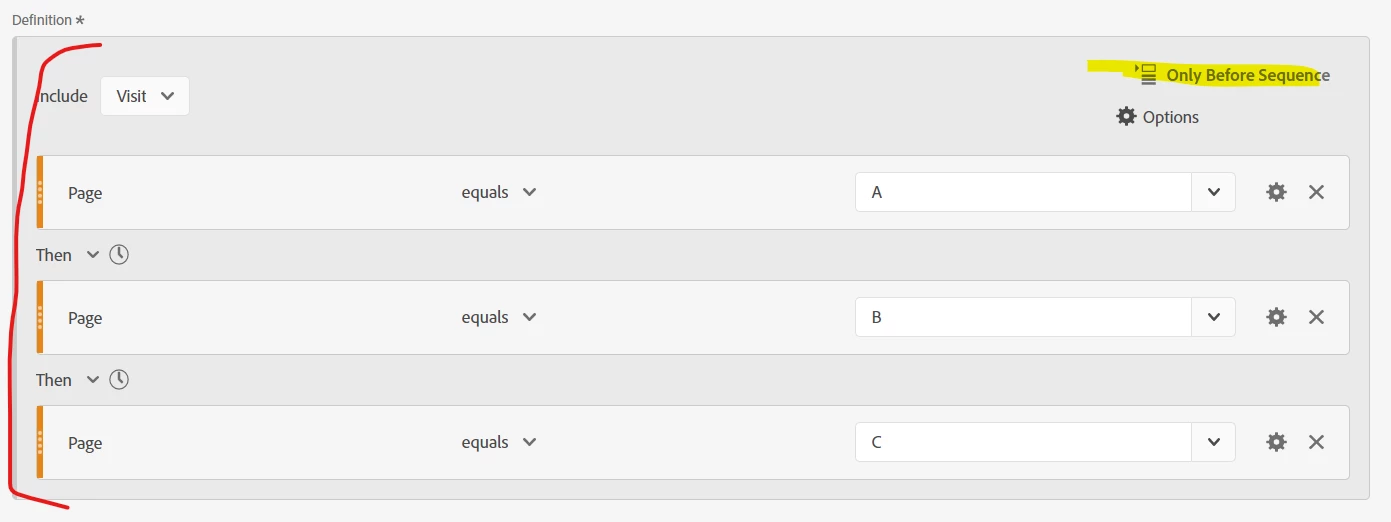


Is going to be fundamentally different than one built like this:
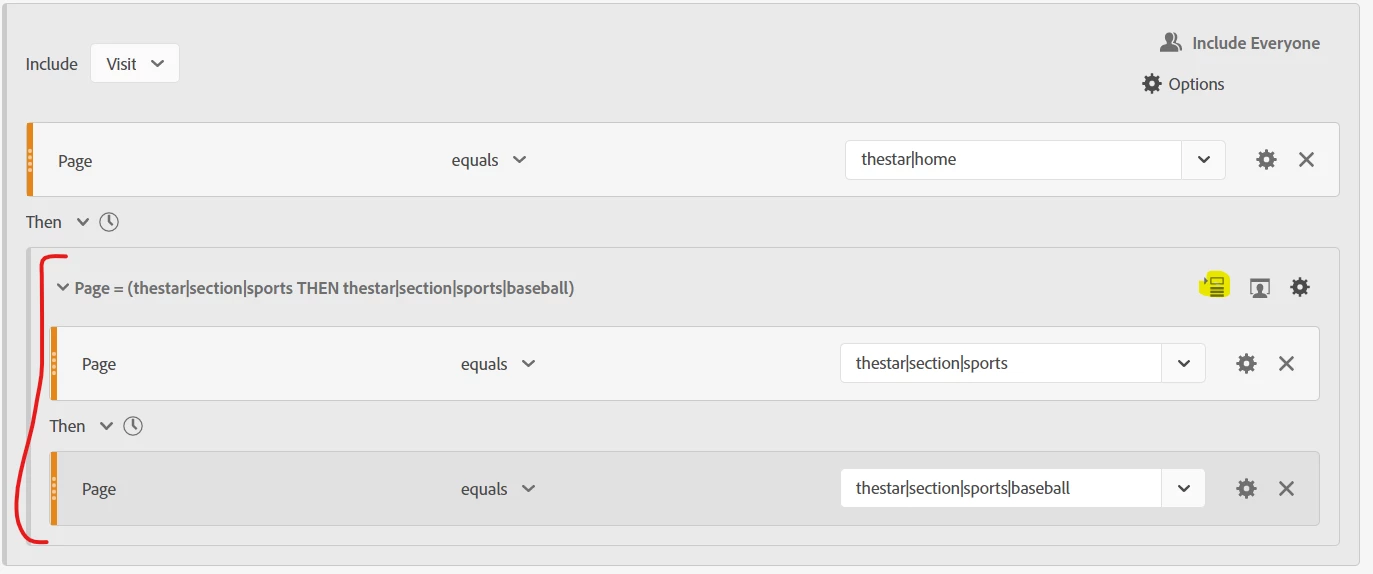


The first segment rule applies to the entire 3 page sequence; the second segment rule, the "Only Before" is only for two of the pages in the sequence.


In the first rule, the Only Before Sequence applies to the entire sequence, meaning you should get data from Before Page A (but not including Page A (correction) and this will include Page A)


In the second rule, the Only Before Sequence applies to only a portion of the sequence, meaning you should get data before Page B (it should include Page A in the returned data AND Page B. since A is not part of the sub-container where the rule is being applied, (correction) and Page B is the first page in the "Before Sequence)


(correction)

In both cases, Page A and B are part of the sequence, but where you are applying the "Only Before" or "Only After" will determine whether Page B is part of the "included" data or not (since you are using a loose "Then" which means that sequences of Page A > Page D > Page B > Page E > Page C are going to meet the criteria....


In both case, Page E and Page C should not be included, but in the second case, where the Only Before is applied against the sub-set of Page B > Page C; Page A, Page D, and Page B will be returned in your data set.

2 replies

yuhuisg
Community Advisor
Community Advisor
September 28, 2022

That sounds about correct.

Jennifer_Dungan
Community Advisor and Adobe Champion
September 28, 2022

I think it depends on where you apply the Only Before / Only After logic... if you apply to the whole segment rule... I would expect that the segment will return the data before A = 1, B = 1, C = 1... If you have containers within the segment and apply the Before/After, then it should be before or after that subset of logic.

em3916Author
September 28, 2022

Hi Jennifer, I am sorry but I am a little confused by the response. What do you mean by 'If you apply to the whole segment rule" and "If you have containers within the segment and apply...." ?


Is this to say that if I put each separate event in a container the logic would be different compared to putting all 3 events in no container?

Jennifer_Dungan
Community Advisor and Adobe Champion
Jennifer_DunganCommunity Advisor and Adobe ChampionAccepted solution
Community Advisor and Adobe Champion
September 28, 2022

A segment built like this:


Is going to be fundamentally different than one built like this:


The first segment rule applies to the entire 3 page sequence; the second segment rule, the "Only Before" is only for two of the pages in the sequence.


In the first rule, the Only Before Sequence applies to the entire sequence, meaning you should get data from Before Page A (but not including Page A (correction) and this will include Page A)


In the second rule, the Only Before Sequence applies to only a portion of the sequence, meaning you should get data before Page B (it should include Page A in the returned data AND Page B. since A is not part of the sub-container where the rule is being applied, (correction) and Page B is the first page in the "Before Sequence)


(correction)

In both cases, Page A and B are part of the sequence, but where you are applying the "Only Before" or "Only After" will determine whether Page B is part of the "included" data or not (since you are using a loose "Then" which means that sequences of Page A > Page D > Page B > Page E > Page C are going to meet the criteria....


In both case, Page E and Page C should not be included, but in the second case, where the Only Before is applied against the sub-set of Page B > Page C; Page A, Page D, and Page B will be returned in your data set.