How to ONLY count the non-repeating instances for a sepcific eVar in Adobe analytics? | Community
Skip to main content
Level 3
October 21, 2021
Solved

How to ONLY count the non-repeating instances for a sepcific eVar in Adobe analytics?

  • October 21, 2021
  • 2 replies
  • 3597 views

Because some wrong practices happend in our Adobe Launch implementation, we set the duration of the utm related data elements as Session.


As a result, the data will continually sent into the report suits. However, the media team only want to see the first hit of every new sources with utm code.


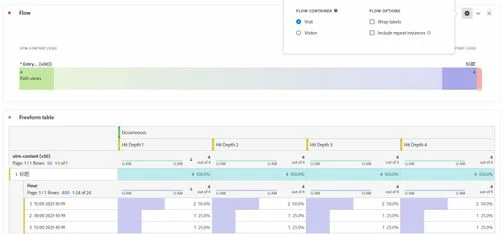
I made a examples for your to understand the situation. 

The GREEN is the Actual Times of the ENTRY, that's the number which media team want.

The RED is the way how we collect the data now. 

 

You can see only count the instances and the entire of each A/B/C can not get the array we want

So I thought of that there is a function of segment which is "Non-repeating Instances", which can help me to only focus on those hit with non-repeating instances.

Which I thought the calculation will be only focus on the hit with LIGHT GREEN, which is just met the actual entry from media. 

I thought that's what I want.
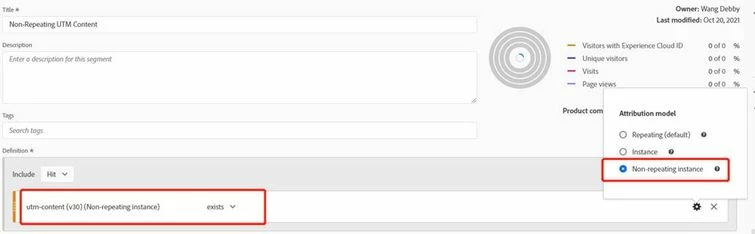


However, the result is, the instances of those Non-repearing Instances is even less than the Visit!
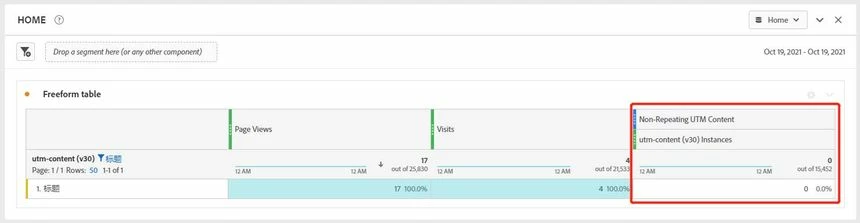


Could you help me point out the problem?


This post is no longer active and is closed to new replies. Need help? Start a new post to ask your question.
Best answer by yuhuisg

You can also use the "Instances" radio button in your segment's variable setting.

"Instances" refers to the hits where the variable had a value set in it.

"Non-Repeating Instances" refers to the hits where AA had persisted the value in the absence of it being set.

The other option is to use the green metric, "[your eVar's name] Instances", instead of "Visits". That reports the number of hits where your eVar had a set value.

Hope that helps!

2 replies

Andrey_Osadchuk
Level 10
October 21, 2021

@debbynpl ,

Use Visits or Visitors with the created segment as the "repeating instances" are detected in a sequence of hits rather than in a single hit (occurrence).

 
DebbyNPLAuthor
Level 3
October 22, 2021

Hi Andrey,


Thanks for your help


I saw the document and it says it need to be the "hit" as segment. 


If I use visit or visitors as the container, then it will contains all hits of a visit which have a non-repeating instances. I just need to pick just the hit which is non-repearting instances, or I can also say "the first hit of a continuous instances"


https://experienceleague.adobe.com/docs/analytics/components/segmentation/segmentation-workflow/seg-build.html?lang=en#build-segments

yuhuisg
Community Advisor
yuhuisgCommunity AdvisorAccepted solution
Community Advisor
October 22, 2021

You can also use the "Instances" radio button in your segment's variable setting.

"Instances" refers to the hits where the variable had a value set in it.

"Non-Repeating Instances" refers to the hits where AA had persisted the value in the absence of it being set.

The other option is to use the green metric, "[your eVar's name] Instances", instead of "Visits". That reports the number of hits where your eVar had a set value.

Hope that helps!

DebbyNPLAuthor
Level 3
October 22, 2021

Hi Yuhuisg


Does the "the hits where AA had persisted the value in the absence of it being set" refers to the post-eVars of the duration setting of the eVar in Adobe Analytics besides the implementation?


I'm pretty sure of that the "Non-repeating Instances" is not refers to the values of post-eVars.

yuhuisg
Community Advisor
Community Advisor
October 22, 2021

@debbynpl , 

Does the "the hits where AA had persisted the value in the absence of it being set" refers to the post-eVars of the duration setting of the eVar in Adobe Analytics besides the implementation?

Yes.


I'm pretty sure of that the "Non-repeating Instances" is not refers to the values of post-eVars.

Good point, I confused myself. So what you did was correct.

What is the expiry setting for your eVar(s)?