How to get a YoY view in table? | Community
Skip to main content
Level 3
April 20, 2023
Solved

How to get a YoY view in table?

  • April 20, 2023
  • 3 replies
  • 1294 views

Hi all,

I was wondering if there was a way to use dynamic date ranges or filters to get a YoY view in a table.

What I currently have is something which looks like this:
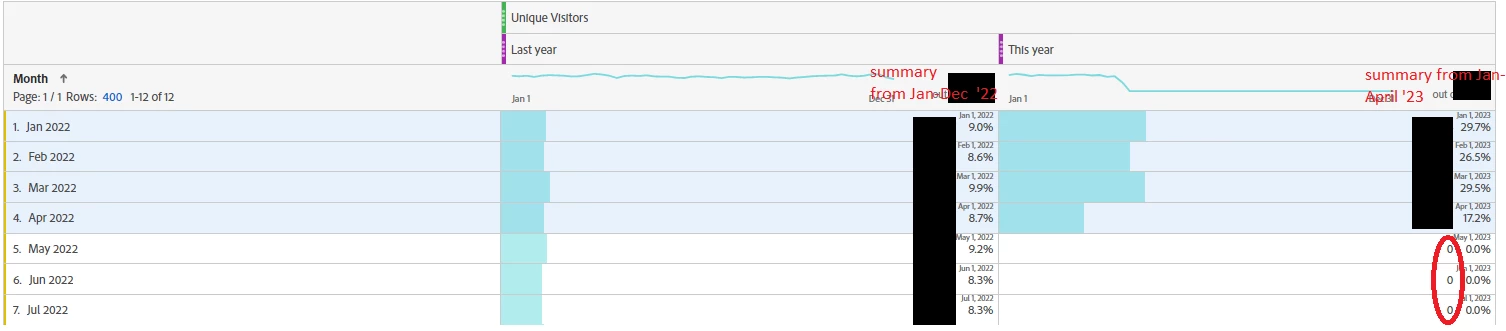
The view that I would like is to only have the numbers from the months last year that can have also occured this year - i.e., to remove the observations of May, June etc - and their contribution to the summary number at the top - until they come to pass. Is there a way to do this?


Thanks in advance 
 

This post is no longer active and is closed to new replies. Need help? Start a new post to ask your question.
Best answer by Jennifer_Dungan

You can use "Custom Date Ranges" for your comparison.


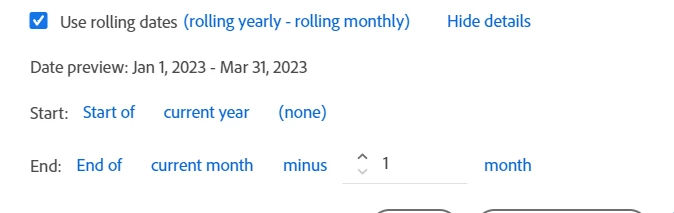
Let's say your Panel Date Range is set to "This Year" (though I would argue using a custom date range here that excludes the current month would be better - so that you aren't comparing a partial month to a full month last year...)


Such a custom range would look like:


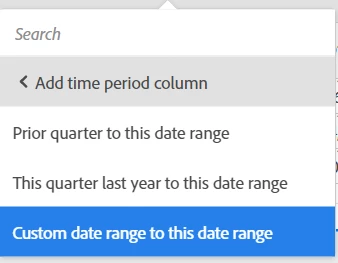
Now, when you right click on your column to "Add time period column", choose "custom date range to this date range"


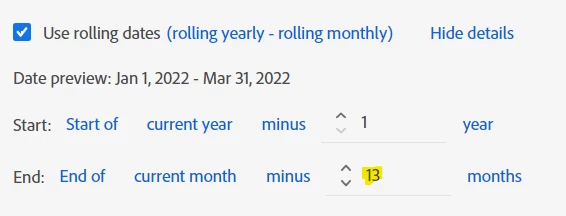
Now, depending on whether you are using "This Year", or the custom "This Year not including this month", you can use:

(If you are using "This Year", then change the highlighted "13" to be "12" so that you include April last year.)

3 replies

Krishna_Musku
Community Advisor
Community Advisor
April 20, 2023

If you add year date range filter to the metric and you are comparing with another year, I don't think there is a possibility to remove the months of which data is not yet available. But you can do that manually.

  1. Select the date range of this year's months as of now (Jan - Apr).
  2. As you already using unique visitors metric, so right click on the metric and select 'add time period column' and select 'These 4 months last year to this date range'

Which will show the table like this:


Hope this helps!

Level 3
April 24, 2023

Thanks for your response Krishna. Though this technically works, I'm wondering does this mean I would need to change the date range each month? 

Jennifer_Dungan
Community Advisor and Adobe Champion
Jennifer_DunganCommunity Advisor and Adobe ChampionAccepted solution
Community Advisor and Adobe Champion
April 20, 2023

You can use "Custom Date Ranges" for your comparison.


Let's say your Panel Date Range is set to "This Year" (though I would argue using a custom date range here that excludes the current month would be better - so that you aren't comparing a partial month to a full month last year...)


Such a custom range would look like:


Now, when you right click on your column to "Add time period column", choose "custom date range to this date range"


Now, depending on whether you are using "This Year", or the custom "This Year not including this month", you can use:

(If you are using "This Year", then change the highlighted "13" to be "12" so that you include April last year.)

Level 3
April 24, 2023

This works perfectly, thank you!