Ah,so basically, if the user does color then size, you will get eVar10="color,size"... but if they do the opposite, size then color, you will get eVar10="size,color"
| |
|
Page Views |
| eVar10 |
|
4 |
| |
color |
1 |
| |
color,size |
1 |
| |
size |
1 |
| |
size,color |
1 |
This is good if the order of operation is important, cause you can see it at a glance... but it does mean a lot more diverse data as these will count against separate rows... and the more filter options you have, the more variations you could end up with.
A list variable is useful because it keeps each item a separate row, so if you have colour > color,size > size > size,color; you will get:
| |
|
Page Views |
| list1 |
|
4 |
| |
color |
3 |
| |
size |
3 |
Both method have merit, just proposing an option you might not have considered.
I have tried in the past to build a segment for a page where an evar was set (and not for a page where an evar persisted from a previous page and therefore sill existed)?
So my segment was a hit container where evarXYZ existed.
However, based on the results, it seems to me that it was showing me all hits where the evar was either set on the page OR all hits where the evar was present because it persisted from a previous page..
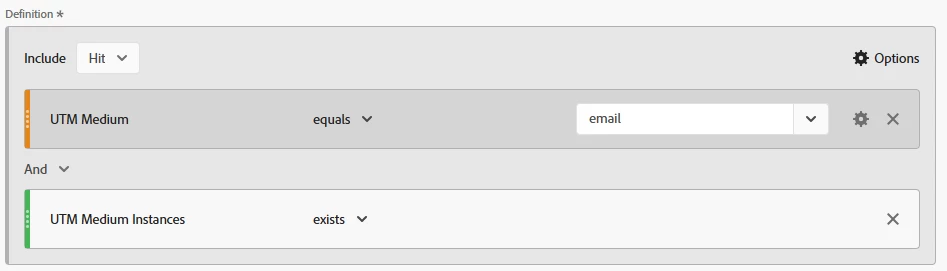
Would using the evar instance metric be a solution to isole hits where an evar was set? (hit container where evarXYZ instances exists)
This is exactly right! There are two ways to do this... you can leverage the Instance Metric directly:
Or, you can use the gear on your eVar to set behaviours:
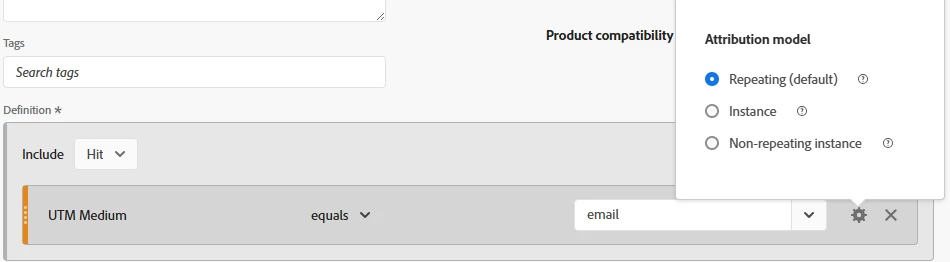
Repeating is the default, this means it will return all the hits where the eVar equals the value (whether explicitly set, or persisted)
Instance will only return the hits where the value was explicitly set (i.e. eVar10="x")
Non-Repeating Instance is interesting, it will return the instances of where the value was set, unless the same value was set in a row, it will exclude the repeats.... for example:
- Page 1 - eVar10="x"
- Page 2 - eVar10="x"
- Page 3 - eVar10 persisted value of "x"
- Page 4 - eVar10="y"
- Page 5 - eVar10="x"
Pages 1 and 5 will be returned, but page 2, despite being an instance, will be ignored because the previous value was also "x" and therefore it repeats. I believe, that if the value is set again after a persisted (i.e. set, persisted, set again to the same value) that this second instance might be ignored... I don't use the too often... I know where I have values set, and where they are persisted, and mostly I just want all or instances...
Hope this helps!