Best Practices for Configuring eVars and Event Rules | Community
Skip to main content
Level 2
September 10, 2025
Question

Best Practices for Configuring eVars and Event Rules

  • September 10, 2025
  • 1 reply
  • 983 views

For a travel ticket booking site, we collect various data points throughout the user journey, including product type, category, customer details (non-PII), and other details at each step (product view, add to cart, details filled, checkout) before a purchase is made. I am considering three different setups for configuring these rules. 
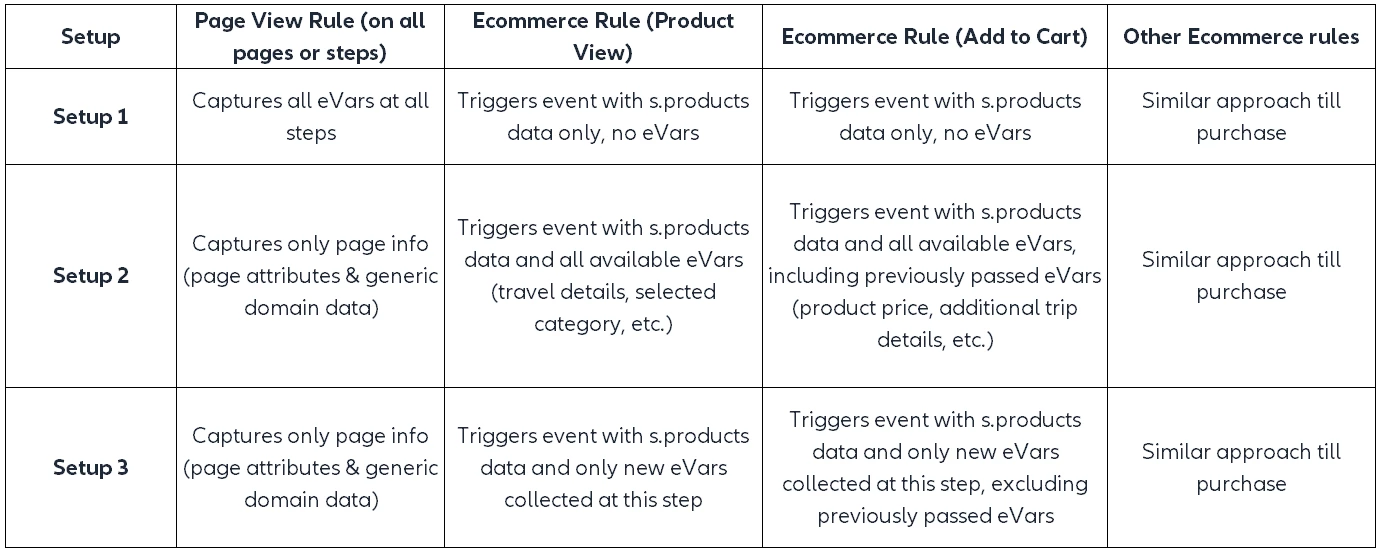
Could you help me understand the differences and recommend the ideal setup? Can we also use props to make the tracking better for any scenario?
Thank you


1 reply

andreiabenites
Level 2
October 3, 2025


Props (traffic variables) are hit-based, not persistent, so they don’t carry forward like eVars. Props are useful when you want pathing analysis. 


With Setup 2 you ensures that each ecommerce milestone (Product View, Add to Cart, Checkout, Purchase) carries all relevant eVars — so even if persistence expires early, you still capture the right attribution.

Setup 1 is not ideal because it bloats every pageview unnecessarily and doesn’t leverage ecommerce rules properly.


Setup 3 is feasible if eVar expiration and persistence are carefully managed to ensure earlier attributes carry through to purchase, but it prioritizes lean payloads at the cost of more complex debugging and reporting.


AnM_SAuthor
Level 2
October 13, 2025

Thank you for your reply.

For Setup 2, if the data is missing at data layer level but we still call the eVar in our hit, wouldn't this result in unspecified data?
Where as in setup 3, due to persistence, we might still have the data