Can we have a Marketo webhook going to another instance? | Community
Skip to main content
Level 1
June 11, 2025
Solved

Can we have a Marketo webhook going to another instance?

  • June 11, 2025
  • 2 replies
  • 480 views

Hoping anyone can offer some insights. I'm trying to create a webhook that will insert an activity log entry on another instance. However I cannot even get the authentication token, the call times out. I'm wondering if the call between instances is possible at all or if I am setting up my webhook wrong. 

I've tried Get, and Post just to try it, but neither works. I can however setup webhooks to salesforce the same way and they work fine. 

Any help is appreciated. 
 

This post is no longer active and is closed to new replies. Need help? Start a new post to ask your question.
Best answer by SanfordWhiteman
Some instances can do this and some can't. It depends on the networks they have in common, and Marketo doesn't guarantee the routing will work.

Either way, this isn't the right way to use the REST API. Even when it apparently "works" you have a race condition where the access token can expire between the identity call and the next call.

Any use of the API should be mediated by an intermediate service. You call the service via a webhook and it connects to the other instance in turn.

2 replies

Michael_Florin-2
Level 10
June 11, 2025

That's certainly possible. One instance sends the webhook, and the REST API of the other instance will consume it. You can even send a webhook within one instance.


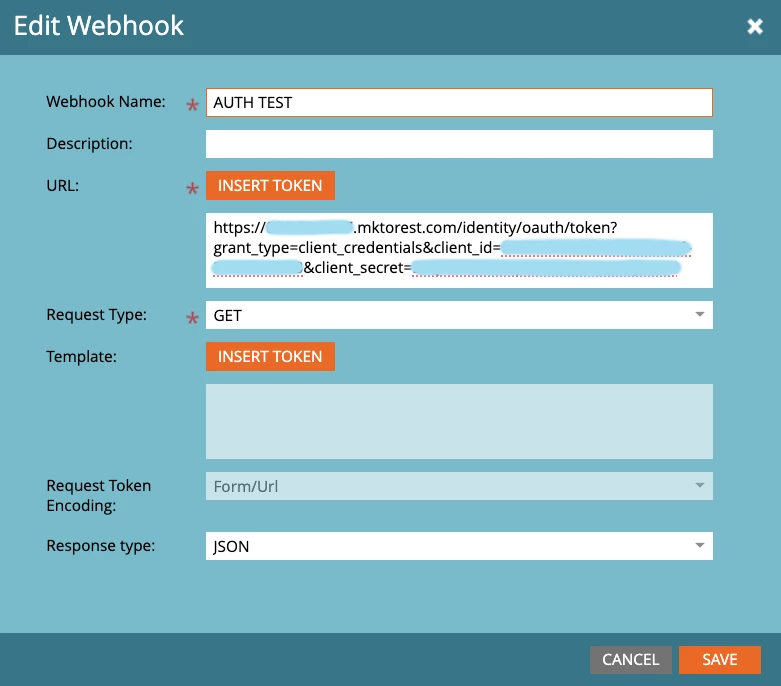
Here's how the webhook looks like:

MUNCHKIN_ID.mktorest.com/identity/oauth/token?grant_type=client_credentials&client_id=abc&client_secret=xyz


An important piece is the response mapping. You need to map the Bearer Token into a Marketo field, and use that field's token for the subsequent call in the header:


SanfordWhiteman
SanfordWhitemanAccepted solution
Level 10
June 11, 2025
Some instances can do this and some can't. It depends on the networks they have in common, and Marketo doesn't guarantee the routing will work.

Either way, this isn't the right way to use the REST API. Even when it apparently "works" you have a race condition where the access token can expire between the identity call and the next call.

Any use of the API should be mediated by an intermediate service. You call the service via a webhook and it connects to the other instance in turn.