Typed/Bookmarked from Reffering Domain not realistic nor accurate! How to solve? | Community
Skip to main content
New Member
August 15, 2023
Solved

Typed/Bookmarked from Reffering Domain not realistic nor accurate! How to solve?

  • August 15, 2023
  • 1 reply
  • 3974 views

Hi, 


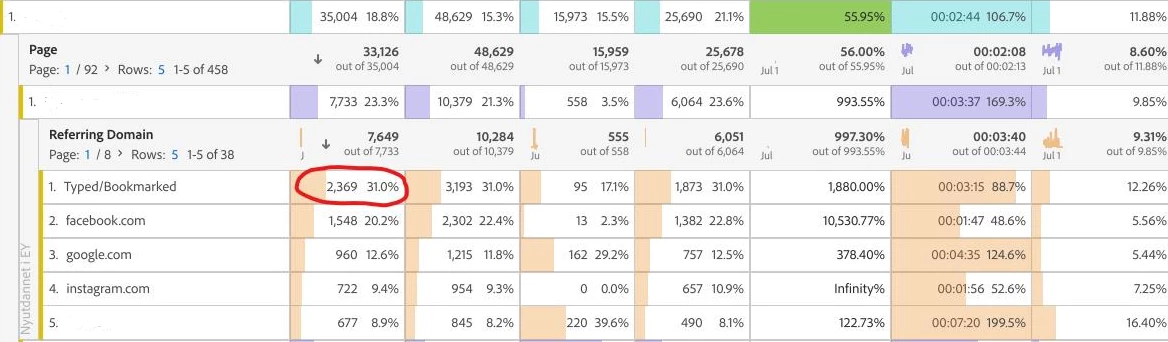
I've been encountering a significant uptick in traffic labeled as "Bookmarked/Typed" within Adobe Analytics, and it's proving to be quite wrong. I'm seeking guidance on how to make sense of this situation. At the moment, the data seems rather unreliable, which is causing challenges in providing accurate reports to stakeholders and effectively addressing crucial internal projects. I'd greatly appreciate your best recommendations. Having been accustomed to the user-friendly and seamless nature of Google Analytics, I now find myself repeatedly investigating issues with Adobe Analytics. Any insights you could provide would be very helpful!


This post is no longer active and is closed to new replies. Need help? Start a new post to ask your question.
Best answer by yuhuisg

"Typed/Bookmarked" is really AA's label for Direct traffic.

The Referring Domain gets its data from the information in document.referrer from the user's browser. Traditionally, the only time when the document.referrer would not be set was when the user typed in the URL directly or opened a bookmark in his browser.

These days, that assumption is invalid. For example, clicking a link from a WhatsApp message will result in the document.referrer not being set too, but that is certainly not via a typed URL nor a browser bookmark. Also, nowadays, server administrators can impose restrictions in their server information such that their URLs never appear in a user's document.referrer.

It could be that you're experiencing an increase in traffic from campaigns, e.g. campaigns that are targeted at users of your mobile apps who are then directed to your website. Try breaking down your "Typed/Bookmarked" row by Tracking Code to see if that yields any clues for you.

You can also try breaking "Typed/Bookmarked" row by Browser, Operating System, and even Country or City to see if there's any pattern that suggests bot-like traffic.

1 reply

yuhuisg
Community Advisor
yuhuisgCommunity AdvisorAccepted solution
Community Advisor
August 15, 2023

"Typed/Bookmarked" is really AA's label for Direct traffic.

The Referring Domain gets its data from the information in document.referrer from the user's browser. Traditionally, the only time when the document.referrer would not be set was when the user typed in the URL directly or opened a bookmark in his browser.

These days, that assumption is invalid. For example, clicking a link from a WhatsApp message will result in the document.referrer not being set too, but that is certainly not via a typed URL nor a browser bookmark. Also, nowadays, server administrators can impose restrictions in their server information such that their URLs never appear in a user's document.referrer.

It could be that you're experiencing an increase in traffic from campaigns, e.g. campaigns that are targeted at users of your mobile apps who are then directed to your website. Try breaking down your "Typed/Bookmarked" row by Tracking Code to see if that yields any clues for you.

You can also try breaking "Typed/Bookmarked" row by Browser, Operating System, and even Country or City to see if there's any pattern that suggests bot-like traffic.

AliaaAuthor
New Member
August 16, 2023

Hi, 


Thank you for your reply.


  1. Could you kindly provide an explanation of what "document.referrer" means, and could you also guide us on how to set it up correctly to prevent situations like these from occurring?

  2. ".. server administrators have the ability to enforce limitations in their server details to ensure that their web addresses never show up in the "document.referrer" of a user." - What is the intended significance of this statement?

  3. When I analyze the "Typed/Bookmarked" category using Tracking Codes, I notice that a significant portion (81.5%) of the traffic falls under the "Unspecified" label. This situation is causing even more confusion.

  4. Yes, I understand. However, the current dataset doesn't provide us with substantial insights. Our primary goal is to gain a comprehensive understanding of the sources of our website traffic and the specific pages that users are visiting.

yuhuisg
Community Advisor
Community Advisor
August 16, 2023

@aliaa wrote:
  1. Could you kindly provide an explanation of what "document.referrer" means, and could you also guide us on how to set it up correctly to prevent situations like these from occurring?


"document.referrer" is automatically set by the browser with the URL of the page that the user was at before the current page.

E.g.

User goes to a 3rd party website that happens to have a link to your website. He clicks that link and ends up at your website's homepage. When the browser loads your website's homepage, it will automatically set "document.referrer" with the URL of that 3rd party website.

Read more about "document.referrer": https://developer.mozilla.org/en-US/docs/Web/API/Document/referrer


@aliaa wrote:
  1. ".. server administrators have the ability to enforce limitations in their server details to ensure that their web addresses never show up in the "document.referrer" of a user." - What is the intended significance of this statement?


This is to inform you that this is another reason why document.referrer might not be set, causing Adobe Analytics to fall back to setting "Typed/Bookmarked" as the referrer.


@aliaa wrote:
  1. When I analyze the "Typed/Bookmarked" category using Tracking Codes, I notice that a significant portion (81.5%) of the traffic falls under the "Unspecified" label. This situation is causing even more confusion.


Well, that just means that we can eliminate campaigns as one possible reason for these "Typed/Bookmarked" traffic. Try breaking down by the other dimensions that I had suggested to see if they might indicate bot traffic.


@aliaa wrote:
  1. Yes, I understand. However, the current dataset doesn't provide us with substantial insights. Our primary goal is to gain a comprehensive understanding of the sources of our website traffic and the specific pages that users are visiting.


Data analysis is difficult. You need to understand a lot of the inner workings of the Internet, web browsers, user behaviour and the analytics tool itself (including how it collects and reports data). Sometimes, the insights aren't immediately obvious, and you need to dig deep into the data using the analytics tool's functions to discover those insights.