
Does Sequential Segment consider only latest event or also consider older events as well? Sequential segment vs Audience with Exclusion criteria | Community
Skip to main content
SahuSa1
Level 3
January 21, 2026
Question

Does Sequential Segment consider only latest event or also consider older events as well? Sequential segment vs Audience with Exclusion criteria

  • January 21, 2026
  • 2 replies
  • 49 views

Hi Adobe community, Greetings!

@_Manoj_Kumar_ @nnakirikanti @dhanesh04s @an1989 @renatoz28 @brekrut @ccg1706 @somen-sarkar @saswataghosh @NickMannion 

I had a doubt regarding a segment. The requirement was to build a segment of – “Investors who bounced from the website i.e., made no hits after the initial page view” preferably in last 90 days. And to verify this we know that Bounce rate is about 56% of the page view traffic.


For this I went through two approaches –

  • Approach A - 
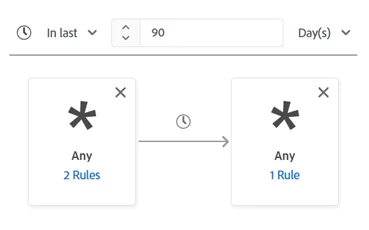
    – Building a sequential audience where the first rule will determine Investors who have had a page view and then did not have any link click value/event. This sequence would happen in Last 90 days.
     

  • Approach B – 
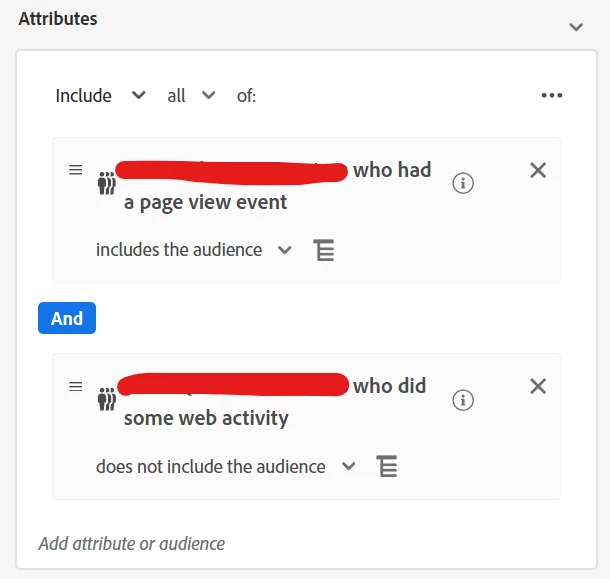
    -  Building two audiences where 1st audience will be Investors who have had a page view event/value in last 90 days.
    -  2nd Audience will be Investors who have had a page view followed by having a link click event/value in last 90 days (Sequential Segment).
    -  3rd   Audience contains above two audiences in the segment builder canvas as rules i.e., Audience 1 is included, and Audience 2 is excluded.


Doubt –

  • For the Approach A I think users who earlier did not had any link click and later do have a link click value would still be considered in the segment as there would be one such event where link click value will be null/zero. Is my understanding correct?
  • For Approach B, I think would be more accurate as it would exclude all such users who have at least one link click value because 2nd Audience of Approach B finds group of users who have alteast a link click value/event. Hence all these users would be excluded from the final audience.


In terms of numbers -

Approach A qualified profiles is exactly 56% of the total users who have had a page view event.

Approach B qualified profiles is 59-60% of the total users who have had a page view event 


I also do not understand how is total bounced users (no link click users + returning users) < total users who have had no link click.


Thanks

2 replies

Level 2
January 21, 2026

@SahuSa1 : I believe Approach A should work, with one additional configuration. In the sequential audience, you can use the time constraint (clock icon) between the two events.
After the first page view, define a session-based time window (for example, 30 minutes, 1 hour, or up to a day—depending on how you define a session). If the link click occurs within that specified time window, the profile will be evaluated accordingly.
By adding this time-bound condition between the events, you can control whether the click is considered part of the same session or journey, which should give you the expected result. I’d recommend trying this setup and validating the output.    


SahuSa1
SahuSa1Author
Level 3
January 21, 2026

Thanks Amruta for replying. 


I wanted to look at users who did not have any link click at all after initial page view. Adding a session-based time window might restrict the number of users. I understand, logically bounce rate is based at session-level rather than user level. Then I guess, Approach A answers questions for bounce rate at session level where a user can have a bounce initially but later might come back and perform a link click which will still make that user part of Approach A audience.


While if I wanted to look at user level, or users who had no link click at all after initial page view, then I guess Approach B looks more aligned in my opinion. Could you also tell me for what reasons do you think Approach A is a better solution than Approach B? 


At this point I am bit confused. According to numbers, Approach B gives higher number than Approach A while I had the thought that Approach A > Approach B as approach A consists of users who have had no link clicks at all + Return visitors who did a link click later at some point.


Thanks

Sukrity_Wadhwa
Community Manager
Community Manager
February 17, 2026

Hi ​@amruta1412,

Could you please help ​@SahuSa1 further with their query?

Thanks!

Sukrity Wadhwa
AmitVishwakarma
Community Advisor
Community Advisor
February 20, 2026

Hi ​@SahuSa1 ,

1. Sequential audiences don’t look only at the latest event. They evaluate the full event history within the lookback window (90 days in your case). So in Approach A, any user who has at least one page view that is not followed by a link click (within your defined session/time window) will qualify – even if they later come back and click on another visit. That’s why Approach A is effectively a session‑level “had a bounce at least once” logic.

2. If you want pure “never clicked at all in last 90 days” at person level, it’s better to avoid sequence and use include/exclude like this:

  • Audience 1 = investors with at least one page view in last 90 days
  • Audience 2 = investors with at least one link click in last 90 days (no sequence needed)
  • Final audience = Audience 1 INCLUDE, Audience 2 EXCLUDE

Your current Approach B uses a sequential “page view -> link click” audience as Audience 2, which only captures a subset of clickers (those who match that exact pattern). That’s why you can see more profiles in Approach B than in Approach A, even though logically you expected the opposite.

So:

  • Approach A = good for bounce at session/journey level (user can later return and still be counted as having bounced once).
  • Approach B (revised as above) = good for user‑level “has never clicked at all in last 90 days”.

Thanks,
Amit