Difference between Web SDK consent 1.0 and 2.0 | Community
Skip to main content
Michael_Soprano
Level 10
February 12, 2026
Solved

Difference between Web SDK consent 1.0 and 2.0

  • February 12, 2026
  • 2 replies
  • 32 views

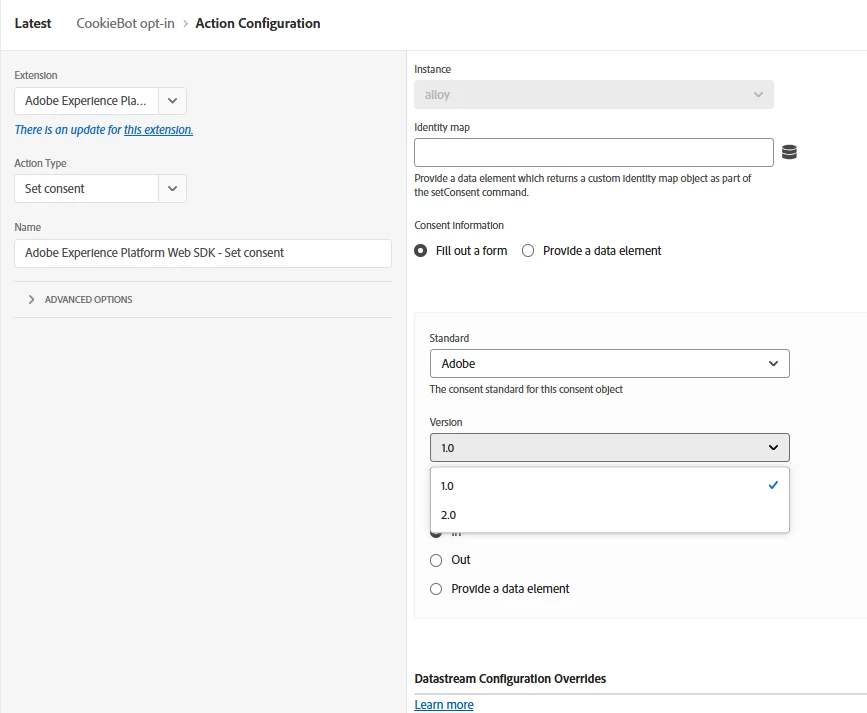
Any ideas what is the difference?


Best answer by bjoern__koth

2.0 is more future oriented since it allows channel-level consent whereas 1.0 just says in/out.

So, 2.0 will likely replace 1.0 at some point.

That being said, 2.0 is currently (and I don't know when and if this going to change) sending “idSpecific” consent data which is different from CRM consent data you onboard directly into the platform through dataset import processes. 
In other words, if you send an email output, this will be tied to your identity namespaces in that very request, like ECID for anonymous users and will not necessarily apply across all other namespaces of the profile. This will (likely) be merged with onboarded CRM-based consent data (based on merge policies).


I think ultimately, the use cases for web based consent are limited, and you will likely anyway control which tags to fire on your website through tag management based on the given consent categories.

But using the XDM Consent and Preferences field group in conjunction with your 2.0 schema is surely the way to go.
 

2 replies

bjoern__koth
Community Advisor and Adobe Champion
bjoern__kothCommunity Advisor and Adobe ChampionAccepted solution
Community Advisor and Adobe Champion
February 13, 2026

2.0 is more future oriented since it allows channel-level consent whereas 1.0 just says in/out.

So, 2.0 will likely replace 1.0 at some point.

That being said, 2.0 is currently (and I don't know when and if this going to change) sending “idSpecific” consent data which is different from CRM consent data you onboard directly into the platform through dataset import processes. 
In other words, if you send an email output, this will be tied to your identity namespaces in that very request, like ECID for anonymous users and will not necessarily apply across all other namespaces of the profile. This will (likely) be merged with onboarded CRM-based consent data (based on merge policies).


I think ultimately, the use cases for web based consent are limited, and you will likely anyway control which tags to fire on your website through tag management based on the given consent categories.

But using the XDM Consent and Preferences field group in conjunction with your 2.0 schema is surely the way to go.
 

Cheers from Switzerland!
Michael_Soprano
Level 10
February 13, 2026

@bjoern__koth So you would send these attributes to RTCP using XDM Individual Profile ( XDM Consent and Preferences) even though for example I know only user ECID?

bjoern__koth
Community Advisor and Adobe Champion
February 13, 2026

That is still a bit of a black box to me. Technically, if you want to onboard CRM consent data, you will need a dedicated dataset with this field group. With the set-consent approach however, you seem to not need it and the set consent request data is stored in a different location (magic...).

At least I have never seen any way to use a dedicated dataset just for online consent handling. So my assumption is that Adobe is handling this implicitly and stores the idSpecific data in a separate location.

You also won't need to populate all channel-specific fields in your 2.0 data object. Collect.val has to be present, metadata with the timestamp, as well as the preferred marketing channel (which I think in most cases you just set to email, since it does not allow undefined or so).

Cheers from Switzerland!
AmitVishwakarma
Community Advisor
Community Advisor
February 20, 2026

Hi ​@Michael_Soprano ,

Conceptual difference

  • Consent 1.0 (Adobe) = one global flag value.general = "in" / "out" -> basically “all Adobe on/off”, no channel‑level detail.
  • Consent 2.0 (Adobe) = XDM‑based object (consents.collect/share/personalize/marketing…) ->supports granular + channel‑level consent (email, push, SMS, etc.) and is the recommended / future‑proof standard. 1.0 is being phased out in favor of 2.0.

About RTCDP + ECID

  • When you use Web SDK setConsent with Adobe 2.0, the SDK ties consent to the ECID (device level) from identityMap and writes it into a Profile-enabled dataset whose schema has “Consent and Preference Details” + identityMap.
  • So yes: you still send the 2.0 consent payload even if you only know the ECID today. Once ECID is stitched to CRM IDs, merge policies handle how that web consent is combined with CRM consent at profile level.

Thanks,
Amit

Amit Vishwakarma - Adobe Commerce Champion 2025 | 16x Adobe certified | 4x Adobe SME