This post is no longer active and is closed to new replies. Need help? Start a new post to ask your question.

6 replies

Level 8
Jul 21, 2017 10:46 PM UTC

Let's say you want to send a tradeshow invite to:

-Anyone who attended the show in the past OR

-Anyone who has the product line that the tradeshow fits

          -is in your CRM

     OR -has a lead score of at least 50

Filter 1: Program Status was changed: TS-2016-Your Tradeshow

               New Status: Attended

Filter 2: Product Line = TradeshowProductLine

Filter 3: CRM Sync = TRUE

Filter 4: Score is at least 50

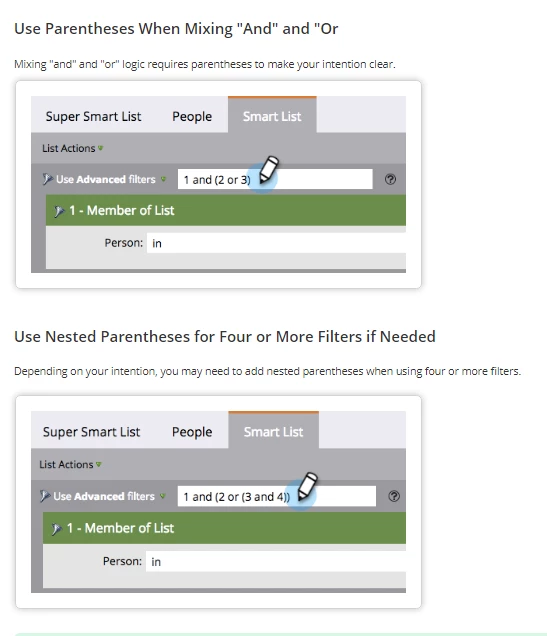
Your filter logic would be 1 or (2 and (3 or 4))

Translate
Jul 26, 2017 4:03 PM UTC

Hi Rachel! 

Thank you so much for your reply!   That makes perfect sense.

Appreciate your help,

Laura

Translate
Grace_Brebner3
Level 10
Jul 24, 2017 9:10 PM UTC

Hey Laura Kimball,

​@Rachel Noble 's example is a really good one. If it helps at all, you can think about it in a more plain english context like follows:

Say you're looking for an audience of customers who live in London, and travel to work either by car, or by the tube and foot. This would be a good example for the logic structure 1 and (2 or (3 and 4)), where:

1 and (2 or (3 and 4)) = London and (car or (tube and foot)).

It can take a bit of practice, and while you're wrapping your head around it I strongly recommend doing some scenario validation tests - map out a few key data scenarios you are likely to encounter, and apply your logic over them to see if they pass or fail as you expect them to - you can either do this by hand or with a test list in the system.

Translate
Jul 26, 2017 4:03 PM UTC

Awesome! Thank you Grace!

Translate