
Requests for consent must be freely given, specific, informed and unambiguous by a statement or by a clear affirmative action | Community
Skip to main content
Dan_Stevens_
Level 10
March 27, 2018
Question

Requests for consent must be freely given, specific, informed and unambiguous by a statement or by a clear affirmative action

  • March 27, 2018
  • 8 replies
  • 12830 views

I recently came across an example where I was registering to download content and the site required me to tick the opt-in checkbox - while submitting the form - in order to download the content: 16 Tips to Capture Marketing Consent for GDPR – CleverTouch .
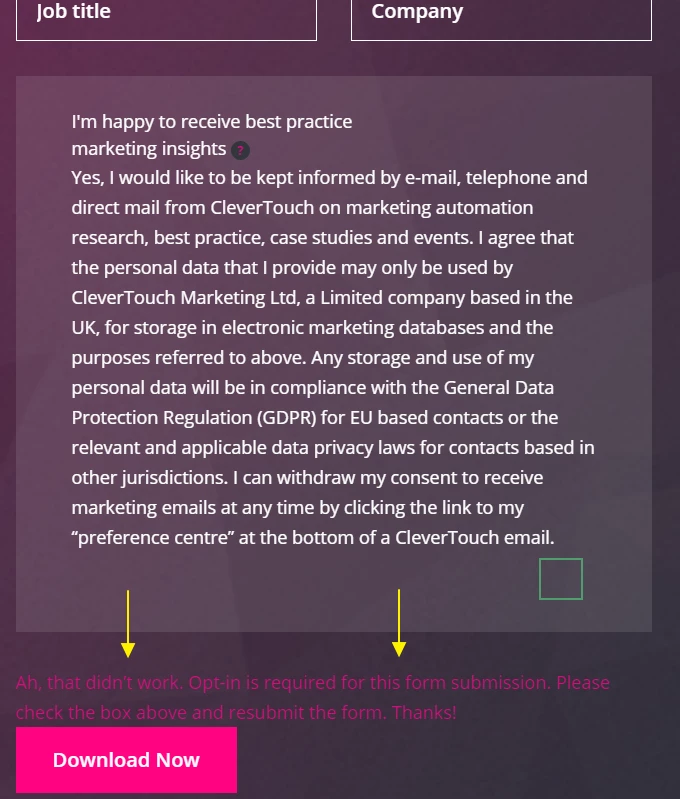
I used their chat feature to inquire about this since much of what we've learned is that you cannot make the ticking of the opt-in checkbox required.  The response I received was as follows:

The GDPR legislation talks about a "balance" in the exchange when it comes to opting-in - we take the view that if we're giving away content for free, there is a balance that you will provide us something in return. If you don't want to provide us that then that's OK - you just won't get the content.  As another example, if this was a paid for event then we wouldn't capture opt-in as well, as that would indicate an imbalance (revenue + an opt-in for 1 event registration).

Again, just wanted to share yet another interpretation/implementation of the GDPR laws.  Thoughts?

@Michelle Miles​

@Grégoire Michel​

This post is no longer active and is closed to new replies. Need help? Start a new post to ask your question.

8 replies

Josh_Hill13
Level 10
March 27, 2018

First, I'm not a lawyer. Best to discuss with legal counsel.

That being said, I would agree with them - if you want to get the content, you must check the box.

For a Contact Us form, or a free trial, perhaps that is less certain - Yes, I want the free trial but no, I don't want extra marketing. Requiring opt in there would likely lead to lower conversion rate.

What CASL and GDPR say is that you cannot "pre-check" the box for them, that is to assume the opt in for the person. You must take a free action that is explicit and deliberate to opt in. Even for events, we were asked that the scanner or tablet be presented to the Lead for opt in checkbox.

keithnyberg
Level 7
March 27, 2018

I can see more companies following this model. I mean there really shouldn't be a reason why we aren't allowed to do this... The person is submitting their information on their own and checking the box on their own. Kinda like a restaurants "right to refuse service to anyone". No info, no free whitepaper. I think it's pretty sweet!

Dan_Stevens_
Level 10
March 27, 2018

Hi Keith - it's not that they're refusing to let someone download the content without filling out the form, it's that they require the user to tick the "opt-in/consent" box.  If you don't, they're blocking you from receiving the content. 

Josh_Hill13
Level 10
March 27, 2018

I just spoke with my team member and they said that you must still offer the asset even w/o opt in checked.

Again, I'd spend some time with legal if you plan to follow such a model.

Nicholas_Manojl
Level 8
March 28, 2018

I guess the question is "can we refuse service to someone who hasn't consented"?

In my opinion, refusing service is the only thing we can do unless someone completely and totally opts-in.

People need to know what they're signing up for - tracked Munchkin, tracked emails, stored data, etc.

If we can't refuse service to people who don't agree to tracked emails and stored data, then we are in a pickle. We can't send one person an email that isn't tracked, and another person an email that is. You're either in or you're not with the Marketo tool the way it is currently built and designed.

SanfordWhiteman
Level 10
March 28, 2018

Sending tracked and untracked links is exactly what we're doing...

Nicholas_Manojl
Level 8
March 28, 2018

per asset, not per person.

Grégoire_Miche2
Level 10
March 28, 2018

Hi Dan,

I think that the approach from Clevertouch is ot GDPR compliant. The article 7.4 of the GDPR writes:

  1. When assessing whether consent is freely given, utmost account shall be taken of whether, inter alia, the performance of a contract, including the provision of a service, is conditional on consent to the processing of personal data that is not necessary for the performance of that contract.

I do not see why a consent is required for the execution of the delivery of the e-book in the Clevertouch case. This is very similar to the discussion on how to interpret the fact that you can send emails to people who are your customers. You can send them emails, but not any email.

Whether or not Clevertouch's approach is really risky ultimately depends on the country your visitors are from and in which EU countries you operate. In Germany I feel the Clevertouch approach is very risky. In France, it's not. To give readers a hint on how strict things can be, a german company was sued (on the previous regulation, not even the GDPR) and fined because the sales people were adding CTAs below their signature in their emails send from their personal mailboxes...

-Greg

Dan_Stevens_
Level 10
March 28, 2018

Thanks Greg. This is aligned to our guidance as well. In fact, I would argue that obtaining the data captured on the form is adequate value received - without the need to also require opt-in consent.

Amy_Goldfine
Level 9
March 28, 2018

For GDPR we are doing two separate checkboxes (neither is pre-checked). One is for content to processing, and that is required. The other is consent to direct marketing, and that is optional.

Amy GoldfineMarketo Champion & Adobe Community Advisor
Grégoire_Miche2
Level 10
March 28, 2018

Hi Amy,

In all strictness, this double consent is what should be done. Most companies are merging the 2 in order to simplify the forms. Which leads to a conclusion: if the person does not consent to be kept in the database, you should delete it or anonymize her immediately. So, if you only use 1 consent box and the person does not consent, you should not only stop sending emails, but also delete the lead or anonymise it. This anonymization issue is one that is listed here: Marketo GDPR Compliance-a summary of key ideas

I am dreaming of a form with a double consent that, when someone does not consent to be stored in the database and submits the form, displays the following follow-up message:

"We are sorry, but we cannot process and send you the link to the requested content since it would require that we store your data in our database, to which just did not consent"

-Greg

Jason_Hamilton1
Level 6
March 29, 2018

It sounds to me more like merging of the interpretation of Legitimate interest and consent.  This damn regulation has so much gray.  I do not think you can force someone to be required check a box, to get the content.

Liz_Davalos
Level 4
March 29, 2018

Not to add fuel to the fire, but a person is still being tracked in Marketo even if you don't include a token on a link and therefore that would violate GDPR unless I'm misunderstanding what people are talking about here. While I personally agree that we shouldn't have to provide free content without receiving the data it does seem that GDPR requires this. I'd say they may be crossing other legal lines there though and they may have to amend that (maybe what that company is banking on). The whole way a free market functions is you get something for your work, requiring it be given away freely breaks that so I can see some lawyer finding a leg to stand on. We're about 99.9% US so for me receiving our emails and being tracked go hand in hand, I can't give one option without the other. They can choose to subscribe all they want, but if they don't also consent to tracking they won't get emails. They simply cannot be a subscriber and not be tracked. We're making that clear for EU residents...

SanfordWhiteman
Level 10
March 29, 2018

but a person is still being tracked in Marketo even if you don't include a token on a link

What do you mean by "tracked" here?

Clicking an untracked link sent in a Marketo email, opened in a browser that has Munchkin disabled, doesn't leave any extra tracks.

Liz_Davalos
Level 4
March 29, 2018

I mean that Marketo still tracks opens and the email still exists in Marketo so technically (although barely) they are being tracked and you are still retaining their "personal" data.

Michelle_Miles3
Level 5
April 3, 2018

@Dan Stevens​ Our counsel has said that you can't bundle or "buy" consent with content. I would not recommend an approach like the one described above.

Michelle Miles
Grégoire_Miche2
Level 10
April 3, 2018

Hi Michelle,

Yes, this was the meaning of my comment above and all the lawyers tend to agreed on this one (at least we have one question on which they all agree )

-Greg

Dan_Stevens_
Level 10
April 4, 2018

@Randy Davis​ offers yet another perspective in this thread (halfway down, dated April 4): Marketing Strategies to Thrive in a GDPR World