


Beyond Opens & Clicks: Rethinking Email Engagement in the Age of Bots
Opens and clicks have long been considered the gold standard for measuring email performance, thanks to their simplicity and broad accessibility. But in recent years, the gap between these metrics and real human behavior has grown rapidly. Today, relying on basic metrics like opens and clicks can be misleading. Why? Because they track technical signals, not real human behavior.
Why Email Metrics Often Don’t Reflect Real Human Behavior
Here’s the reality: Opens are recorded when a tracking pixel loads, and clicks register when a link is requested. Neither proves that someone actually read your email, paid attention, or intended to engage. Factor in modern email bots, security scanners, and privacy tools, and what looks like an “engaged” audience can be a mix of real humans and automated systems.
As marketers, it’s crucial to grasp not just how this skews standard email engagement metrics, but also the ripple effects it can have on revenue and the sales funnel:
-
Compromised A/B Test Results:
-
When your open rates are inflated, A/B tests can end up pointing you in the wrong direction—making certain subject lines or content seem like they’re resonating when they’re not
-
-
Inflated Lead Qualification:
-
If your lead scoring model gives a lot of weight to clicks, you might end up giving too much credit to non-human activity — and prioritizing the wrong prospects because of it.
-
-
Misleading Success Metrics:
-
Campaign performance reporting can make it look like things are working—even when there’s little real impact on the business.
-
In the meantime, real human behavior is happening outside the email itself: prospects are visiting your website directly and completing a form later, or they are interacting with content across multiple channels. By relying solely on opens and clicks, marketers risk missing the signals that truly drive conversions, pipeline progression, and revenue.
The solution? Marketers need to shift from measuring activity to measuring outcomes and behaviors that correlate with business impact. When email metrics are tied to actual engagement in your funnel—like form completions, demo requests, or revenue-influencing actions—they become far more meaningful for optimizing campaigns and proving ROI.
Engagement Metrics That Actually Drive Revenue
So if opens and clicks only tell part of the story, what should marketers actually be tracking to understand real human engagement—and how it’s impacting the funnel? Focus on metrics that reflect behavior and outcomes, not just email activity.
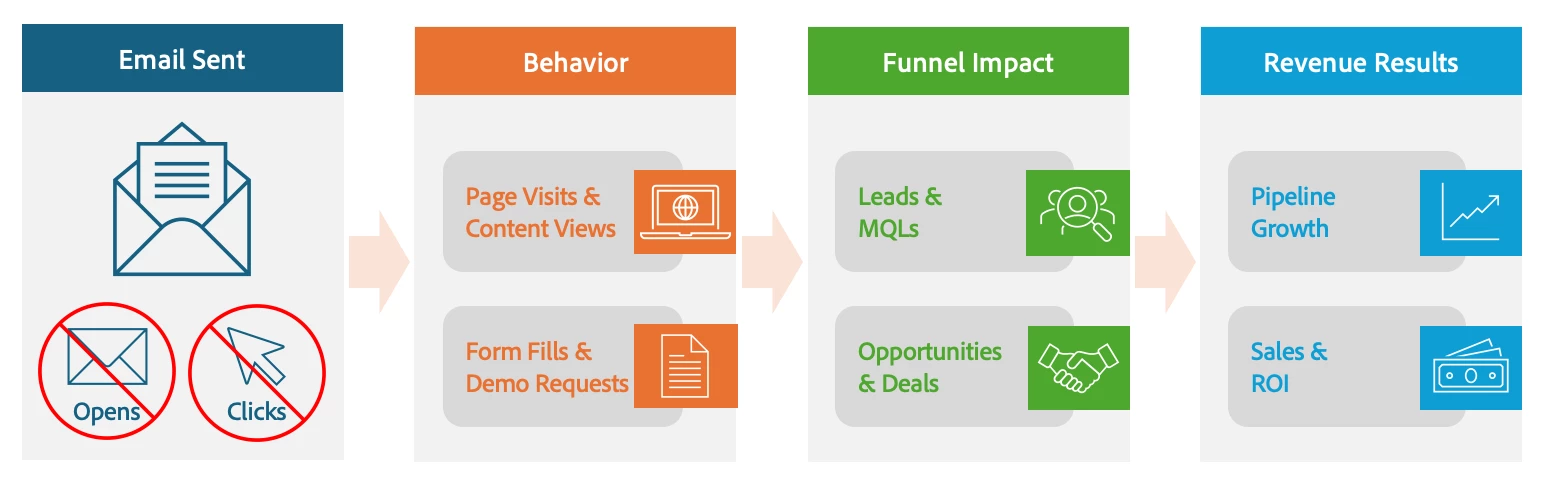
Here are some recommendations to get you started:
1. Look at Downstream Behavior
- Track actions that occur after the email: website visits, content downloads, or video views. These actions signal genuine interest and often correlate directly with lead qualification or funnel progression.
2. Look at Conversion Events
-
Measure form submissions, demo requests, free trials, or purchases that are influenced by email campaigns. These are the touchpoints that generate pipeline and revenue, not just “activity” inside an inbox.
3. Engagement Quality Over Quantity
-
Look at repeat interactions over time—like multiple page views, returning visits, or interacting with premium content—rather than one-off opens or clicks. Depth of engagement indicates high-intent prospects.
4. Take Care of Your Data
-
Track unsubscribe trends, spam complaints, and deliverability. Healthy, responsive lists amplify ROI, while inflated metrics from bots can mask list fatigue or deliverability issues.
Rethinking How We Measure Marketing
The future of email measurement isn’t about chasing opens or clicks—it’s about understanding how emails influence real human decisions and revenue impact. By aligning metrics with downstream behavior and funnel progression, marketers can optimize campaigns for actual business results rather than inflated signals.
Alternately, if your organization is ready to move beyond just measuring engagement to measuring real impact, it might be time to look at a marketing attribution tool (like Marketo Measure). Why? Because attribution reporting helps you connect marketing activity directly to pipeline and revenue in a clear, defensible way. It shows how marketing is actually contributing to revenue—so you can prove impact and make smarter investment decisions.
What engagement data are you measuring right now? Is it actually helping you run smarter campaigns? Let’s talk about it in the comments.