


Composable and Decoupled Architectural Design to Build Real-Time High-Value Transactional Email Pipeline with Adobe Journey Optimizer (AJO)
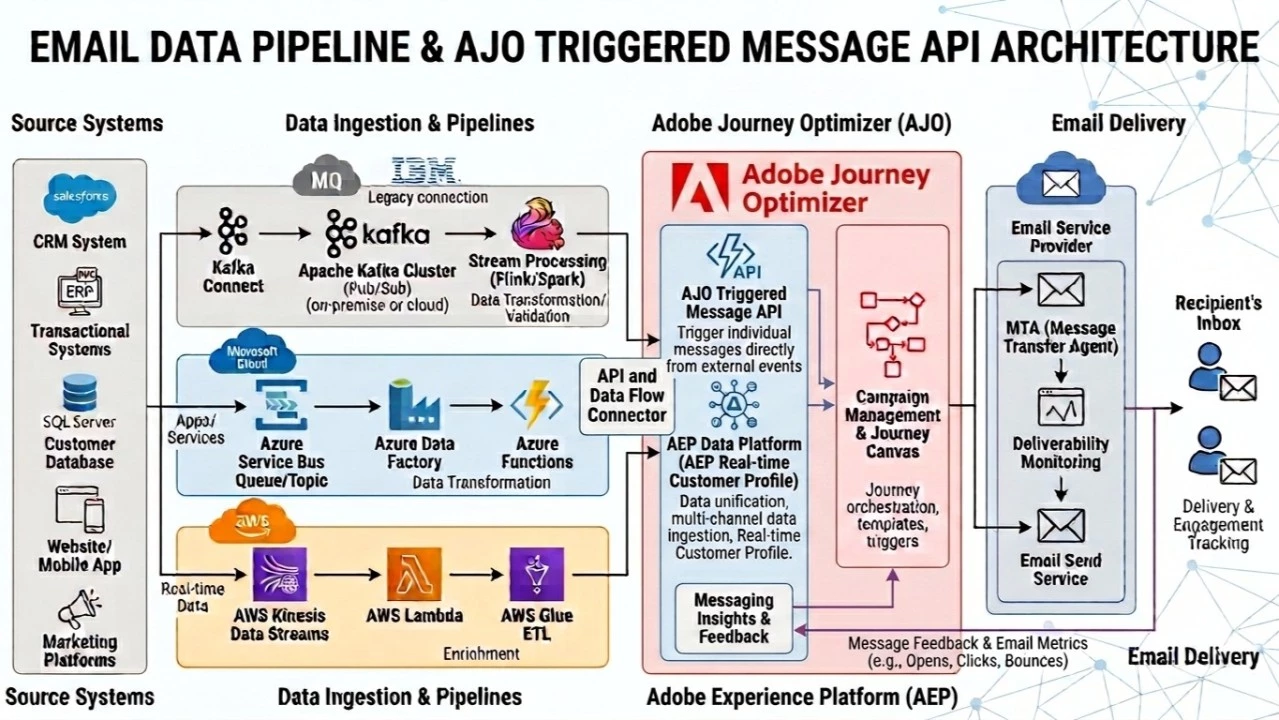
1. High-Level
The architecture is a state-of-the-art, event-driven ecosystem designed for an "Always-On" digital business model. It separates operational concerns by funneling distinct data types through purpose-built, highly available pipelines, converging them within the Adobe Journey Optimizer (AJO) for real-time communication, which orchestrates instant, reliable delivery via a scalable Email Delivery Network. The entire design is structured to prioritize the seamless, instantaneous transmission of high-value transactional communications.
2. Design Philosophy for "Zero Disruption"
A "Zero Disruption" guarantee cannot rely on a single system's uptime. It must be designed as a System of Systems with fundamental principles of resilience.
Core Resilience Pillars of this Design:
- Loose Coupling via Async Messaging: By using Kafka / Azure Service Bus / AWS Kinesis, we decouple the core CRM/ERP transactional databases from the marketing delivery network. Even if the entire Adobe suite is offline for maintenance, the Kafka/Azure/AWS queues will continue to collect transactional events from source systems, preventing any loss of "high-value" data.
- Infrastructure Diversity (Multi-Cloud): The design intentionally uses an any cloud approach (Azure or AWS or GCP). Critical transactional flows can be primary/secondary or load-balanced across regions or even cloud providers, mitigating a complete cloud availability zone (AZ) or cloud region failure.
- Real-Time Data Priority (Segmentation): The architecture separates data into two lanes:
- Persistent Queue Buffering: The transactional messaging lane must be designed to queue events at every hop. If the AJO API is slow, the upstream pipelines (like Kinesis/Azure Bus/Kafka) will buffer the demand.
- Multi-Level Monitoring & Alerting (Deliverability Monitoring): Feedback loops are native to the architecture, monitoring delivery status, MTA health, and engagement (Opens, Clicks, Bounces) in real-time.
3. Verbose Component Breakdown & Design Considerations
Section A: Source Systems (The Producers)
This section represents the origin of all transactional and customer behavioral data. These systems generate high-valued events that must reach the consumer.
- CRM System (Salesforce): Manages the primary account relationship and generates transactional events like contact updates or new account creation.
- Transactional Systems (POS, ERP): The most critical systems for this discussion (e.g., Inventory, Payment). These generate events such as Order Confirmed, Payment Received, Inventory Low (a high-value notification for logistics). These must have transactional guarantees into the subsequent messaging queue.
- Customer Database (SQL Server): The underlying durable store for profile attributes.
- Website/Mobile App: A source of behavioral events (e.g., Password Reset Requested)—high-value security and commerce events.
- Marketing Platforms: Legacy or side-by-side systems providing enrichment data.
Section B: Data Ingestion & Pipelines (The Transport & Buffer)
This is the most crucial layer for decoupling and buffering critical transactional messages. It ensures that if downstream systems are down, transactional data is durable.
Section C: Adobe Journey Optimizer (The brain)
The AJOis a centralized hub that makes sense of the fragmented data streams.
- AJO Triggered Message API:
Section D: Email Delivery (The last mile)
This is the scalable engine that guarantees deliverability and provides monitoring feedback.
- Email Service Provider (ESP) / MTA:
- Deliverability Monitoring & Tracking:
4. Summary of Traffic Flow (High-Value Transactional Scenario)
Scenario: A consumer places an order on the Mobile App, generating a critical Order Confirmation event.
- Mobile App: Secures the transactional data and publishes the event to the durable AWS Kinesis Data Stream.
- AWS Kinesis: Buffers the message. A serverless AWS Lambda function pulls the message, validates its schema, enriches it with the current warehouse status (retrieved via an API), and transforms it into the Adobe schema.
- AWS Lambda: Posts the enriched, transactional payload directly to the AJO Triggered Message API.
- AJO Triggered Message API: Acknowledges receipt instantly to AWS Lambda (completing the Kinesis shard checkpoint), ensures the message is queued within the internal AJO infrastructure, and notifies Campaign Management.
- Campaign Management: Instantly matches the event to the Order Confirmation Campaign, pulls necessary template personalization (customer name, order details), and sends the final formatted email payload to the MTA layer.
- MTA Layer: Delivers the email using the prioritized Transactional IP Pool.
- Email Send Service: Successfully delivers the message and writes a Delivered event to the Messaging Feedback loop.
- Messaging Insights: Writes the Delivered event to the consumer’s Unified Profile in the AEP Data Platform.
Designing composable, event-driven architectures that bridge cloud infrastructure with modern MarTech ecosystems is where the future of customer engagement lies.
If you’re exploring similar architectural modernization or want to exchange ideas on scaling real-time message triggers, feel free to connect or reach out! 💬