
Michael_Soprano
Level 10
May 13, 2026
Question

Relation schemas - many to one

  • May 13, 2026
  • 2 replies
  • 22 views

What conditions need to be met in order to set up one to many relationship?

It has to be experience event schema? 
 

2 replies

awalker827
Level 2
May 13, 2026

Were you able to figure this out? 

Level 3
May 13, 2026

Hi ​@Michael_Soprano ,


In AEP Schema Registry, the relationship type options available to you depend entirely on the class of the schemas involved.


For a many-to-one relationship the source schema must be an ExperienceEvent schema. This is the key condition you asked about. ExperienceEvent schemas represent individual behavioral events tied to a profile over time, and because multiple events can reference the same profile record, the relationship from ExperienceEvent to an Individual Profile schema is inherently many-to-one. AEP enforces this at the data model level which is why the UI restricts your options based on schema class.


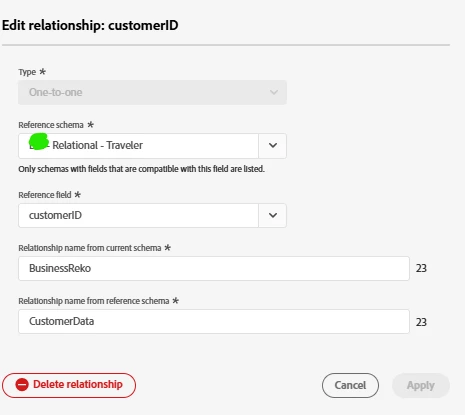
Looking at your screenshot you currently have a one-to-one relationship configured between what appears to be two Relational schemas. If you want a many-to-one relationship you would need your source schema to be an ExperienceEvent class schema referencing a destination schema of Individual Profile class. The reference field on the destination side needs to be the primary identity field of that Profile schema.


The practical setup is an ExperienceEvent schema that captures transactional or behavioral data with a field like customerID that maps to the primary identity of your Individual Profile schema. AEP then understands that many event records can point to one profile record, which is what enables stitching and journey analysis across the platform.


If your use case genuinely requires a many-to-one between two non-ExperienceEvent schemas, that relationship type is not natively supported in the Schema Registry UI today. The workaround teams use in that scenario is to model the relationship through the Profile union schema rather than a direct schema relationship.