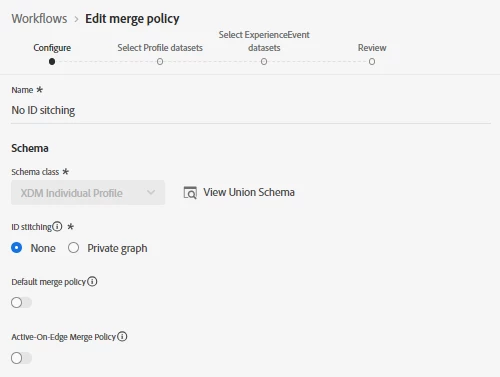
Hi @michael_soprano - As @kumar29917170hcyp pointed out, selecting this option ensures that IDs will not be combined. This means that if segmentation occurs, the system will not attempt to merge identities potentially belonging to the same individual. Instead, segmentation will evaluate the attributes associated with each unique ID to decide whether a customer fits into a particular audience group. Consequently, it is possible for a single customer to be represented by multiple profiles, each qualifying for different audience segments. This could lead to the same customer receiving several marketing messages tailored to these diverse segments.
One practical application of creating a merge policy that excludes ID stitching involves situations where you need to delete data associated with a specific identity. Consider having two schemas: one with the primary ID as CRM ID, and the other with ECID as the primary ID and CRM ID as the secondary ID. Under normal circumstances, using stitching would combine data from both sources.
However, if you later decide to remove data ingested under the first schema, which uses CRM ID as its primary identifier, you can establish a merge policy that does not incorporate stitching. By providing the CRM ID and the merge policy ID to the deletion API, you can ensure that only the data from the first dataset is eliminated.
Thanks,
Arpan