


AEP Data Explorer: A Practitioner Built Desktop Workspace for Adobe Experience Platform
Adobe Experience Platform provides the foundational capabilities for collecting, unifying, activating, and analyzing customer experience data. But practitioners involved in implementation, production support, QA, migrations, and ongoing enhancements often need to move quickly between Query Service, dataset previews, Real-Time Customer Profile lookup, audience validation, and ingestion workflows.
That day-to-day investigation can become difficult when business stakeholder question that requires more than a sample preview or a high-level UI view. Often, it is required to inspect a specific profile with hundreds of its attributes and events, extract and deep dive into a specific dataset, not just a preview and investigate all the profiles included in an audience, a capability not available in current AEP UI. In many cases, the question is not simply whether data exists, but whether the right data exists in the right place and can be validated efficiently.
I faced these same challenges while working with AEP data and wanted a more direct way to explore, validate, and understand data across the platform. That led me to build AEP Data Explorer, an open-source desktop application built on AEP APIs and designed to help practitioners work more efficiently with Adobe Experience Platform data.
The application and source code are available on GitHub for anyone who wants to use it, review the code, or contribute. Download and install the app
Why AEP Data Explorer
AEP Data Explorer is not intended to replace the Adobe Experience Platform UI, Query Service, or APIs. Those remain the core platform capabilities. The goal of this app is to sit alongside them as a focused practitioner workspace for the data investigation and validation work that often happens around AEP implementations.
During real projects, teams often need to answer questions such as:
- Did the expected records land in the correct dataset?
- What does the exported data contain beyond the sample preview?
- Is a specific profile showing the right identities, attributes, and events?
- Which profiles qualified for an audience?
(In AEP UI, currently it is possible to only check list of audiences a profile qualified, but not all profiles qualified in an audience) - Can I analyze exported data locally without recreating the same query repeatedly?
- Can I upload a prepared CSV or parquet file into AEP for testing, correction, or backfill?
- Automate native AEP activities by running sequence of tasks as a workflow, such as ingest data, run queries in sequence and export to external cloud storage
These are common questions for AEP developers, data analysts, data engineers, solution architects, implementation consultants, QA teams, and business analysts. AEP Data Explorer is designed to make these tasks easier to perform, easier to repeat, and easier to connect.
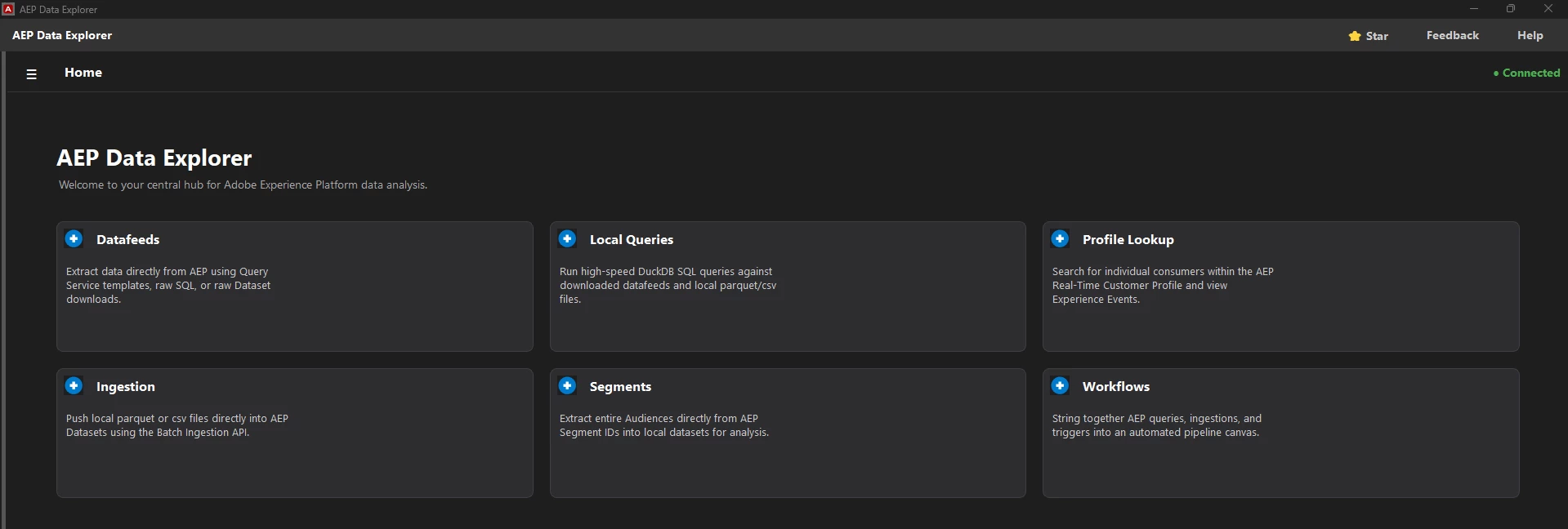
Key Capabilities
Datafeeds
The Datafeeds module allows practitioners to extract data from Adobe Experience Platform using Query Service templates, raw SQL, or direct dataset downloads.
This is useful when validating onboarded data, reviewing dataset contents, creating analysis extracts, or pulling specific records for deeper investigation outside the platform UI.
Local Queries
AEP Data Explorer includes local querying powered by DuckDB. Practitioners can run SQL directly against downloaded datafeeds, CSV files, and parquet files.
This is helpful for iterative analysis. Instead of sending every follow-up question back through Query Service, users can query local exports, join files, compare results, and refine their analysis faster.
Profile Lookup
The Profile Lookup feature helps users search for individual consumers in Real-Time Customer Profile, store profile, compare and review profile attributes and Experience Events.
This is valuable to compare 2 different profiles or profile update over time, along with further QA and troubleshooting, especially when the investigation is tied to a specific profile. For example, you may need to confirm whether an identity stitched correctly, whether an event was received, or whether a profile has the expected attributes before audience qualification.
Segments
The Segments module the most important capability is to find all the profiles qualified in a single audience segment (looked up through profile snapshot or segment export dataset) and allowing users to extract audience membership from AEP segment IDs into local datasets.
This helps teams validate audience logic, review audience composition, compare expected and actual membership, and investigate why specific profiles did or did not qualify for a segment.
Ingestion
The Ingestion module supports uploading local CSV or parquet files into AEP datasets through the Batch Ingestion API.
This can be useful for business users or developers to do controlled uploads, backfills, data corrections, or moving prepared files into Adobe Experience Platform without creating a separate script for each scenario.
Workflows
The Workflows area is designed to connect queries, ingestions, and triggers into repeatable processes.
I had a use case to allow business users to ingest a compiled file and immediately trigger multiple query service execution in sequence and do a dataset export to cloud storage and even trigger an API on AWS to trigger downstream activation. This was not a one-time tasks, hence a saved workflow allows to run the same steps in automated orchestration manner helping practitioners turn those recurring steps into reusable processes.
Try the application and share your feedback, let me know if you need any further features to be updated or introduced to make the application more practitioner friendly.
Download & Install the App: https://github.com/devyendarm/AEP-Data-Explorer/releases/tag/v1.4.0
AEP Data Explorer Github Repo: https://github.com/devyendarm/AEP-Data-Explorer