


Migrating Sites to Classic (Non-EDS) AEM with AI: Adobe Experience Modernization Agent
Migrating Sites to Classic (Non-EDS) AEM with AI: Adobe Experience Modernization Agent
Introduction
Website migrations to Adobe Experience Manager (AEM) can require considerable manual effort, particularly in large enterprises that regularly onboard new brands, markets, and websites into an established AEM platform.
Adobe's Experience Modernization Agent introduces new opportunities to automate this process. However, its primary focus is Edge Delivery Services (EDS) and the creation of new blocks, rather than the reuse of components within an existing classic AEM implementation.
We wanted to explore whether the same AI capabilities could be leveraged by organizations that are not using EDS and already have an established AEM platform.
In this article, we share the results of our proof of concept, explain how we adapted Adobe's Experience Modernization Agent to migrate content to classic AEM, and explore how a dedicated AI-assisted migration tool could further simplify the process.
Key Points
The Challenge of Onboarding Websites to an Existing AEM Platform
Enterprise migrations are often about consolidating content into a shared platform rather than replicating the original website's design and functionality. The challenge is determining how heterogeneous source content fits into the target platform's existing component library.
Leveraging Adobe's Experience Modernization Agent Beyond EDS
Although the agent is primarily designed for EDS, its ability to interpret website content is not dependent on the target frontend architecture. We explored whether this capability could be applied to traditional AEM Sites implementations.
Providing the AI Agent with AEM Platform Context
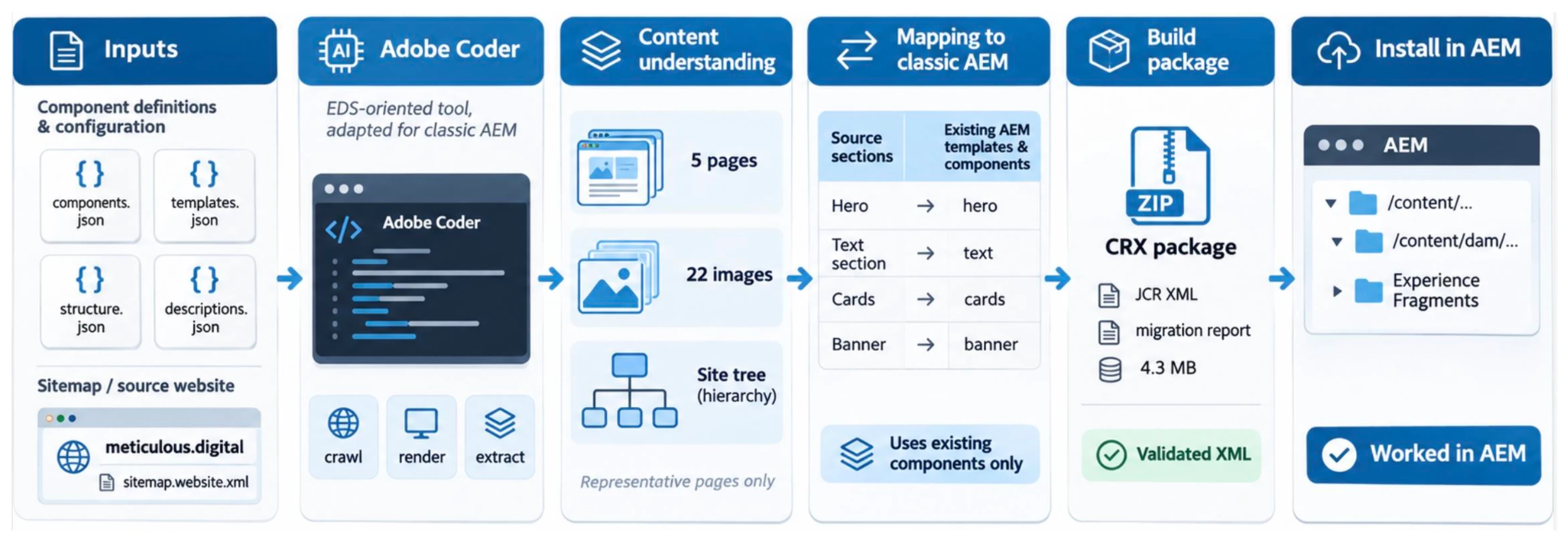
For AI to make meaningful content mapping decisions, it needs to understand the target platform. Using GitHub Copilot, we generated four JSON files from our existing AEM codebase describing component definitions, their intended usage, templates, and repository conventions.
Migrating a Non-AEM Website to Classic AEM
We selected ten pages from our own website to evaluate the feasibility of the approach. Instead of requesting an EDS implementation, we asked the agent to produce content compatible with our existing AEM application.
Generating and Downloading an AEM Content Package
One particularly interesting result was how the agent overcame the absence of a dedicated package download feature. It independently used its preview functionality to make the generated ZIP archive accessible, which we could subsequently install through AEM Package Manager.
The POC Migration Results
The experiment resulted in working AEM pages, including migrated assets, Experience Fragments, updated references, and a report identifying content that could not be mapped. No additional application code or components were required.
Limitations and Production Readiness
The approach demonstrates technical feasibility, but it is not an officially supported classic AEM migration workflow. Larger migrations would benefit from stronger validation, repeatability, editorial oversight, and safeguards against unintended repository changes.
Building a Custom AI-Assisted Migration Tool
We also developed an initial custom POC in two days. The proposed approach separates AI-driven content interpretation from deterministic processing and introduces editorial approval before importing content into AEM.
The Broader Lesson for AI-Ready AEM Architectures
As AI becomes more involved in content operations, investing in reusable components, consistent content models, and machine-readable platform definitions becomes increasingly important. AI can help enterprises extract additional value from their existing AEM investments rather than continuously building new implementations.
Full Article
Read the full article on https://meticulous.digital/blog/migrating-sites-to-classic-non-eds-aem-with-adobe-experience-modernization-agent/ to find out more.
Q&A
Please use this thread to ask questions relating to this article or share your experiences with AI-assisted website migrations in AEM.