


Headless using AEM Sites, not only Content Fragments
Headless using AEM Sites, not only Content Fragments
Introduction
Headless delivery in AEM is often associated with flexibility, performance, and modern frontend architectures. For developers, this usually sounds like a clear step forward. However, in many enterprise projects, headless has also introduced a major tradeoff: marketers and content authors lose access to many of the AEM Sites features and the familiar WYSIWYG editing experience they rely on every day.
This is why "headless AEM" is still too often reduced to "Content Fragments exposed through GraphQL APIs". Content Fragments are powerful and absolutely have their place, but they are not the only way to build headless experiences with AEM. At least not anymore.
With AEM as a Cloud Service, AEM Sites, and the Universal Editor, we can now take a more balanced approach: keep enterprise-grade content management and visual authoring in AEM Sites, while delivering experiences through a modern headless frontend architecture.
Key Points
Why Headless AEM Should Not Mean Content Fragments Only
Headless AEM is often associated with Content Fragments and GraphQL APIs, but this is only one possible model. Content Fragments are powerful for structured, reusable content, but they should not be treated as the default answer for every headless requirement.
The Historical Tradeoff of Headless AEM
Traditional headless implementations often improved frontend flexibility but weakened the authoring experience. Authors could lose access to visual editing, page context, workflows, translations, MSM, governance, and other AEM Sites capabilities they rely on in daily content operations.
Full Page Experiences Need More Than Structured Fields
Enterprise websites often require layout decisions, component ordering, market-specific overrides, inherited content, translations, approvals, personalization, tracking, and visual context. When all of this is forced into a pure Content Fragment model, complexity often moves into the frontend or custom orchestration logic.
Why AEM Sites Still Matters in Headless Architectures
For clients already using AEM, Sites is usually more than a page editor. It is the enterprise content management layer where authors manage pages, governance, approvals, translations, MSM structures, permissions, workflows, and operational processes.
Reusing Existing AEM Investments
Many enterprise clients already have established AEM Sites implementations, trained authors, localization processes, workflows, and governance models. A headless strategy that ignores this maturity can create unnecessary migration cost, operational risk, and change management overhead.
Universal Editor Changes the Conversation
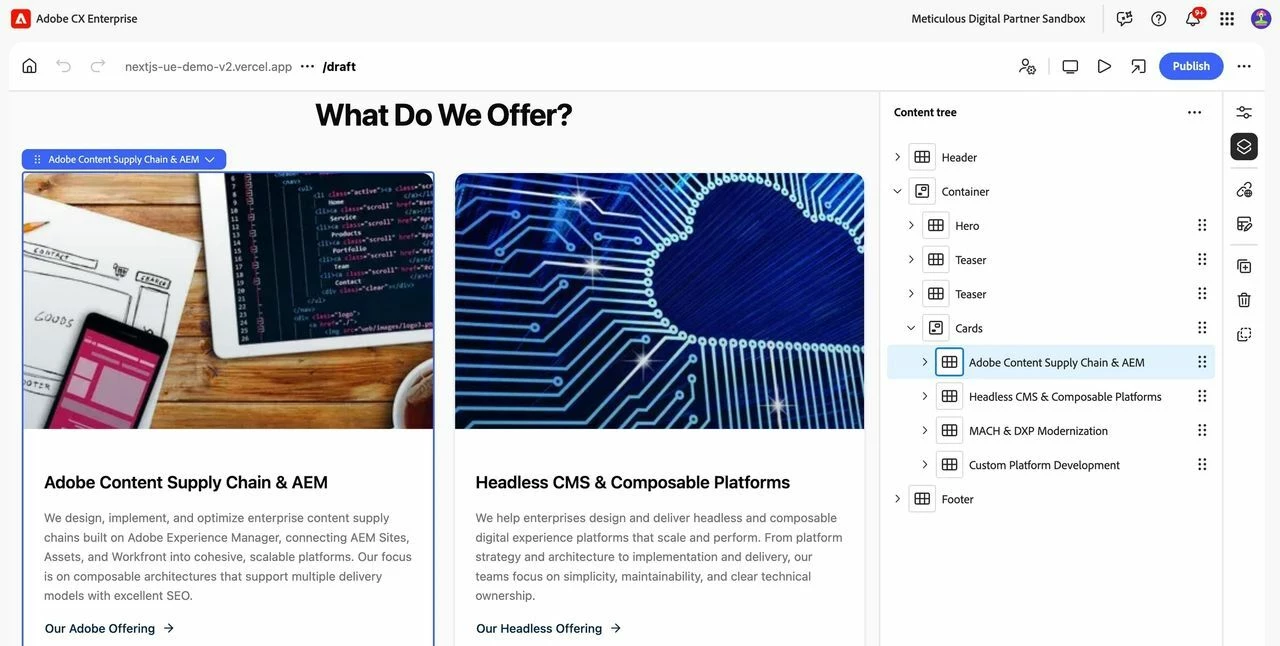
Universal Editor makes it possible to combine modern frontend delivery with visual, in-context authoring. Authors can interact with content closer to the final experience, while developers keep the freedom to build with modern frontend technologies.
Universal Editor Is Becoming More Enterprise-Ready
Support for MSM, richer component definitions, multifields, and nested component structures makes Universal Editor more practical for real enterprise AEM Sites implementations. This is important because enterprise components are rarely simple and often require repeated items, CTAs, tracking metadata, and market-specific overrides.
A Better Architecture: Sites as CMS, Frontend as Delivery Layer
The stronger model is not traditional AEM Sites versus headless. It is AEM Sites plus modern frontend delivery. AEM Sites manages content operations, Universal Editor provides visual editing, and the frontend focuses on rendering, performance, and user experience.
Using the Right AEM Model for the Right Job
A good AEM architecture should use Content Fragments for reusable structured content and AEM Sites for full experiences, localization, governance, and authoring workflows. The goal is not to avoid Content Fragments, but to stop treating them as the only answer to headless AEM.
Modern Delivery Without Downgrading Authoring
With AEM as a Cloud Service, AEM Sites, Universal Editor, and modern frontend delivery, teams can keep the authoring experience marketers already know while still delivering fast, flexible, headless experiences. In other words: decouple delivery, not content operations.
Full Article
Read the full article on https://meticulous.digital/blog/f/headless-using-aem-sites-not-only-content-fragments to find out more.
Q&A
Please use this thread to ask questions relating to this article