AEMaaCS shared Binary Cloud Storage. | Community
Skip to main content
rsl_lucky
Level 4
October 4, 2023
Solved

AEMaaCS shared Binary Cloud Storage.

  • October 4, 2023
  • 3 replies
  • 964 views

Hi All,

In AEMaaCS, Binary Cloud Storage for Assets is a centralized repo for storing binary for assets and it is shared across Cloud Service. Can we have different Binary cloud storage for different apps with in an application running on Cloud Service. Have a requirement where different apps upload Assets onto AEMaaCS. In case different apps upload Assets onto Cloud service and Binary cloud storage being shared where other apps can have access of assets uploaded by other apps.
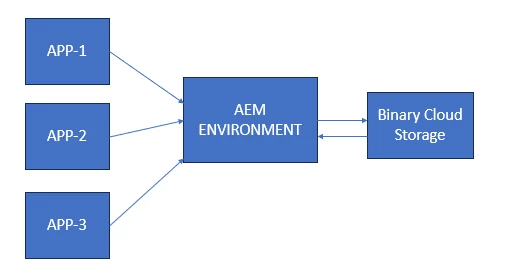
Can anyone share your thoughts around this how to handle such use case that respective Apps have access to corresponding assets uploads on to AEM.

 

This post is no longer active and is closed to new replies. Need help? Start a new post to ask your question.
Best answer by DPrakashRaj

No that’s not possible. Similar can be achieved by creating a separate folder for your asset in aem dam

3 replies

DPrakashRaj
Community Advisor
DPrakashRajCommunity AdvisorAccepted solution
Community Advisor
October 4, 2023

No that’s not possible. Similar can be achieved by creating a separate folder for your asset in aem dam

Hemalatha
Level 4
October 4, 2023

Hi @rsl_lucky 


For your use case you don't need to use different binary cloud storage for different apps that uploads assets to AEM. If you wants to have a restricted access to assets uploaded to DAM you can achieve the same via folder level ACLs and different folders for assets uploaded from different apps. Hope this helps.


Regards,

Hemalatha

joerghoh
Adobe Employee
Adobe Employee
October 7, 2023

As already mentioned by the others, this is not possible. But it is also not necessary, because the access control layer on AEM checks if you are allowed to access binaries, and there is no other way to access binaries than going through AEM and these checks.

That means if you want to have APP-1 not being able to access content/binaries of APP-2, design these apps by using permissions.