

The 2026 Analytics Mandate: Why We Must Retire the Report Suite to Survive the AI Wave
Let us have a moment of complete honesty here in the community. Keeping up with the Adobe ecosystem right now is both completely exhilarating and absolutely exhausting.
If you have logged into Experience Cloud recently, you know exactly what I mean. Generative AI is dropping into Analysis Workspace. Customer Journey Analytics (CJA) is rewriting how we stitch data. Real-Time CDP (RTCDP) is demanding instant activation. It is incredibly easy to look at this new landscape and feel drowned in acronyms and feature fatigue.
Managing digital analytics at massive enterprise scale (currently at Verizon, with past lives at Deloitte and Micron), I see this friction every single day. We are all feeling the pressure to implement "AI personalization," but the reality on the ground tells a very different story.
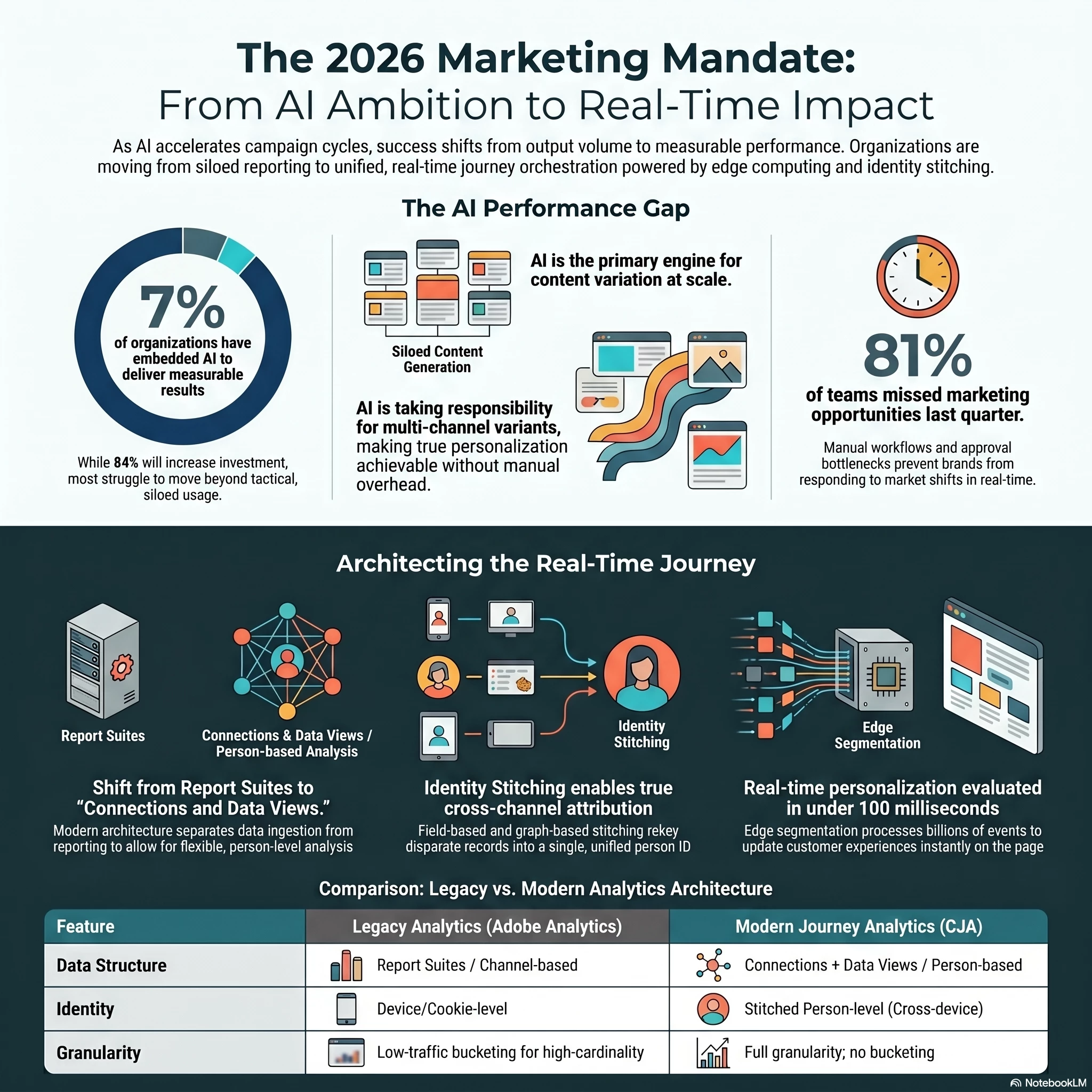
Recent data shows that only 7% of organizations have successfully embedded AI to deliver measurable results. Meanwhile, a staggering 81% of teams are missing real-time marketing opportunities.
Why is there such a massive gap between ambition and reality? Because we are trying to run 2026 generative AI on 2010 legacy data plumbing. We are building AI sports cars but driving them on dirt roads.
If we want to close this gap and step into the future of Adobe Analytics, we have to undergo a massive mindset shift. We must stop being reactive "Data Historians" and start becoming proactive "Experience Architects."
Here is the blueprint for how we actually make that happen.
1. The Death of the Report Suite
For years, the Report Suite was our safety blanket. We mastered our eVars, configured our props, and built siloed, channel-based reports.
In a world driven by omnichannel AI, the traditional Report Suite is a bottleneck. We must aggressively shift our architecture toward Connections and Data Views within CJA. The modern mandate requires us to separate data ingestion from reporting. We can no longer afford to analyze a device on a specific channel. We must analyze the unified human being across their entire digital and physical journey.
2. Identity Stitching is No Longer a Luxury
If you cannot stitch the user, your AI cannot personalize the experience. It is that simple.
Legacy analytics relied heavily on device-level cookies, which left us with fragmented, highly inaccurate behavioral maps. Modern journey architecture demands graph-based identity stitching. We must take disparate cross-channel records (a mobile app login, a web browse session, a call center interaction) and rekey them into a single, unified Person ID. This is the only way true, cross-channel attribution actually works.
3. The 100-Millisecond Rule
This is where RTCDP and Edge Segmentation change the game entirely.
In the legacy model, we relied on batch processing. We would collect data, process it overnight, and maybe update a customer segment by the next morning. Today, that latency is a conversion killer. Edge segmentation now requires us to evaluate and update a customer’s personalized experience directly on the page in under 100 milliseconds. If your personalization takes longer than a literal blink, the customer has already moved on.
Curing Dashboard Fatigue
All of this brilliant architecture means absolutely nothing if we fail at the human element.
As practitioners, we are deeply guilty of causing dashboard fatigue. We build massive Workspaces with infinite breakdowns, complex attribution models, and 40 different metrics because stakeholders ask for "everything."
We have to stop doing this.
As Experience Architects, our job is to translate complex, stitched data into instant business strategy. I use a strict three-second rule: If a non-technical executive cannot look at your Analysis Workspace or Tableau dashboard and find the "why" in three seconds, the dashboard is a failure. We must use these advanced tools to simplify the narrative, not complicate it.
Embracing the Overwhelm
The transition from legacy Adobe Analytics to modern Journey Analytics is steep. Rewiring enterprise plumbing to support edge computing and AI is messy, difficult work.
But this overwhelm is exactly what innovation feels like when you are standing right in the middle of it. The technology is finally here to let us process billions of events and become true data fortune-tellers. We just have to be bold enough to build the roads.
I would love to hear how the rest of the community is handling this transition. What is the biggest bottleneck keeping your organization from achieving real-time, AI-driven activation? Drop your thoughts below and let us troubleshoot the future together.