Level 1
April 22, 2026
Solved

Spike in Direct Traffic vs SEO

  • April 22, 2026
  • 9 replies
  • 161 views

Hi!!

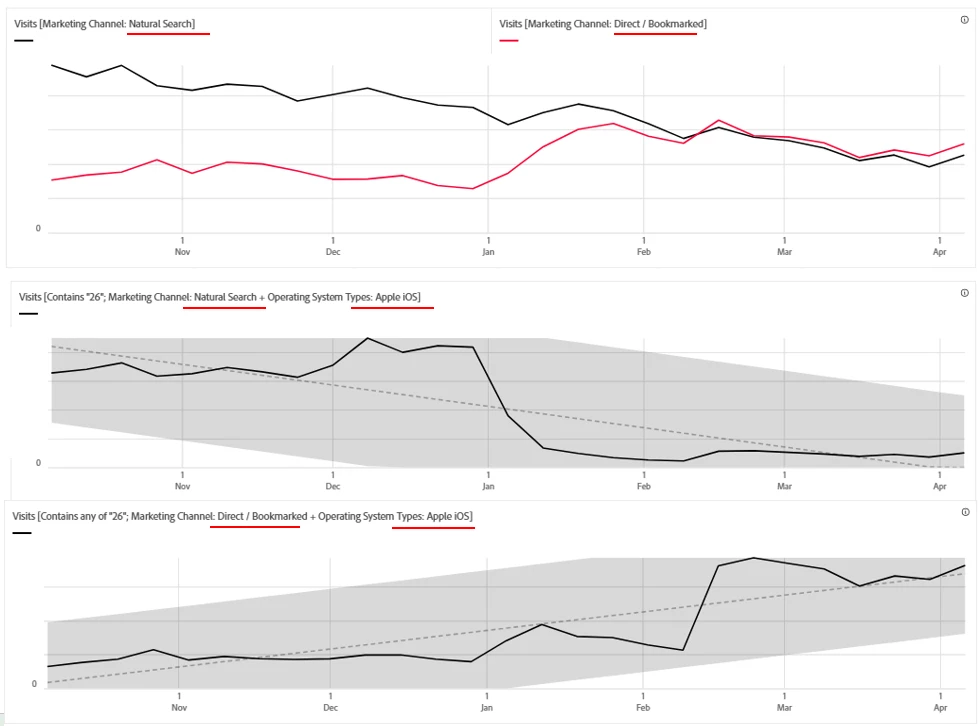
Since late december 25, beginning january 26, we have noticed a spike in Direct / Bookmarked traffic and a drop in SEO. The only reason we could find was that the spike corresponds to an update to iOS 26.

We can see clearly the impact iOS had on the dropping of SEO and the rise of Direct.

We investigated with other markets / projects / clients, and this does not happen in their results - it is occurring only on this specific project in Spain.
The only hypothesis we have is that the iOS update is affecting Adobe and is including visits from iOS 26 as Direct rather than SEO.
Is there a way to correct this?


Best answer by rasikabhave2002

Hi everyone,

Thanks for all the detailed inputs—this has been a really insightful thread.

Just to add a consolidated Adobe Analytics perspective:

What you’re observing (rise in Direct + drop in SEO around the same time as iOS 26 rollout) is very likely not a true loss of organic traffic, but rather a channel attribution shift caused by referrer loss or suppression.

In Adobe Analytics, both Natural Search and Referring Domains classification rely heavily on the referrer string. If that signal is missing or partially stripped (which can happen due to Safari privacy changes, redirects, intermediate hops, or consent timing), the hit will default to Direct / Bookmarked.

That aligns with what several of you have mentioned:

  • SEO landing pages still receiving traffic, but misclassified
  • Direct increasing proportionally
  • Referring Domains and Natural Search declining together
  • GSC showing a drop (which adds complexity and suggests either attribution mismatch or combined visibility effects)

The key point here is:
Adobe is not “reclassifying SEO as Direct due to iOS”
It is simply not receiving a usable referrer in those sessions, so the marketing channel processing rules fall back to Direct

Since this is not consistent across all markets/projects, it strongly suggests a site-specific amplification factor, such as:

  • Redirect chains (especially cross-domain or tracking links)
  • Referrer-policy differences
  • Consent Management Platform delaying Adobe beacon firing
  • Edge/security layers (Cloudflare, bot protection, etc.) stripping headers
  • Marketing Channel rules behaving more strictly in this report suite

As others mentioned, even small implementation differences can significantly amplify iOS/Safari privacy effects.

The most reliable validation steps are:

  • Test real iOS journeys and inspect document.referrer
  • Compare request headers in network tab
  • Validate whether Adobe hit fires before/after redirects or consent
  • Cross-check Natural Search vs Referring Domains trend alignment

There is no direct way to restore lost referrer data once it is not passed to Adobe Analytics. However, you can reduce the impact by:

  • Strengthening marketing channel rules (fallback logic where appropriate)
  • Reducing redirect hops for SEO landing pages
  • Ensuring consistent referrer-policy headers
  • Reviewing CMP implementation timing vs tracking calls

This is almost certainly a data attribution shift, not an actual SEO performance drop, but the fact that it is isolated to one project strongly indicates a combination of iOS privacy behavior + implementation-specific fragility rather than iOS alone being the root cause.
 

9 replies

LizzieSc
Level 1
April 26, 2026

Ooo this is an interesting one!

Are your Direct (iOS) visits landing on the same types of pages as your SEO traffic on other devices? If yes, that’s usually a bit of a giveaway that the traffic is still coming from search, it’s just no longer being attributed as such.

The way Adobe works, if the referrer isn’t there, it can’t classify the visit as Natural Search, so it falls into Direct. Unfortunately, if iOS is removing the referrer before the data reaches Adobe, then Adobe simply doesn’t have the signal it needs, so there’s no straightforward way to reclassify that traffic without implementing some potentially damaging rules.

If you want to sanity check what’s happening, it’s worth following the journey yourself and inspecting the referrer. For example:

  • Open the dev console and check document.referrer when you land on the site
  • Or use the Network tab to inspect the request headers and see if a referrer is being passed

If you’re coming from a Google result on iOS and the referrer is already missing or empty at that point, then Adobe never receives that signal, which explains why it ends up in Direct. It’s a simple test, but a really useful way to confirm whether the referrer is being dropped before it even reaches your analytics.

The other thing that stands out to me is that it’s only happening on one project. If this were purely an iOS change, you’d expect to see it across other markets/clients/projects too. That usually means iOS is part of the story, but something in this specific setup is amplifying it. A few things I’d look at:

  • Marketing Channel processing rules
    If the rules are stricter here, anything with a missing or partial referrer will fall straight into Direct, whereas other setups might still recover it as Natural Search
  • Redirects or cross-domain behaviour
    Additional hops (HTTP to HTTPS, tracking domains, JS redirects) can cause referrer loss, and iOS tends to be more sensitive to that
  • Referrer policy settings
    A stricter policy could mean the referrer is being dropped more aggressively on this site
  • Consent / CMP timing
    If Adobe fires after consent and there’s any delay, the referrer might be lost before it’s captured

So it’s less likely that iOS is behaving differently just for this market, and more likely that this implementation is less resilient to the referrer loss that iOS introduces. Is there anything standing out that’s different? 

bjoern__koth
Community Advisor and Adobe Champion
April 27, 2026

Fully agree with what ​@LizzieSc wrote!
 

Safari has its advanced fingerprinting protection which protects the users from various invasive fingerprinting techniques, one of which is removing referrer information. But this does not explain the drop only on Spanish pages.

Are you certain that your Spanish campaign does not get redirected and hence may lose the referrer information e.g. through a URL shortener?

But then again, this would also affect Android traffic.

Would you mind sharing the URL where you see the behavior in a private message for further investigation?

Cheers from Switzerland!
Jennifer_Dungan
Community Advisor and Adobe Champion
April 27, 2026

That is very interesting…


As ​@LizzieSc said, I think the best way to see what is happening is to test it yourself. You may or may not be aware, but proxy testing (a common method of testing mobile apps before AEP Assurance / Griffon) can also be used to test your web data on your mobile devices.


This way, you can use real iOS and Android devices, perform a search, and click through to your website… then you can check the referrer that is passed. Since this is Natural Search, there won’t be any campaign codes, so your channels will rely solely on the referrer.


If the new iOS is dropping the referrer, then we are all in trouble… but if it’s not, you will need to check your Paid/Natural Search rules, and your Marketing Channel rules to make sure that nothing was missed there.


Good luck, and let us know how you make out.

Level 1
April 28, 2026

Interesting case — but it’s unlikely that iOS 26 itself is “killing SEO”. What’s more common is tracking misattribution, especially with tools like Adobe Analytics.

iOS updates often increase privacy restrictions (like referrer stripping / ITP), which can cause organic traffic to be classified as Direct instead of SEO. That would explain why you’re seeing a spike in Direct and a drop in SEO without real ranking loss.

A few things you should check:

  • Compare Google Search Console vs Adobe data → if clicks/impressions are stable, SEO isn’t actually dropping
  • Look at landing pages → if SEO pages still receive traffic but show as Direct, it’s a tracking issue
  • Check channel classification rules in Adobe → they may need updating for new iOS behavior

To analyze this properly, you can use Rankar.ai — it helps you:

  • verify if rankings/keywords actually dropped
  • detect traffic anomalies across channels
  • identify whether the issue is SEO loss or attribution error

That way, you don’t rely only on Adobe data and can confirm the real impact before making changes.

You can check it here: https://rankar.ai

If GSC + Rankar data stay stable, then the issue is almost certainly tracking (not SEO decline) 👍


Level 1
April 28, 2026

Thanks to everyone who replied :)


Talking to our HQ about this case, and I have some updates.


  1. Apparently, this is happening in other countries, not only in Europe/EU (which I assume could be the case), but also in the UK, Australia, Finland, and Germany confirmed their Adobe is reporting a spike in Direct and a drop in SEO, also segmenting for iOS 26 + versions users.
  2. On the other hand, this is only happening in my project. HQ has another project within the same niche, and they’re not experiencing results like this.
    1. We considered the % of iPhone users on both, and they are kinda balanced - my project has around 60% iPhone users, while the other project has 48%.
  3. I’ve checked other channels, and this is only happening with Direct and Natural Search. On the other hand, Paid Search shows growth and a trendline change around the same time (january), but there was also a budget increase for PS campaigns, so this explains it.
  4. We checked Google Search Console, and it’s reporting the same drop.
  5. I still can’t check because in my office I work with windows hahahah so as soon as I go home, I’ll try and check the document.referrer. on my apple products.

I also found this article explaining Apple’s constant updating Safari’s privacy protection and the new AFP (Advanced Fingerprinting Protection)

https://medium.com/billy-grace/safari-on-macos-ios-26-tracking-changes-whats-really-changing-31e2d26cb727


Anyways, any other updates, I’ll let you know.

Thank you so much!

Level 4
April 29, 2026

If the Referrer is lost, the data in the Referring Domains channel will also decrease.

Jennifer_Dungan
Community Advisor and Adobe Champion
April 29, 2026

That is basically the only indicator for “Natural Search”…


I wonder, ​@carolmadureira how are you collecting the referrer? Is it possible you have a JS issue that is throwing an error only on iOS 26?


I checked my iOS 26 data, and I have a normal Marketing Channel distribution, including Natural/Organic and Paid Search… so I don’t think that OS is doing anything funny… but your own site might have some issue that is causing it to fail in certain markets???

Level 3
April 29, 2026

We had a similar issue with one of our B2C website, and the root was cloudflare bot detection screen stripping off referrer, technically ‘no referrer’ presence whereupon website’s landing page thus Adobe reported direct traffic is not unexpected. Suggested cloudflare managed page embed/dispatch the Adobe hit, so visit capture little advanced to ensure referrer comes into Adobe before landing page; compromise slightly BR getting affected, but BR metric to adjustable in Adobe luckily. Testing the journey by yourself may uncover gaps like this, which might be unique. Thanks

manpreetkaur27
Adobe Support
Adobe Support
May 3, 2026

Hi ​@carolmadureira 
I’m just following up to check if any of the responses helped address your query. If so, please consider marking it as the best answer.

rasikabhave2002Accepted solution
Level 2
May 4, 2026

Hi everyone,

Thanks for all the detailed inputs—this has been a really insightful thread.

Just to add a consolidated Adobe Analytics perspective:

What you’re observing (rise in Direct + drop in SEO around the same time as iOS 26 rollout) is very likely not a true loss of organic traffic, but rather a channel attribution shift caused by referrer loss or suppression.

In Adobe Analytics, both Natural Search and Referring Domains classification rely heavily on the referrer string. If that signal is missing or partially stripped (which can happen due to Safari privacy changes, redirects, intermediate hops, or consent timing), the hit will default to Direct / Bookmarked.

That aligns with what several of you have mentioned:

  • SEO landing pages still receiving traffic, but misclassified
  • Direct increasing proportionally
  • Referring Domains and Natural Search declining together
  • GSC showing a drop (which adds complexity and suggests either attribution mismatch or combined visibility effects)

The key point here is:
Adobe is not “reclassifying SEO as Direct due to iOS”
It is simply not receiving a usable referrer in those sessions, so the marketing channel processing rules fall back to Direct

Since this is not consistent across all markets/projects, it strongly suggests a site-specific amplification factor, such as:

  • Redirect chains (especially cross-domain or tracking links)
  • Referrer-policy differences
  • Consent Management Platform delaying Adobe beacon firing
  • Edge/security layers (Cloudflare, bot protection, etc.) stripping headers
  • Marketing Channel rules behaving more strictly in this report suite

As others mentioned, even small implementation differences can significantly amplify iOS/Safari privacy effects.

The most reliable validation steps are:

  • Test real iOS journeys and inspect document.referrer
  • Compare request headers in network tab
  • Validate whether Adobe hit fires before/after redirects or consent
  • Cross-check Natural Search vs Referring Domains trend alignment

There is no direct way to restore lost referrer data once it is not passed to Adobe Analytics. However, you can reduce the impact by:

  • Strengthening marketing channel rules (fallback logic where appropriate)
  • Reducing redirect hops for SEO landing pages
  • Ensuring consistent referrer-policy headers
  • Reviewing CMP implementation timing vs tracking calls

This is almost certainly a data attribution shift, not an actual SEO performance drop, but the fact that it is isolated to one project strongly indicates a combination of iOS privacy behavior + implementation-specific fragility rather than iOS alone being the root cause.


manpreetkaur27
Adobe Support
Adobe Support
May 6, 2026

Thanks for the detailed explanation ​@rasikabhave2002. ​


 @carolmadureira I hope this has addressed your concern.