Good afternoon Jennifer,
Thank you for your quick and detailed reply.
First of all I would like to tell you that my business is an online newspaper, hence some of the characteristics of the marketing channels. Within the company our main web KPIs are: page views and unique browsers. We are interested in where browsers are coming from when they land on the site.
I will respond to the issues you mention:
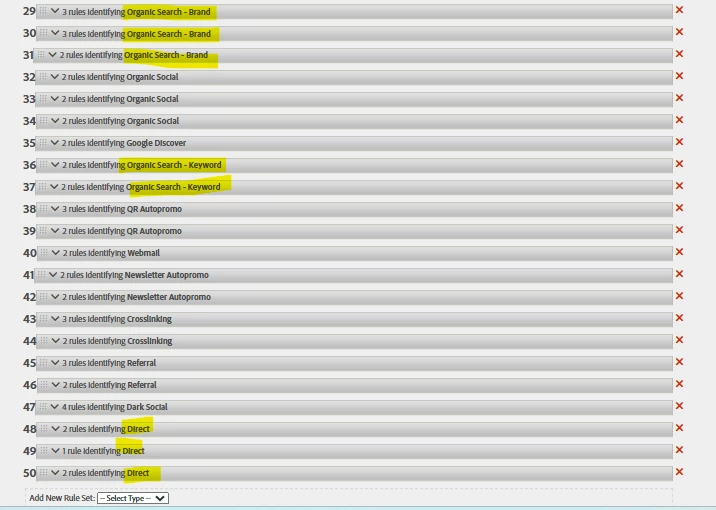
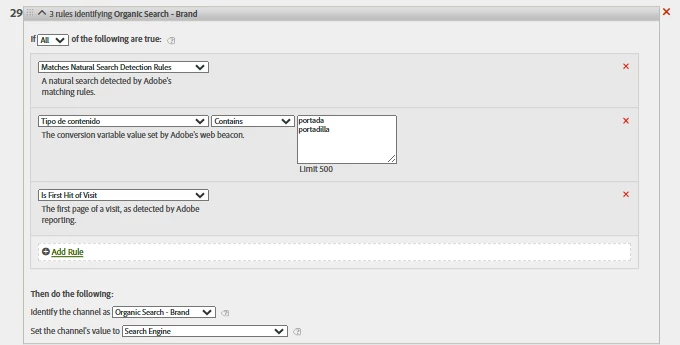
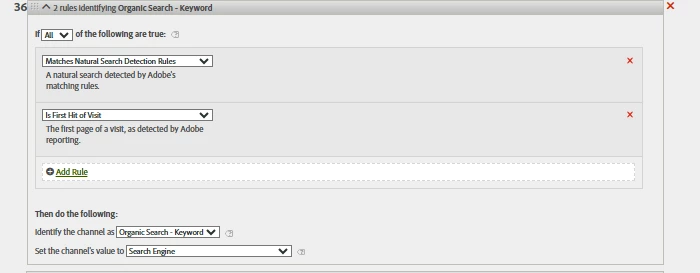
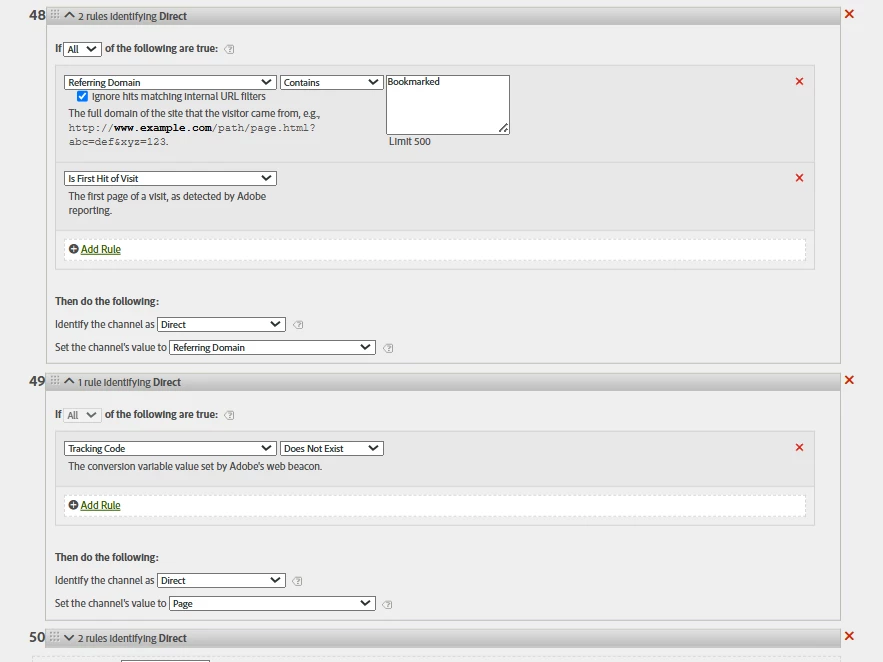
1. I have used ‘first hit of visit’ because for me it is important to collect the channels from where they access at visit level and not at URL level. In this way I wanted to make sure that the external reference of the traffic is collected. I have always had doubts about whether it was necessary or not, but the results fit me better when I put it in. So can you confirm that I don't need it, and that it is automatically collected at the visit level?
2. About the division between organic brand or keyword search, it is important for us because we want to know who is searching for us by name or by pure SEO. The only way we have always found to differentiate between them is by "content type", as it is very difficult to differentiate by keyword.
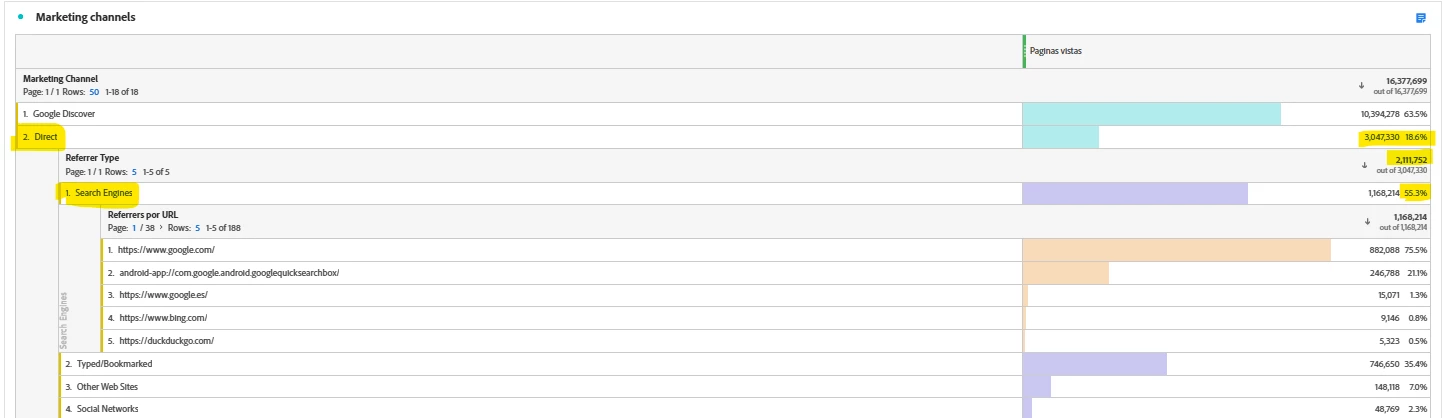
3. About "Direct". For us this channel is very important, in fact the most important. As a media company, we are very interested in knowing who accesses our website because they know us and want to consume our news because of who we are, because they like our brand. I know the "override last touch channel" option, but if I understand it correctly, leaving it empty assigns the traffic to the previous channel in that period of time, making the "direct" traffic minimal, and we are not interested in that. I understand that in an e-commerce business the "direct" channel is not so important and it makes sense in this case, to know the efficiency of the campaigns.
Thank you very much for your help, I would like to know if with this information I have given you I have clarified and you can tell me if you also recommend me the same. Above all I am interested in knowing when I have to include or not "fist hit of visit" because I think it is what is altering my data the most. Knowing that I want to measure the traffic per visit.
Oh, I see you reposted in English (for the record I wasn't ignoring you, I was just super busy and this question has a lot to unpack)
We are also an online Newspaper if that helps.
1. I have used ‘first hit of visit’ because for me it is important to collect the channels from where they access at visit level and not at URL level. In this way I wanted to make sure that the external reference of the traffic is collected. I have always had doubts about whether it was necessary or not, but the results fit me better when I put it in. So can you confirm that I don't need it, and that it is automatically collected at the visit level?
The problem with this is that fundamentally, you can have multiple different referrals to a site within the same visit. Restricting to "first hit of visit" mean that all the other referrals will get lost and collected in your catchall "None" bucket.
Let's look at an example:
Visit:
- (User performs a Search)
- Page 1 - (first hit of visit)
- Marketing Channel set to "organic search"
- Marketing Channel Instance triggered
- Page 2
- Marketing Channel persists value "organic search"
- Marketing Channel Instance not triggered
- (User gets a Marketing Email)
- Page 3...
You don't want to ignore your Marketing Email because it's not the "first hit of the visit", same with if the user went back and did another search, but this time clicked on a Paid Search link.....
You want to collect all your Marketing Channels, and then you can look at them by Visit (where you could have 1 or many channels for the same visit), or you can look at them by Marketing Channel Instance (each instance the site was entered), you can also look at cross channel attribution.
If you restrict all your rules to "First Hit of Visit" then you're going to get a lot of referral data fall into the "None" channel that will be a mix of everything that wasn't properly classified above, and in some cases, you might lose channels altogether....
I mean, it's up to you in the end... but given that users rarely have a single entry point during a visit; I would be cautious of creating such tight restrictions in my rules (which is why I questioned it in the first place, and still stand by that now)....
2. About the division between organic brand or keyword search, it is important for us because we want to know who is searching for us by name or by pure SEO. The only way we have always found to differentiate between them is by "content type", as it is very difficult to differentiate by keyword.
Lol, fair enough... since Keywords barely work now, save for a few random search engines that no one uses... Google stopped sharing Keywords back in 2016....
This is again a decision for you, personally, I would probably opt to keep my Marketing Channels clean with a simple "Organic Search" distinction, then if I want to see the people that land directly on specific content pages using "Content Type" as the breakdown, and Marketing Channel Instance Metric stacked with Organic Search Marketing Channel.
Something like this:
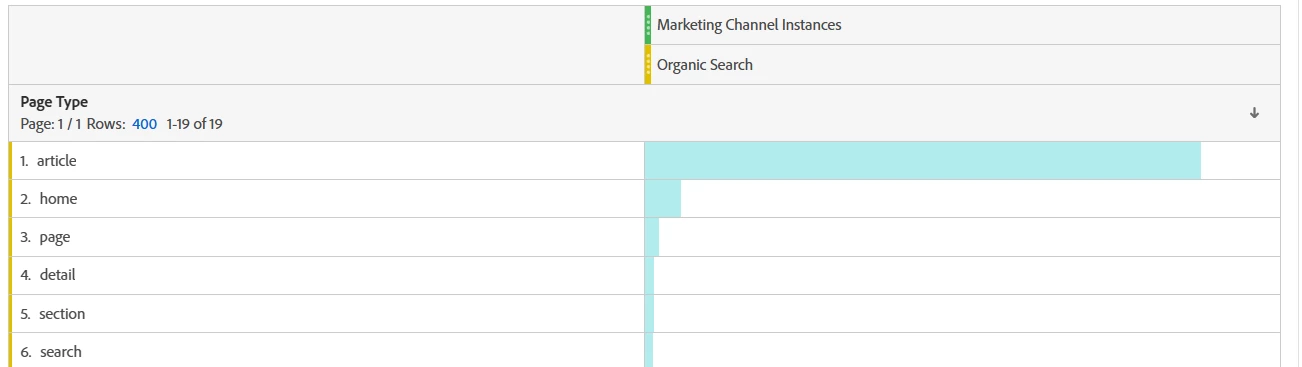
Simply because it's easier to break something down, then to add it together... and if you need to look at all Organic Search, having it divided is a bit more effort to combine....
3. About "Direct". For us this channel is very important, in fact the most important. As a media company, we are very interested in knowing who accesses our website because they know us and want to consume our news because of who we are, because they like our brand. I know the "override last touch channel" option, but if I understand it correctly, leaving it empty assigns the traffic to the previous channel in that period of time, making the "direct" traffic minimal, and we are not interested in that. I understand that in an e-commerce business the "direct" channel is not so important and it makes sense in this case, to know the efficiency of the campaigns.
I completely agree! But this is why I use a combination of Marketing Channels (7 Day Attribution**), Tracking Code (7 Day Attribution), Referrers (Visit and Instance Attribution) and Custom Visit Level Campaign Tracking (Visit and Instance Attribution).
This way, I can pull out different attribution models for different teams... some teams like the Marketing (depending on what they are looking at) want to see the 7 Day model or the Direct model.
** Marketing Channels have a default attribution of 30 Days, but you can change this setting to suite your needs... for us, 30 Days was too long, but 7 Days was good because a lot of times, a marketing email would go out, people would check it but not immediately convert to being a subscriber... However, they might come back to the site directly and convert that week; so it allowed us to tie some of that "direct visit" conversion to those marketing emails... IF we need to check 30 Day attribution, I can always use the custom attribution models in my workspace (which work better to scale up than down).
Basically, I don't generally use Marketing Channel data if I am specifically looking at for Direct.
I hope this helps.