Level 2
April 30, 2026
Solved

Question about creating an Average Time to Complete Flow calculated metric

  • April 30, 2026
  • 2 replies
  • 53 views

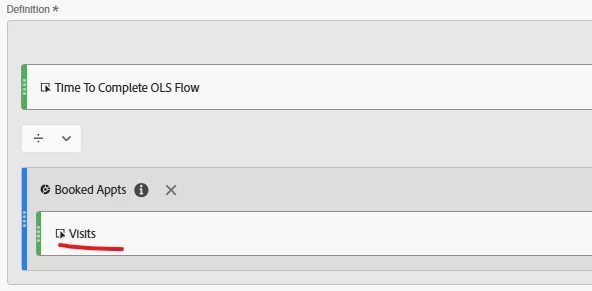
Hello all! Question for the community. I’m looking to figure out how long it takes users to complete one of our online scheduling flows on the site on average (from form 1 to the confirmation screen), to see if mobile or desktop takes longer to complete the flow. I figured out how to create a derived field in CJA to calculate the total time it takes users to complete the flow from start to finish (meaning it calculates the entire total of seconds all users have spent completing the flow). I called that dimension Time To Complete OLS Flow and added it to my data view. Then in workspace, I created a calculated metric with Time To Complete OLS Flow divided by the total number of flow completions (booked appointments) to find the average time per user it takes to complete the flow. However, I'm not sure whether to use events or visits as the persistence in the denominator for that calculated metric. ie, Time To Complete OLS Flow / Booked Appts (visits) OR ie, Time To Complete OLS Flow / Booked Appts (events)? What do you think would be best practice? I feel like the events data will overinflate the clicks to finish the flow, but visits won’t count users who have completed multiple bookings in one session. When I use visits vs events I get very different answers. Thank you in advance for any insight offered!!
 

Best answer by rasikabhave2002

Hi,

Best practice recommendation

For this use case, do not use visits.

Visits are session-based and will undercount completions when:

  • a user completes multiple bookings in one session
  • users restart the flow within the same visit

So using visits will inflate your average time per completion.

What about events?

Using events is closer to correct, but only if your “Booked Appointment” event is:

  • fired once per successful completion
  • not duplicated due to reloads or retries
  • consistently implemented across devices

If that’s true, then:

Time To Complete OLS Flow / Booked Appointments (Event) is the correct approach

Why your numbers differ so much

  • Visits denominator → fewer completions → higher average time
  • Events denominator → more granular completions → lower (and usually more accurate) average time

This gap is expected and usually highlights a definition mismatch rather than a data issue.

Best practice (what most teams do)

Instead of relying on visits or raw events, the ideal setup is:

  • A deduplicated “Flow Completion” metric (based on the confirmation event)
  • Scoped at the correct level (usually event/person depending on your definition)
  • Then calculate:

    Total flow duration ÷ number of completions

This ensures you are measuring true completed journeys, not session artifacts

Bottom line

  • Visits = not recommended for flow completion analysis
  • Events = acceptable only if clean and deduplicated
  • Best practice = dedicated “completion” metric aligned to confirmation step

2 replies

rasikabhave2002Accepted solution
Level 2
May 4, 2026

Hi,

Best practice recommendation

For this use case, do not use visits.

Visits are session-based and will undercount completions when:

  • a user completes multiple bookings in one session
  • users restart the flow within the same visit

So using visits will inflate your average time per completion.

What about events?

Using events is closer to correct, but only if your “Booked Appointment” event is:

  • fired once per successful completion
  • not duplicated due to reloads or retries
  • consistently implemented across devices

If that’s true, then:

Time To Complete OLS Flow / Booked Appointments (Event) is the correct approach

Why your numbers differ so much

  • Visits denominator → fewer completions → higher average time
  • Events denominator → more granular completions → lower (and usually more accurate) average time

This gap is expected and usually highlights a definition mismatch rather than a data issue.

Best practice (what most teams do)

Instead of relying on visits or raw events, the ideal setup is:

  • A deduplicated “Flow Completion” metric (based on the confirmation event)
  • Scoped at the correct level (usually event/person depending on your definition)
  • Then calculate:

    Total flow duration ÷ number of completions

This ensures you are measuring true completed journeys, not session artifacts

Bottom line

  • Visits = not recommended for flow completion analysis
  • Events = acceptable only if clean and deduplicated
  • Best practice = dedicated “completion” metric aligned to confirmation step
manpreetkaur27
Adobe Support
Adobe Support
May 13, 2026

@rasikabhave2002 Thanks for sharing the suggestion. I am marking this as the best answer.

manpreetkaur27
Adobe Support
Adobe Support
May 11, 2026

Hi ​@AlexisHa I hope your question has been answered. If so, please consider marking this response as the best answer.

AlexisHaAuthor
Level 2
May 15, 2026

My question was answered beautifully! Thank you for marking it as the best answer, I’ll get to that sooner in the future.