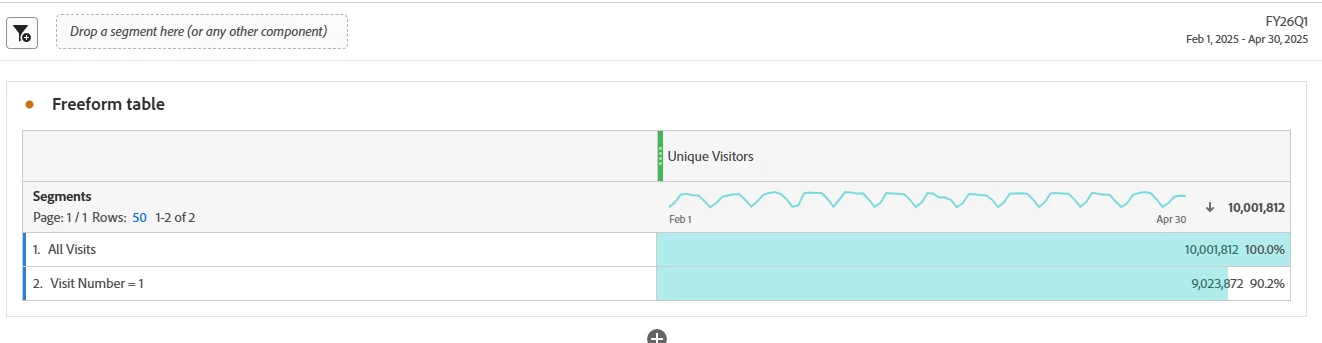
As @vinay_chauhan mentioned, people with multiple devices, clearing cookies, using incognito, using different platforms like web vs app, can all have an impact on the Visitor Count.... If you have enabled Cookie Consent, and are not setting ECIDs for opt-outs, that will also cause inflation for your visitors and how many people are new.
Now, you just look like you are looking at the numbers in aggregate... but if you decide that you need more granular information, like by month, the segment you have created will cause issues.
Using Visitor Scope for your segment means that within your reporting range, any user who had a Visit Number of 1 (at any time) will be counted as a New Visitor in every visit, in every month in your report.
Visitor Scope returns ALL hits and visits for any visitor that matches the criteria.
So if I was a user:
- Feb 4
- Feb 7
- Mar 10
- Apr 1
- ....
Your definition using "Visitor" will return all of the visits above... it will also count me as a UV in Feb, again in March, again in Apr, etc....
You are much better off looking at Visit or Hit scope, and pairing that with your UV metric...
That way, I will only show in Feb as a "New Visitor" and not in March, April or whenever....
Remember that the scope of your segment has little to do with the metric you want to pair it with...
While this article is more focused on exclusions, containers and attribution, I do touch on segment scope:
https://experienceleague.adobe.com/en/perspectives/the-magic-behind-the-curtain-complex-segments
You can also watch a session I did for Skill Exchange:
https://experienceleague.adobe.com/en/docs/events/the-skill-exchange-recordings/analytics/aug2024/segmentation