

Understanding Programmatic Transactions in the Current Era of Digital Marketing
Numerous Names but Functions Same – Confused?
Programmatic has transformed the way we buy & sell ad inventory in real-time without traditional human intervention. It is now a thing of the past when we used to associate programmatic to “remnant inventory” or “unsold inventory”. Now the media planners enjoy the privilege to choose & complement their media buy with exclusive, custom, live streaming & premium inventory. As the audience marketing strategies getting sophisticated, advertisers started looking beyond RTB and using various programmatic RTB bridges to facilitate media transactions. Hence, this space is cluttered with a lot of tech terms used interchangeably such as “programmatic direct”, “pragmatic premium”, “Deal ID buy” & “private deals” etc. It is important to understand different programmatic transactions so we can utilize programmatic traditional media along with popular Ad formats & inventories (CTV, OTT, Audio, etc.) in media plans effectively.
Types of Programmatic Transactions
Basically, we have four types of programmatic transactions,
- Automated Guaranteed
- Unreserved Fixed Rate
- Invitation-Only Auction
- Open Auction
TABULAR VIEW
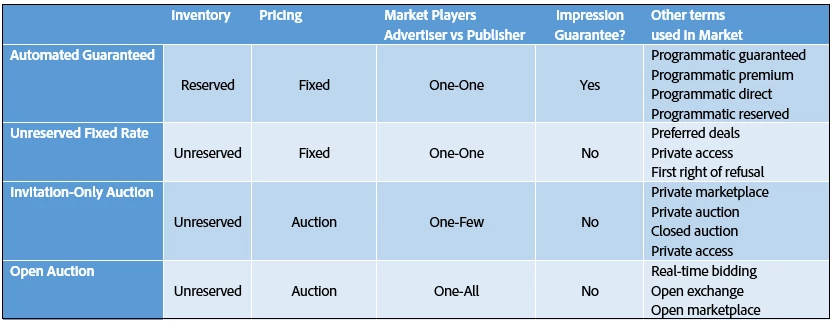
See the table below, showing the distinct elements and their respective, popular market names.
QUADRANT GLIMPSE
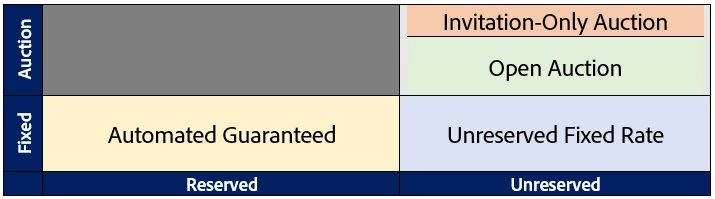
The below quadrant view helps to quickly memorize the tabular view– Price Model on Y-Axis Vs Inventory Type on X-Axis.
Detailed Differentiation of programmatic transactions
Automated Guaranteed
| Unreserved Fixed Rate
|
Invitation-Only Auction
| Open Auction
|
Living in New Age of Uncertainty– Programmatic Can be Your North Star
Even with all the different names, that are now popular in the market, the underlying principle of the whole eco-system stays the same - which is Real-time Bidding (RTB), and it is gaining popularity every year. As per the recent study, the programmatic digital display spend is going to chart $79B by the end of 2021. [1]. In the current phase of the global pandemic, advertisers are wondering ways to connect with their customers and are blending their content with the popular theme of the day, Care. On the other hand, advertisers also don’t want to display crucial messages next to news about disease spread or COVID content. Customers are turning to different media channels & ON Demand platform to take a break from news content. While advertisers are reinventing methods to connect with their customers, they are also getting more cautious with the media budget in their plans.
As per the recent IAB study, advertisers are making tactical changes in their digital ad strategies and are focusing on target opportunities. This trend is majorly rising in Audience Targeting, OTT/CTV targeting, Mobile & Tablet targeting, and Programmatic traditional buying. Advertisers now have various options to reach these engaged consumers on different media channels by leveraging programmatic media. It’s a perfect blend to effectively reach data-driven audiences at scale at an economical cost while also, using numerous brand safety controls. Programmatic buying offers flexibility to buy various media channels ranging from Display banners to Connected TV, OTT, Audio, etc. at a single place.
Conclusion
Finally, if we look back on the advertising history, during any economic crisis, advertisers tend to shift ad spend from branding to performance marketing. That way, they try and manage increasing the sales and scale customer base by narrowing ad strategies and putting accurate messages useful for customers. This outbreak can be considered a great time to make an investment in digital presence, with less competition and more opportunities to plan available budgets. Programmatic is best known to enhance the performance capabilities of brands and have a better brand recall rate. When the lockdown phase would be over and the economy has risen, brands that stood with customers during this phase will get the benefits.