AI and HR Technology: The Skills Employers Want Today
AI SCREENING WORKFLOW: WHERE HUMAN SKILL FILLS THE GAP
Three hiring managers I spoke with last month said the same thing: they stopped filtering resumes for job titles and started filtering for specific tool proficiencies and workflow logic.
That shift matters more than most people realize. It tells you where AI in HR is actually heading, and it is not the utopian "AI replaces the recruiter" narrative you read in thought leadership posts. What is actually happening inside enterprise teams is a lot messier and more specific.
I want to share what we have been seeing at VKNOWTECH AI while building training curriculum around HCM configuration and enterprise AI adoption, because a lot of the friction points our learners hit in the classroom mirror what real HR tech teams are dealing with in production.
THE REAL SKILLS GAP IS NOT WHAT THE JOB BOARDS SAY
Job postings for HR technology roles are asking for Workday proficiency, AI literacy, and data analysis in the same breath. What they actually need are people who can do something very specific: configure a skills taxonomy inside an HCM system that an AI screening layer can actually use.
That sounds narrow. It is not. When the taxonomy is wrong or incomplete, the AI-assisted candidate screening process produces shortlists that make zero sense to the hiring managers reviewing them. The system is working exactly as configured. The configuration is the problem.
This is the root cause of a failure mode we hear about repeatedly. A company invests in talent intelligence tooling. The analytics output looks impressive. But the underlying data model, the way competencies are mapped to roles inside the HCM platform, has never been cleaned up or aligned to how the business actually operates. The AI is sorting candidates against a skills framework that reflects what HR wrote three years ago, not what the engineering team actually needs today.
WHAT EMPLOYERS ARE PAYING FOR NOW
When we map out the skills our enterprise learners are being hired to perform, a pattern has emerged clearly over the past 18 months.
Employers want people who understand workforce planning and headcount modeling, not just as a finance function but as a technical skill set that lives inside the HCM system. They want someone who can sit in a room with a CFO and a CHRO and translate headcount decisions into system configuration decisions. That is a very specific skill and it is genuinely rare.
They want people who understand role-based access and workflow logic at the platform level. Not just that it exists. Not just that you can check a box to give a manager access to their team data. They want people who can design the permission architecture so that AI recommendations surface to the right stakeholder at the right stage of the hiring workflow, without creating audit risk or compliance exposure.
They want people who can evaluate AI-assisted candidate screening outputs with genuine skepticism. The ability to look at a shortlist and say "this ranking looks wrong and here is why in terms of how the scoring model is weighting these attributes" is a skill. It requires knowing how the underlying matching logic is configured, not just how to read the output.
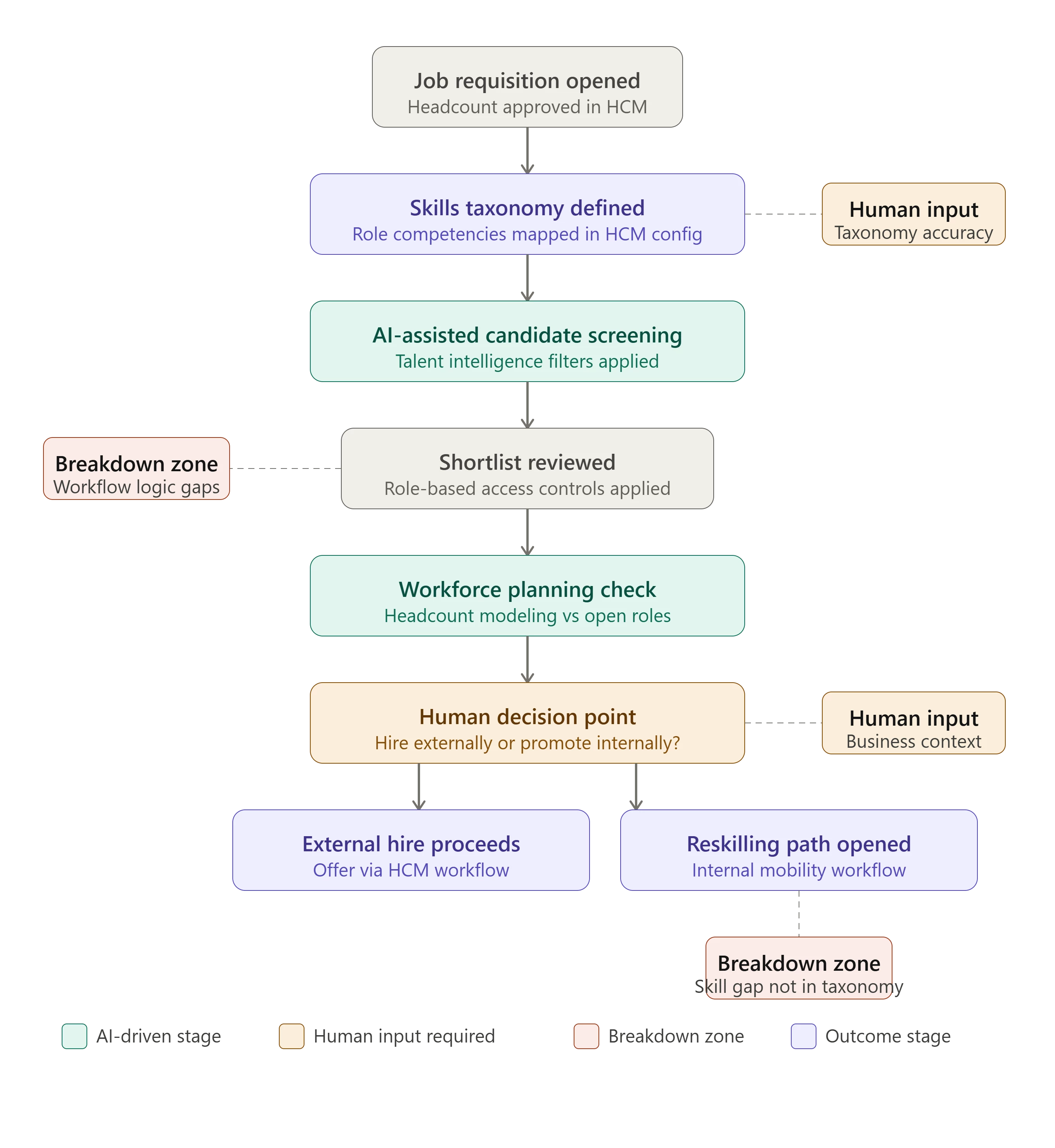
THE DIAGRAM ABOVE: WHAT IT SHOWS AND WHERE IT BREAKS
I built the workflow diagram above to document the exact points where AI-assisted screening falls apart in real enterprise environments. We use this internally at VKNOWTECH AI when running Workday and generative AI training. The two breakdown zones are worth studying.
The first breakdown happens at the skills taxonomy stage. If the competency mapping done during HCM configuration does not reflect how roles actually function today, every downstream AI recommendation is built on bad inputs. This is not an AI problem. It is a data quality and configuration problem that shows up as an AI problem.
The second breakdown happens at the internal mobility stage. When a hiring manager decides to reskill an internal candidate instead of hiring externally, the system often has no clean workflow for this. The reskilling path exists in the L and D module. The open role exists in the recruiting module. Connecting them requires human intervention and, often, custom workflow logic that was never built.
These are not theoretical failure modes. They are real friction points that our learners come back and tell us they are encountering within the first 90 days of a new role.
WHAT RESKILLING AND INTERNAL MOBILITY ACTUALLY REQUIRE
A lot of organizations say they want to prioritize reskilling and internal mobility. Very few have built the system architecture to support it. What it actually requires is a feedback loop between the skills taxonomy layer and the learning catalog, configured so that when AI flags a skill gap in a candidate or current employee, a learning path can be automatically surfaced.
Building that feedback loop is not a consultant-level project that gets handed off after go-live. It is an ongoing configuration responsibility. Someone inside the organization has to own it. That person needs to understand both the HCM data model and how the AI scoring logic consumes that data.
We documented the full workflow framework and the breakdown zone analysis we use with our enterprise cohorts over here if you want the underlying structure: https://vknowtech.ai
THE SKILLS I WOULD BUILD RIGHT NOW
If someone asked me what to focus on in 2025 and 2026 to be genuinely useful to an enterprise HR tech team, I would say four things.
Get comfortable inside the HCM configuration layer, not just as a user but as someone who understands how data structures in the platform affect downstream analytics and AI outputs.
Learn how workforce planning connects to the financial model. The people doing headcount modeling are increasingly using the same platform as HR. Understanding how those modules talk to each other is a differentiator.
Build a point of view on AI-assisted screening outputs. Know what questions to ask when a shortlist looks wrong. Know where to look in the configuration to understand why it happened.
Understand the internal mobility architecture for at least one major HCM platform at the workflow logic level. This is where most organizations are investing right now and where the tooling is least mature.
The employers who are ahead of this are not the ones who have the most sophisticated AI tools. They are the ones who have people who know how to configure and maintain the systems those tools depend on.
What are you seeing in your organization when it comes to the gap between what AI screening tools promise and what they actually deliver in production? Particularly curious whether others have run into the taxonomy accuracy problem at the configuration stage.