

5 lessons from bringing Premium Learning into the room
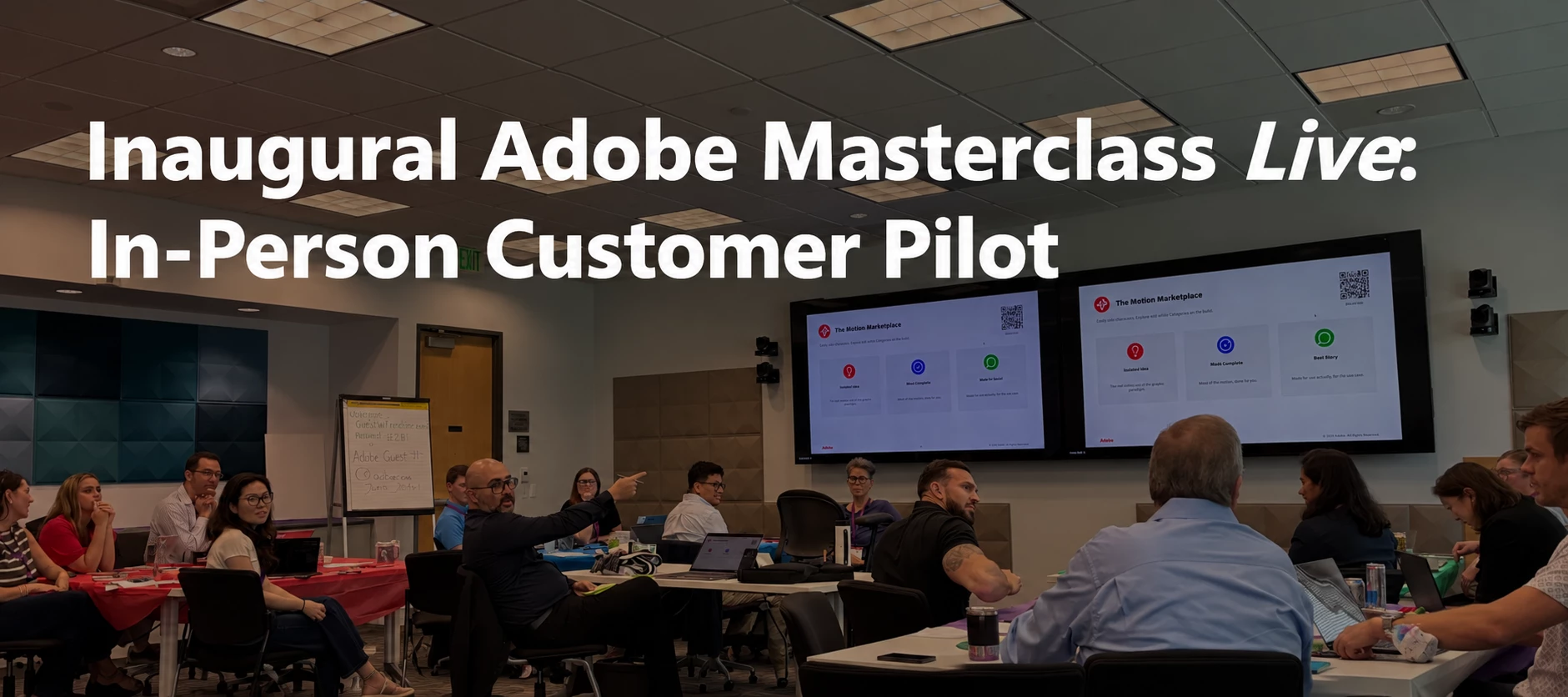
What makes a learning experience truly impactful? Beyond expert instruction and course content, opportunities for hands-on practice, peer collaboration, and real-world application can make all the difference.
Adobe Premium Learning is an enterprise-wide learning subscription designed to help organizations build Adobe product expertise through on-demand learning, instructor-led training, cohort-based learning journeys, hands-on labs, and certifications.
Recently, Adobe hosted its first in-person Premium Learning experience, bringing 15 customers together to explore personalization across Adobe Real-Time Customer Data Platform, Adobe Journey Optimizer, and Customer Journey Analytics through expert-led instruction, practical exercises, an end-to-end capstone, and collaborative learning.
The goal was not simply to recreate a virtual class in a physical space. We wanted to understand what becomes possible when learners can step away from day-to-day work, solve problems together, and apply concepts in real time. This article shares five lessons from the experience, focused learning environments, hands-on application, peer connections, relevant use cases, and continuous learning, and offers actionable insights for the broader community on helping teams build confidence and turn new skills into meaningful business results.
1. Focus is part of the learning experience
One of the clearest themes was surprisingly simple: being physically present helped learners focus.
Virtual learning offers flexibility, but it also competes with the realities of the workday. Email, chat messages, meetings, household interruptions, and the everyday distractions that come with working from home do not disappear when a class begins. Several attendees told us that coming on-site made it easier to turn those distractions off and commit their attention to learning.
That matters because effective learning is not only about the quality of the content. It is also about creating the conditions for people to engage with it. Sometimes the most valuable thing an in-person experience can provide is protected time to learn.
2. Hands-on practice turns concepts into something usable
Customers consistently responded to opportunities to work directly with the technology. The capstone was a particular highlight because learners had to take a use case from an idea through audience creation, activation, and measurement across multiple Adobe solutions.
Hertz attendees described the value of seeing how the products connect end to end rather than learning each one in isolation. That shift from “how does this feature work?” to “how would I use these capabilities together to solve a problem?” is important.
Learning becomes more meaningful when people can practice making decisions, test an approach, and see the consequences in a safe environment before the stakes are higher in their day-to-day work.
3. Peers can be as valuable as the curriculum
The instructor and course content were only part of the experience. Customers repeatedly mentioned the value of hearing how other people approached the same exercise, comparing use cases, and meeting learners from different organizations and industries.
One Optum attendee called out networking as a meaningful part of the experience. Hertz participants similarly noted that seeing how other teams interpreted the same challenge gave them new ways to think about their own work.
The format also introduced light gamification, with attendees competing on a leaderboard during the experience. That friendly competition helped keep energy high and gave learners another reason to stay engaged with the exercises and each other.
One comment from Optum stood out in particular: they said they could tell the Adobe team worked well together and genuinely enjoyed collaborating. That kind of energy mattered too. It reinforced that the learning environment was shaped not only by the course design, but also by the people facilitating it.
That is a useful reminder for anyone designing learning: do not treat conversation between learners as time away from the curriculum. In the right setting, it is part of the curriculum.
4. Relevance increases when learning starts with real-world customer needs
The pilot also surfaced an opportunity to make future experiences even stronger: start with the real-world goals, workflows, and business needs learners bring into the room.
Customers appreciated practical examples, but they also wanted scenarios that reflected their industries, workflows, and business realities. One attendee specifically noted that examples rooted in retail did not always translate directly to their organization.
For future experiences, we see an opportunity to collect customer use cases before the class and use them to shape exercises and discussion. The lesson is broader than any one event. The closer learning gets to the decisions someone needs to make at work, the easier it becomes to connect knowledge with action.
5. Learning should continue after the class ends
An in-person event can create momentum, but the experience should not stop when learners leave the room.
The pilot prompted us to think more intentionally about what surrounds the class: making materials easy to access, creating spaces where attendees can continue sharing ideas, connecting learners with the right Adobe resources, and helping them identify what to learn next.
Premium Learning is designed around continuous skill development across learning formats, including on-demand learning, instructor-led training, cohort-based learning journeys, hands-on labs, and certifications. In-person experiences can complement that model by creating moments of deeper focus and connection, then giving learners a path to keep building from there.
Design the environment, not just the content
The strongest takeaway from the pilot was that effective learning is an experience, not simply a collection of content. The environment, opportunities to practice, relevance of the examples, and people in the room all shape what a learner takes away.
Our first pilot also gave us plenty to improve, from preparing technology and course materials differently to incorporating customer use cases earlier. That is exactly what a pilot should do.
As we continue exploring in-person Premium Learning experiences, the goal is not to choose between digital and physical learning. It is to understand where each format is strongest and connect them in ways that help people build skills, confidence, and practical knowledge they can take back to their work.
Interested in learning more about how Adobe Premium Learning helps teams build practical skills through expert-led instruction, hands-on learning, and collaboration? Explore Adobe Premium Learning.